
Introduction
Laser tattoo removal is a widely used, non-invasive procedure to erase unwanted tattoos. While generally safe, patients with sensitive or special skin types—such as darker skin tones, skin prone to hyperpigmentation, or those with dermatologic conditions—require tailored protocols to minimize complications and achieve optimal results. Sensitive skin tends to react strongly to external stimuli, leading to redness, irritation, or delayed healing, while special skin types may have unique responses to laser energy. This article explores the mechanisms, risks, and best practices for safely performing laser tattoo removal in these populations, emphasizing personalized approaches and post-treatment care.
1. Understanding Sensitive and Special Skin Types
Before discussing treatment strategies, it is important to understand the characteristics of sensitive and special skin and why they require careful attention.
1.1 What Defines Sensitive Skin
Sensitive skin is characterized by a thin stratum corneum, impaired barrier function, and heightened responsiveness to stimuli. Patients often experience redness, itching, burning, or stinging in response to skincare products or environmental factors. Clinically, dermatologists evaluate erythema, transepidermal water loss, and reactivity to topical irritants. Because the skin barrier is compromised, procedures like laser tattoo removal can induce exaggerated inflammatory responses, including prolonged redness, swelling, and discomfort. Understanding these characteristics enables clinicians to adjust laser parameters and post-treatment care to reduce adverse reactions while maintaining effective ink clearance.
1.2 Special Skin Types
Special skin types include individuals with higher Fitzpatrick classifications (IV–VI), those with pigmentary disorders such as melasma, and those prone to chronic skin conditions like eczema or acne. Darker skin contains more melanin, which competes with tattoo ink for laser absorption, increasing the risk of hyperpigmentation or hypopigmentation. Compromised or reactive skin may also respond to laser exposure with excessive inflammation, blistering, or delayed healing. Recognizing these variations is essential for selecting appropriate laser devices, wavelengths, and treatment parameters to ensure safe and effective outcomes.
2. Risks of Laser Tattoo Removal on Sensitive or Special Skin
Laser tattoo removal is highly effective, but sensitive and special skin types carry unique risks that must be carefully managed.
2.1 Hyperpigmentation and Hypopigmentation
A common complication is post-inflammatory pigmentation changes. Hyperpigmentation occurs when melanocytes overproduce melanin in response to laser-induced inflammation, causing darkened patches around the treated area. Conversely, hypopigmentation involves melanin loss, creating lighter areas that may be permanent. These changes are influenced by laser wavelength, fluence, spot size, and skin type. Clinicians often employ lower energy settings, longer pulse durations, and gradual treatment to minimize thermal injury, while emphasizing sun protection post-treatment to prevent further pigmentary changes.
2.2 Scarring and Skin Irritation
Excessive inflammation, thermal damage, or improper technique can lead to scarring, blistering, or persistent redness. Sensitive skin is particularly prone to irritation, and special skin types may flare dermatologic conditions in response to laser treatment. Proper energy selection, cooling devices, and gradual treatment protocols help reduce these risks. Close monitoring during and after sessions ensures early detection of complications and preserves long-term skin integrity.
2.3 Allergic Reactions and Photosensitivity
Tattoo inks contain metals and organic dyes that can elicit allergic reactions when broken down by laser energy. Reactions may include localized swelling, erythema, or pruritus. Sensitive or special skin types may also exhibit photosensitivity, increasing susceptibility to post-laser redness or pigmentation changes. A detailed history and, if necessary, patch testing are essential prior to treatment to ensure safety.
3. Choosing the Right Laser for Sensitive Skin
Selecting the correct laser type and parameters is critical to safely removing tattoos in sensitive and special skin types.
3.1 Pico Laser for Sensitive Skin
Pico lasers deliver ultra-short pulses in picoseconds, shattering ink particles with minimal heat generation. This reduces collateral tissue damage and inflammation, lowering the risk of hyperpigmentation or hypopigmentation. Their precision makes them ideal for sensitive or darker skin types, allowing effective ink removal with fewer side effects.
3.2 Wavelength Selection and Energy Settings
Different ink colors absorb energy at specific wavelengths. For darker skin, longer wavelengths (e.g., 1064 nm Nd:YAG) penetrate deeper and target tattoo ink while sparing epidermal melanin. Energy fluence is adjusted to balance effective ink fragmentation with minimal thermal damage. Clinicians often start conservatively, gradually increasing fluence based on observed skin response to achieve optimal results safely.
3.3 Spot Size and Pulse Duration
Spot size and pulse duration directly affect both efficacy and safety. Larger spot sizes provide deeper penetration and uniform energy distribution, reducing the number of passes required. Ultra-short pulses concentrate energy on ink particles while sparing surrounding tissue. These adjustments minimize thermal diffusion and inflammation, which is particularly important for sensitive or special skin.
4. Pre-Treatment Preparation for Special Skin
Proper preparation ensures safe and effective laser tattoo removal for sensitive and special skin types.
4.1 Skin Assessment and Patch Testing
A thorough evaluation identifies skin type, pigmentation, and dermatologic history. Patch testing involves treating a small area to observe immediate and delayed reactions, enabling clinicians to personalize laser settings and anticipate adverse events. Patch testing is particularly important for darker skin types or patients with pigmentary disorders.
4.2 Skin Care Before Treatment
Optimizing skin health prior to treatment reduces complications. Patients should maintain hydration, avoid exfoliating or irritating products, and protect treated areas from sun exposure. Topical emollients strengthen the skin barrier, while anti-inflammatory creams may be recommended under supervision.
4.3 Patient Education
Educating patients on the expected treatment process, potential side effects, and post-care instructions improves adherence and reduces anxiety. Clear communication regarding healing times, sun avoidance, and realistic outcomes fosters a better experience and enhances safety.
5. Post-Treatment Care and Recovery
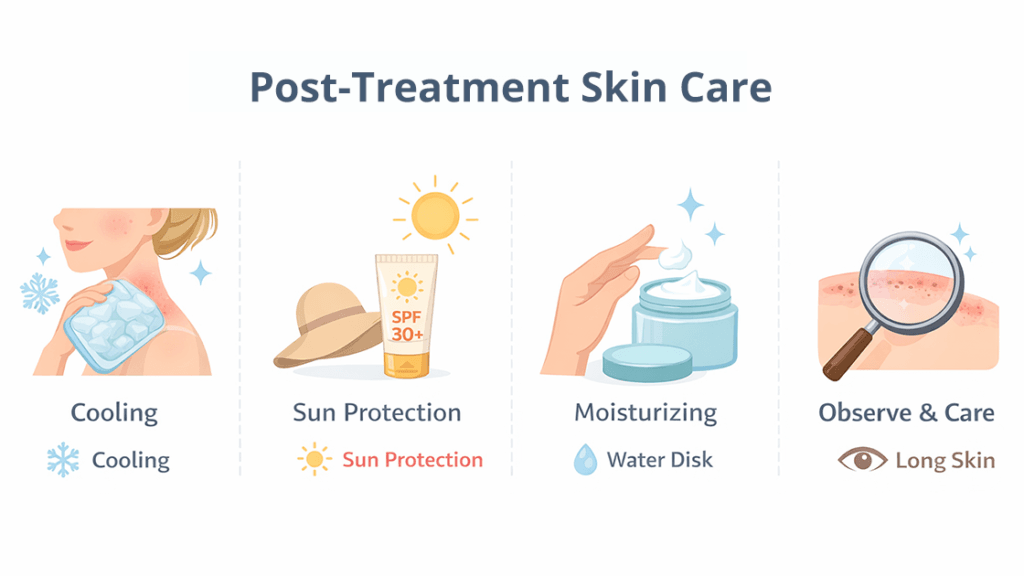
Effective post-treatment care is essential for minimizing complications and promoting optimal results.
5.1 Immediate Aftercare
Immediately after treatment, cooling the area helps reduce erythema, edema, and discomfort. Protective dressings prevent friction or contamination. Patients should avoid rubbing or scratching the area and follow clinician instructions regarding topical applications. Gentle cleansing and non-irritating moisturizers support barrier repair and accelerate recovery.
5.2 Long-Term Care
Long-term care involves sun protection, ongoing hydration, and monitoring for pigmentary changes. Sunscreens with SPF 30 or higher prevent UV-induced hyperpigmentation. Patients should report any abnormal changes, such as persistent redness or unusual pigmentation, to allow timely intervention and maintain skin health.
5.3 When to Seek Professional Help
Severe swelling, blistering, or persistent pigment changes require prompt professional evaluation. Early intervention prevents long-term complications such as scarring or permanent dyschromia. Follow-up allows adjustment of treatment parameters for safe, effective tattoo removal.
FAQ
Is laser tattoo removal safe for all sensitive skin types?
With proper assessment, patch testing, and careful parameter adjustment, it can be performed safely.
How many sessions are typically needed for special skin?
Small to medium tattoos generally require 4–8 sessions, depending on ink color and depth.
Can hyperpigmentation be completely avoided?
Careful laser selection and post-treatment care minimize risks, but minor pigmentary changes may occur.
Are topical anesthetics recommended?
Yes, numbing creams or cooling devices can enhance comfort without increasing risks.
What are warning signs of adverse reactions?
Persistent redness, blistering, oozing, or unusual pigmentation should prompt immediate clinical review.
Conclusion
Laser tattoo removal for sensitive and special skin types requires individualized treatment protocols, careful laser selection, and meticulous pre- and post-treatment care. By considering skin characteristics, adjusting laser parameters, and educating patients, clinicians can achieve safe, effective, and aesthetically satisfying tattoo removal while minimizing risks such as hyperpigmentation, hypopigmentation, or scarring. With professional guidance and adherence to protocols, patients with sensitive or special skin can successfully undergo laser tattoo removal while preserving skin health.
References
Pulselight Clinic. Laser Tattoo Removal for Sensitive and Darker Skin Types.
https://www.pulselightclinic.co.uk/laser-tattoo-removal-for-sensitive-and-darker-skin-types
Ross EV, et al. Laser treatment of tattoos in patients with darker skin types: risk of postinflammatory hyperpigmentation. Dermatologic Surgery. 2000;26(11):1023–1028.
Kossida T, et al. Evaluation of Q-switched Nd:YAG laser treatment for tattoo removal in patients with Fitzpatrick skin types IV–VI. Lasers in Surgery and Medicine. 2009;41(10):754–758.
https://pubmed.ncbi.nlm.nih.gov/19800240/
Saedi N, Alster TS. Management of adverse effects of tattoo removal. Dermatologic Therapy. 2009;22(5):464–472.