
Введение
Postpartum melasma is a common skin concern that affects facial pigmentation and overall skin tone balance. While topical skincare products may help improve surface brightness, they often struggle to address deeper pigmentation layers and long-term discoloration patterns. As a result, more skincare professionals are turning toward advanced laser-based skin rejuvenation systems that target multiple skin layers, support pigment management, and improve overall dermal quality. These technologies focus not only on reducing uneven pigmentation but also on restoring skin clarity, texture, and structural health after pregnancy-related hormonal changes.
1 Understanding Postpartum Melasma as a Multi-Layer Skin Condition
Melasma after pregnancy is not a simple surface pigmentation issue. It involves complex interactions between hormonal changes, melanin activity, and dermal structure. This complexity makes it a condition that often requires more than topical solutions.
1.1 Hormonal Influence and Melanin Overactivation
During pregnancy, elevated hormone levels can stimulate melanocytes, leading to increased melanin production. This overactivation does not stop immediately after childbirth, which means pigmentation may continue to develop or remain visible.
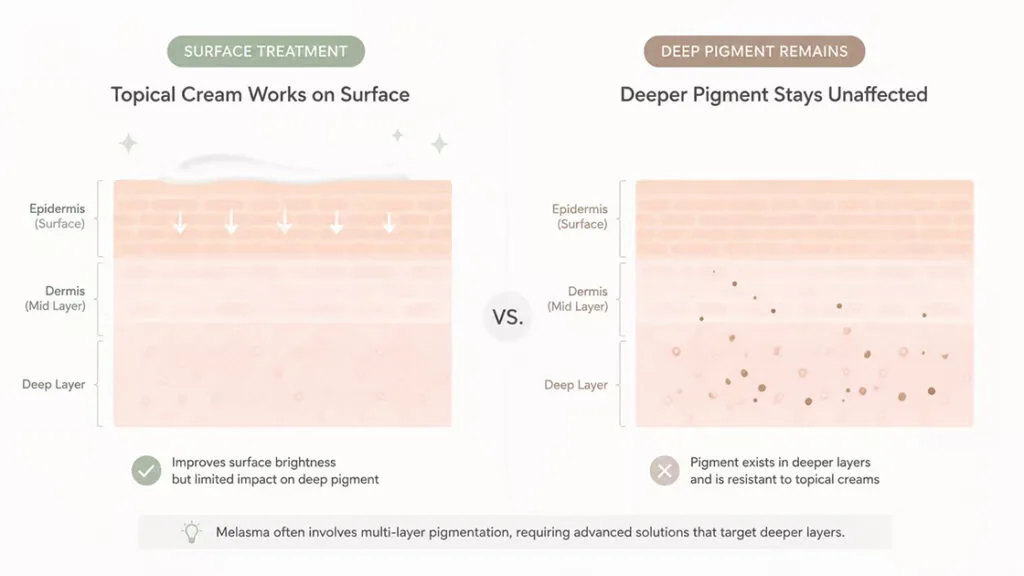
In many cases, melanin deposits extend beyond the epidermis into deeper skin layers. This multi-layer distribution makes pigmentation more resistant to surface-level treatments and requires technologies that can interact with different depths of skin tissue using controlled energy delivery.
1.2 Structural Skin Changes After Pregnancy
Beyond pigmentation, postpartum skin often experiences changes in elasticity, hydration balance, and texture. Collagen levels may decrease, contributing to dullness and uneven skin appearance.
These structural changes mean that melasma management is no longer just about reducing dark patches. It also involves restoring dermal stability and improving overall skin quality, which is where advanced light-based systems become increasingly relevant.
2 Limitations of Conventional Topical and Surface Treatments
Many individuals initially rely on brightening creams, exfoliating agents, and sun protection. While these approaches are important for daily care, they often do not fully address deeper pigmentation or structural skin changes.
2.1 Surface-Level Action vs. Deep Pigment Activity
Topical treatments primarily act on the epidermal layer. However, melasma frequently involves pigment located in deeper dermal regions.
Because of this, surface-focused approaches may lead to temporary brightness without long-term pigment stability. This gap has led to increased interest in energy-based systems that can reach multiple skin layers and interact directly with melanin clusters.
2.2 The Need for Controlled Energy Delivery Systems
Modern skin management increasingly relies on controlled energy delivery mechanisms that can precisely target pigment while minimizing unnecessary thermal impact.
These systems typically use specific wavelengths of light energy that selectively interact with melanin. This allows for a more targeted approach to pigmentation while maintaining surrounding tissue integrity and supporting overall skin balance.
3 How Advanced Laser-Based Skin Rejuvenation Systems Address Melasma
Advanced aesthetic platforms are designed to treat pigmentation at multiple levels while also supporting skin renewal processes. Their effectiveness comes from combining pigment targeting with dermal stimulation.
3.1 Selective Photothermolysis for Targeted Pigment Interaction
One of the core principles used in modern laser-based skin systems is selective photothermolysis. This mechanism allows specific wavelengths of energy to be absorbed by melanin while minimizing interaction with surrounding structures.
Once melanin absorbs this energy, pigment particles gradually break down into smaller fragments. These fragments can then be processed naturally by the body over time, leading to a more even skin tone appearance.
This selective targeting makes the technology particularly suitable for conditions like melasma, where pigment distribution is irregular and multi-layered.
3.2 Multi-Layer Skin Interaction for Comprehensive Pigment Management
Unlike traditional approaches that focus only on the surface, advanced systems are designed to interact with both epidermal and dermal layers.
This multi-layer capability allows practitioners to address different depths of pigmentation within a unified approach. As a result, uneven skin tone, post-inflammatory pigmentation, and hormonally induced discoloration can be managed more effectively within a single treatment framework.
4 Skin Rejuvenation Functions Beyond Pigment Correction
Modern laser-based systems are not limited to pigment reduction. They also support broader skin rejuvenation functions that improve overall skin health.
4.1 Collagen Stimulation and Dermal Remodeling
Controlled thermal energy delivered into the dermal layer can stimulate fibroblast activity, which plays a key role in collagen production.
Collagen is essential for maintaining skin firmness, elasticity, and structural integrity. As collagen networks strengthen, skin texture often appears smoother and more refined.
This process is particularly relevant for postpartum skin, where hormonal changes can temporarily affect dermal support structures and overall skin vitality.
4.2 Skin Texture Refinement and Tone Balancing
In addition to collagen support, advanced systems also contribute to skin surface refinement. This includes improving rough texture, reducing dullness, and enhancing overall skin brightness.
By combining pigment management with texture improvement, these technologies provide a more complete approach to skin rejuvenation rather than focusing on a single concern.
5 Why Integrated Light-Based Solutions Are Becoming the Preferred Approach
As skincare needs become more complex, single-function treatments are being replaced by integrated systems that address multiple concerns simultaneously.
5.1 Combined Management of Pigmentation and Skin Quality
Postpartum melasma rarely exists in isolation. It is often accompanied by uneven tone, reduced radiance, and changes in skin texture.
Integrated laser-based systems are designed to address these multiple concerns in parallel. They combine pigment targeting, collagen support, and skin renewal functions into a unified approach, making them more aligned with modern aesthetic expectations.
5.2 A Shift Toward Long-Term Skin Maintenance Strategies
Instead of focusing solely on short-term visible improvement, modern skin rejuvenation emphasizes long-term skin balance.
By supporting both pigment regulation and dermal health, advanced laser-based systems help maintain a more stable skin condition over time. This approach aligns with the growing demand for sustainable skin management solutions after pregnancy-related changes.
FAQ
What makes postpartum melasma different from regular pigmentation?
It is often deeper, hormonally influenced, and more resistant to surface-level skincare treatments.
How do laser-based systems target pigmentation?
They use specific wavelengths of energy that selectively interact with melanin and break pigment clusters into smaller particles.
Do these systems only focus on pigmentation?
No. They also support collagen stimulation, skin texture improvement, and overall skin rejuvenation.
Why is multi-layer treatment important?
Because melasma often exists in both epidermal and dermal layers, requiring deeper and more precise energy interaction.
Can skin quality improve alongside pigmentation concerns?
Yes. Many systems are designed to improve both tone and overall skin structure simultaneously.
Заключение
Postpartum melasma requires more than surface-level skincare because it involves multi-layer pigmentation and structural skin changes. Advanced laser-based skin rejuvenation systems provide a comprehensive approach by combining selective pigment targeting, controlled energy delivery, and dermal stimulation. This integrated method allows for improved skin tone balance, enhanced texture, and overall skin revitalization. As a result, these technologies are increasingly viewed as a modern solution for managing complex pigmentation concerns after pregnancy while supporting long-term skin health.
References
Melasma Overview and Clinical Features
https://my.clevelandclinic.org/health/diseases/21454-melasma
Melasma: Pathophysiology and Treatment Concepts
https://www.aad.org/public/diseases/a-z/melasma-treatment
Hyperpigmentation Mechanisms in Skin
https://www.ncbi.nlm.nih.gov/books/NBK459271
Principles of Laser and Light-Based Skin Therapy
https://www.ncbi.nlm.nih.gov/books/NBK560548
Dermal Pigmentation and Rejuvenation Approaches