Introdução
Aesthetic clinics increasingly rely on advanced laser systems to deliver precise skin rejuvenation and pigment correction treatments. These devices work through controlled light energy that interacts with different layers of the skin, allowing practitioners to target pigmentation irregularities while also supporting dermal renewal processes. Modern multi-wavelength laser platforms are designed to address multiple skin concerns within a single system, making them an essential part of clinical skincare workflows focused on texture improvement, tone balancing, and overall skin clarity.
1. The Clinical Role of Advanced Aesthetic Laser Systems
1.1 Multi-Wavelength Design and Skin Layer Targeting
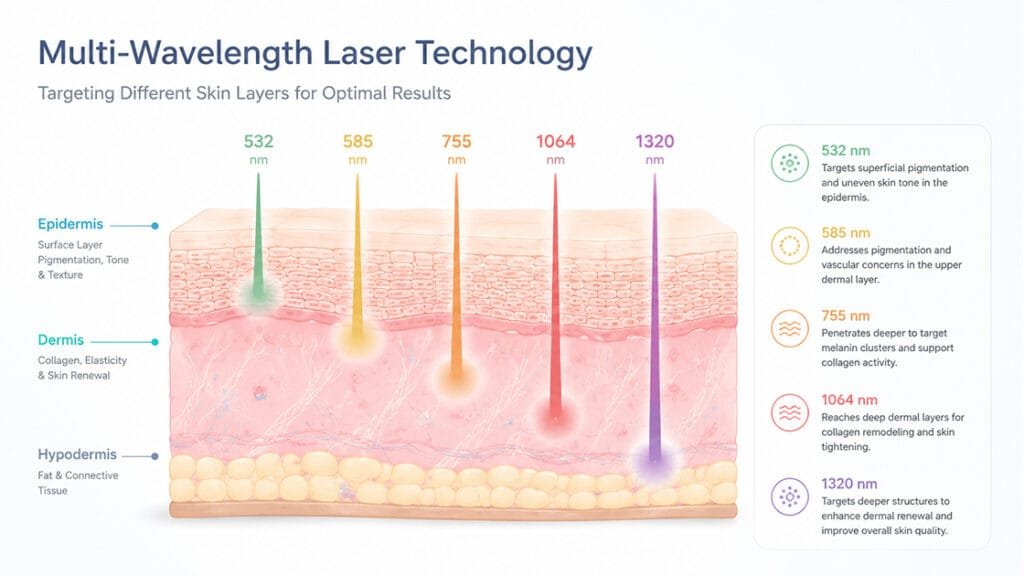
Modern aesthetic laser devices are built with multi-wavelength technology, allowing energy to interact with different depths of the skin. Shorter wavelengths typically act on the epidermis, where most pigmentation concerns such as dark spots and uneven tone appear. Longer wavelengths penetrate deeper into the dermis, where collagen structures influence skin firmness and elasticity.
This layered targeting approach allows clinics to address both surface-level discoloration and deeper structural aging signs in a single treatment platform, improving efficiency and treatment precision in aesthetic practice.
1.2 Why Clinics Prefer Integrated Laser Platforms
Aesthetic clinics increasingly prefer integrated laser systems rather than single-function devices. These platforms combine pigment correction and skin rejuvenation capabilities, allowing practitioners to manage multiple skin concerns without switching equipment.
In clinical workflow, this reduces treatment complexity while improving consistency in outcomes. It also enables practitioners to tailor procedures based on individual skin analysis, making treatment plans more personalized and adaptable.
2. Laser Mechanisms in Skin Rejuvenation
2.1 Photonic Energy and Cellular Response
Laser skin rejuvenation is based on controlled photonic energy interacting with skin cells. When delivered at specific wavelengths, this energy influences cellular activity related to skin regeneration and metabolic balance.
In aesthetic applications, this interaction supports improved skin texture, smoother surface appearance, and enhanced overall skin vitality. The precision of energy delivery allows practitioners to adjust treatment depth based on skin condition and desired outcomes.
2.2 Supporting Collagen Structure and Dermal Remodeling
One of the key functional goals of aesthetic laser systems is to support dermal remodeling processes associated with collagen maintenance. Collagen is essential for maintaining skin firmness and elasticity, but its structural integrity naturally declines over time.
By delivering controlled energy into the dermal layer, laser systems stimulate biological responses that support collagen organization and skin density improvement, contributing to a more refined and youthful skin appearance.
3. Pigment Correction in Aesthetic Practice
3.1 Understanding Skin Pigmentation Irregularities
Pigmentation concerns such as sun spots, post-inflammatory hyperpigmentation, and uneven skin tone are commonly treated in aesthetic clinics. These conditions are linked to melanin distribution within the skin, which can become irregular due to environmental exposure or internal biological factors.
Laser systems designed for pigment correction target melanin clusters using specific wavelengths, helping reduce visible discoloration and improve overall skin tone uniformity.
3.2 Precision Targeting of Melanin Structures
Professional aesthetic laser devices allow precise targeting of pigment deposits while preserving surrounding healthy tissue. This selectivity is essential in clinical practice, where safety and controlled energy delivery are priorities.
By adjusting wavelength and pulse parameters, practitioners can address both superficial pigmentation and deeper dermal discoloration, resulting in a more balanced and consistent complexion over time.
4. Clinical Functionality of Multi-Wavelength Laser Systems
4.1 Dual-Action Capability: Pigment + Rejuvenation
Advanced laser systems used in aesthetic clinics are designed to perform dual functions: pigment correction and skin rejuvenation. One function focuses on breaking down excess melanin responsible for dark spots and uneven tone, while the other supports dermal activity associated with collagen renewal and skin tightening.
This dual-action capability allows a single platform to address both aesthetic concerns simultaneously, improving clinical efficiency and treatment versatility.
4.2 Adjustable Energy Control for Personalized Treatment
A key feature of professional laser devices is adjustable energy output. Clinicians can modify wavelength combinations, pulse duration, and intensity levels based on individual skin type and treatment goals.
Lower energy settings are often used for superficial pigmentation and sensitive skin types, while deeper settings are applied for dermal restructuring and long-term skin rejuvenation goals. This flexibility ensures that treatments remain both safe and adaptable across different patient needs.
4.3 Workflow Integration in Aesthetic Clinics
In clinical environments, laser systems are integrated into structured treatment workflows. Practitioners typically begin with skin analysis, followed by parameter configuration based on pigmentation depth and skin condition.
Treatments are often delivered in multiple sessions to allow gradual skin response and controlled improvement over time. This structured approach supports consistent outcomes and allows skin to adapt progressively to energy-based stimulation.
5. Observations in Clinical Use
5.1 Patient Experience During Laser Treatments
During aesthetic laser procedures, patients typically experience controlled and targeted energy application across specific facial zones such as cheeks, forehead, and jawline. The process is designed to be precise and systematic, focusing on areas affected by pigmentation or texture irregularities.
The clinical environment emphasizes safety, consistency, and controlled application of energy, ensuring that treatment remains predictable and aligned with skin analysis findings.
5.2 Progressive Skin Improvement Over Time
Improvements from laser-based treatments generally occur gradually across multiple sessions. Patients often notice more even skin tone, reduced visibility of pigmentation, and smoother skin texture as treatments progress.
These changes reflect the cumulative effect of controlled energy exposure and skin response mechanisms that develop over time within structured clinical protocols.
FAQ
What do aesthetic laser devices treat?
They are used for skin rejuvenation, pigment correction, and improving overall skin texture and tone.
How do multi-wavelength laser systems work?
They deliver different wavelengths to target both superficial skin layers and deeper dermal structures.
Are laser skin treatments invasive?
No, most modern aesthetic laser treatments are non-invasive and use controlled light energy.
Can laser systems treat both pigmentation and aging signs?
Yes, dual-function systems are designed to address both concerns within one platform.
Why do clinics prefer integrated laser devices?
Because they improve workflow efficiency and allow multiple skin concerns to be treated using one system.
Conclusão
Aesthetic clinics increasingly adopt multi-wavelength laser systems to deliver comprehensive skin rejuvenation and pigment correction treatments. These devices combine precise energy control with layered skin targeting capabilities, allowing practitioners to address both superficial pigmentation and deeper structural concerns. As demand for non-invasive aesthetic solutions continues to grow, advanced laser platforms remain central to modern clinical skincare strategies.
References
Laser Skin Resurfacing and Dermal Remodeling Mechanisms
https://www.ncbi.nlm.nih.gov/pmc/articles/PMC5523874
Photobiomodulation and Cellular Response in Skin Tissue
https://www.ncbi.nlm.nih.gov/pmc/articles/PMC4743666
Low-Level Laser Applications in Dermatology and Aesthetic Medicine
https://pubmed.ncbi.nlm.nih.gov/26815124
Advances in Multi-Wavelength Aesthetic Laser Systems
https://www.sciencedirect.com/science/article/pii/S1360859216300104
Laser-Based Pigment Correction and Skin Tone Improvement