Introduction
Fine lines and early wrinkles are a common concern for performance professionals who work under intense lighting, frequent makeup, and demanding schedules. Modern aesthetic platforms based on multi-wavelength laser technology provide a non-invasive way to support skin renewal. By combining 755nm, 808nm, and 1064nm wavelengths in a single system, these devices deliver controlled energy into different skin depths, targeting both superficial texture and deeper dermal structures. This layered approach supports collagen activity, improves skin elasticity, and helps maintain a smoother appearance under high-visibility conditions such as stage lighting and camera exposure.
1. How Multi-Wavelength Laser Systems Target Skin Aging
1.1 Layered Skin Interaction Through 755nm, 808nm, and 1064nm
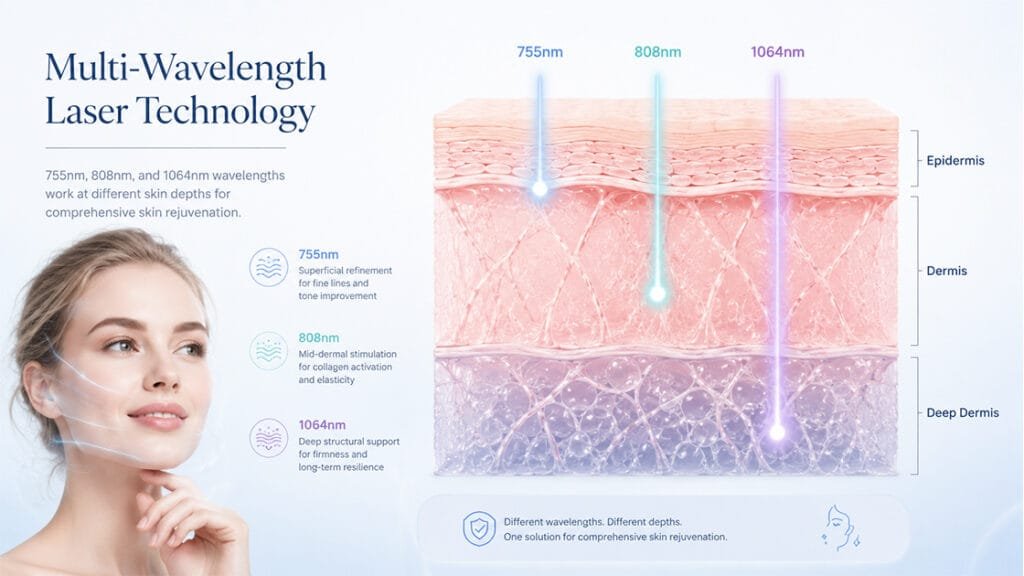
Advanced laser platforms use multiple wavelengths to interact with different layers of the skin simultaneously. The 755nm wavelength primarily focuses on superficial dermal layers, where early fine lines often begin to form. The 808nm wavelength penetrates deeper, supporting mid-dermal collagen stimulation. The 1064nm wavelength reaches deeper tissue structures, helping to reinforce overall skin firmness and resilience.
This multi-layered energy delivery allows a more comprehensive approach to skin rejuvenation compared with single-wavelength systems, especially for individuals exposed to repetitive facial expressions and environmental stress.
1.2 Controlled Energy Delivery for Facial Precision
Precision control is essential when treating delicate facial areas such as the eye contour, forehead, and mouth region. Modern laser systems allow adjustable energy density and pulse duration, ensuring that each treatment area receives optimized stimulation without excessive thermal stress.
For performers, this level of control is particularly important because facial expressions and skin sensitivity vary under different working conditions, such as long filming sessions or stage performances.
2. Collagen Remodeling Through Targeted Laser Energy
2.1 Dermal Stimulation Mechanism
The core function of multi-wavelength laser technology is to stimulate fibroblast activity within the dermis. Fibroblasts are responsible for producing collagen and elastin, which are essential for maintaining skin structure and elasticity. When controlled laser energy is delivered into the dermal layer, it activates natural regenerative processes that gradually improve skin firmness and texture.
This mechanism is especially relevant for early-stage fine lines commonly seen in high-expression facial zones.
2.2 Improving Skin Density and Elastic Support
With consistent dermal stimulation, the skin’s structural density gradually improves. Increased collagen fiber production helps reduce the visibility of fine lines while enhancing skin resilience under stress. This is particularly beneficial for individuals exposed to heavy makeup or stage lighting, where skin texture irregularities are more noticeable.
3. Why Multi-Wavelength Laser Platforms Are Suitable for Facial Rejuvenation
3.1 Adaptability Across Skin Types
One of the key advantages of combining multiple wavelengths is adaptability. Different wavelengths interact differently with melanin and dermal structures, allowing safer and more effective treatment across a variety of skin tones and sensitivities.
- 755nm: superficial refinement
- 808nm: balanced dermal penetration
- 1064nm: deeper structural support
This flexibility makes the technology suitable for professional aesthetic applications where clients present diverse skin conditions.
3.2 Non-Invasive Design with Minimal Disruption
Non-ablative laser systems operate without removing surface skin layers, making them suitable for individuals with active schedules. There is minimal disruption to daily activities, which is a key consideration for actors and performers who cannot afford extended downtime between appearances.
The treatment process focuses on gradual improvement rather than immediate surface alteration, aligning with the demand for natural-looking aesthetic enhancement.
4. Role of Laser Skin Rejuvenation in Performance Aesthetics
4.1 Maintaining Camera-Ready Skin Quality
Under high-intensity lighting and close-up filming conditions, even minor fine lines can become visually prominent. Multi-wavelength laser systems help maintain smoother skin texture by continuously supporting collagen regeneration and dermal integrity.
This contributes to a more consistent appearance across different lighting environments.
4.2 Supporting Long-Term Skin Stability
Beyond surface-level improvement, repeated stimulation of dermal structures helps maintain long-term skin stability. This is particularly relevant for individuals whose careers require frequent exposure to makeup, lighting, and environmental stressors that accelerate visible aging.
5. Advantages of Advanced Laser Rejuvenation Platforms
5.1 Multi-Depth Skin Targeting
Unlike traditional single-layer treatments, multi-wavelength systems address multiple skin depths simultaneously. This improves overall treatment efficiency and ensures more balanced skin rejuvenation results.
5.2 Customizable Treatment Parameters
Adjustable settings such as energy output, pulse duration, and wavelength selection allow professionals to tailor treatments based on skin condition and aging severity. This customization enhances treatment precision and safety.
5.3 Progressive and Natural Skin Improvement
Laser-based skin rejuvenation promotes gradual collagen remodeling rather than abrupt changes. This ensures that improvements appear natural, which is especially important for individuals in performance-related industries where appearance consistency is essential.
FAQ
What makes multi-wavelength laser technology different from traditional lasers?
It combines multiple wavelengths to target different skin depths simultaneously, improving overall treatment coverage.
Is this technology suitable for sensitive facial areas?
Yes, energy levels and pulse settings can be adjusted for delicate regions such as the eyes and mouth area.
Does this treatment require downtime?
As a non-ablative approach, it typically involves minimal to no downtime.
How does it improve fine lines?
By stimulating collagen and elastin production within the dermal layer.
Can it be used for long-term skin maintenance?
Yes, it is designed for progressive and cumulative skin improvement.
Conclusion
Multi-wavelength laser skin rejuvenation technology provides a structured and controlled approach to addressing fine lines and early wrinkles. By integrating 755nm, 808nm, and 1064nm wavelengths into a single platform, these systems deliver layered dermal stimulation that supports collagen production and improves skin elasticity. For performance professionals exposed to intense visual environments, this technology offers a non-invasive method to maintain smooth, stable, and camera-ready skin over time. Its adaptability, precision control, and progressive improvement characteristics make it a key component in modern aesthetic skin management.
References
Laser Treatment for Wrinkles and Skin Rejuvenation
https://www.ncbi.nlm.nih.gov/pmc/articles/PMC5843354/
Non-Invasive Laser Therapy in Dermatology
https://www.sciencedirect.com/science/article/pii/S0738081X19302064
Effects of Laser Therapy on Skin Aging
https://www.jaad.org/article/S0190-9622(19)32567-9/fulltext
Collagen Stimulation with Laser Therapy
https://www.aad.org/public/diseases/a-z/laser-skin-rejuvenation
Clinical Applications of Non-Ablative Lasers for Wrinkle Reduction