Introduction
Uneven pigmentation around the lips is a common skin concern that can affect overall facial balance and confidence. The skin around the mouth is delicate and frequently exposed to factors such as sun exposure, hormonal changes, daily habits, and external environmental stress. Modern aesthetic laser technology provides a targeted approach for people who want to support a more balanced-looking complexion. Advanced picosecond laser systems with dual wavelength technology, including 532nm and 1064nm wavelengths, are designed to address different pigment depths by delivering controlled energy to specific skin areas. Through precise pigment targeting and skin rejuvenation support, laser-based aesthetic treatments have become an important option for managing concerns such as lip pigmentation, uneven skin tone, and dull-looking skin.
1. Understanding Lip Pigmentation and Uneven Skin Tone Around the Mouth
1.1 What Causes Pigmentation Around the Lips?
Lip pigmentation refers to darker or uneven color changes that appear around the mouth area. Unlike the lips themselves, the surrounding skin contains melanin-producing cells that can respond to different internal and external factors.
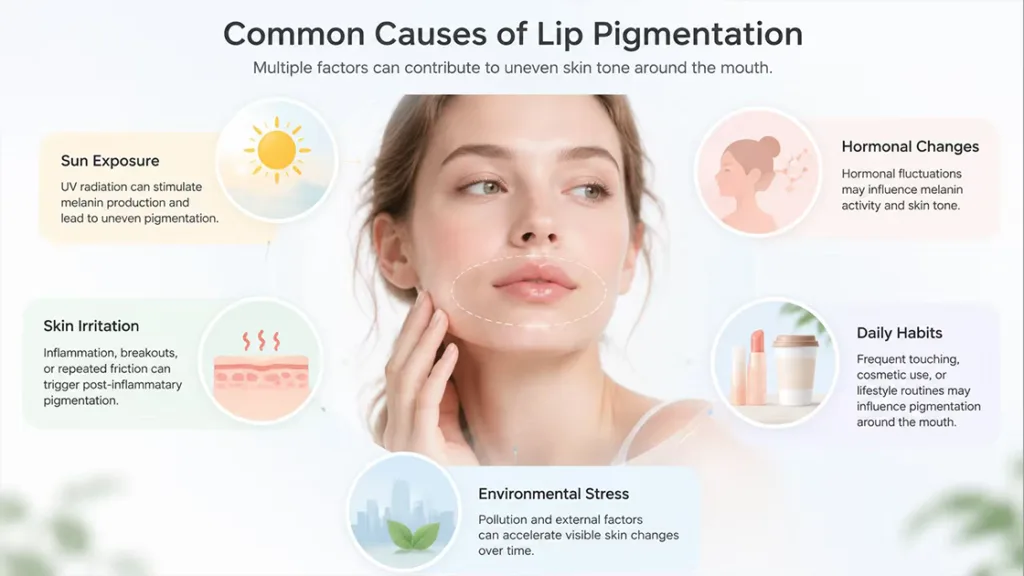
Common contributors include prolonged sun exposure, hormonal fluctuations, skin irritation, lifestyle habits, and repeated friction around the mouth area. Daily activities such as frequent touching, shaving, cosmetic use, or certain skincare routines may also influence the appearance of pigmentation over time.
The skin around the mouth is constantly exposed to environmental factors, making it important to understand the causes behind uneven pigmentation before choosing a suitable skincare approach.
Modern aesthetic solutions focus on supporting more balanced skin appearance by addressing visible pigmentation concerns while considering the unique characteristics of facial skin.
1.2 Why Lip Pigmentation Can Be Difficult to Manage
Pigmentation around the mouth can involve different layers of the skin. Some discoloration appears closer to the surface, while other pigment concerns may develop deeper within the dermal layer.
Because pigment depth varies, a single approach may not always address different types of pigmentation patterns. Surface-level pigmentation and deeper pigmentation require different energy approaches to achieve targeted results.
Factors such as skin sensitivity, pigment type, and individual skin characteristics also influence how people respond to aesthetic treatments.
This is why advanced laser technology often focuses on adjustable parameters, allowing professionals to customize treatment approaches according to specific skin concerns.
1.3 The Growing Interest in Laser Pigmentation Treatment
Laser pigmentation treatment has become increasingly popular because it provides a precise method for targeting unwanted pigmentation while supporting overall skin appearance.
Picosecond laser technology uses extremely short energy pulses measured in trillionths of a second. These rapid pulses create a photoacoustic effect that helps break pigment particles into smaller fragments, allowing the body’s natural processes to gradually handle these particles.
Compared with traditional aesthetic approaches, modern laser systems provide greater control over wavelength selection and energy delivery. This allows professionals to focus on different pigmentation depths while supporting skin texture and tone improvement.
For lip pigmentation concerns, this targeted approach helps create a more personalized pathway for individuals seeking a brighter and more even-looking complexion.
2. How Dual Wavelength Laser Technology Supports Pigmentation Management
2.1 Understanding 532nm and 1064nm Wavelength Functions
Dual wavelength laser technology uses different wavelengths to address pigmentation located at different skin depths.
The 532nm wavelength belongs to the green spectrum and is commonly used for superficial pigmentation concerns. It is absorbed effectively by melanin, making it suitable for addressing surface-level pigment irregularities such as freckles, sun-related pigmentation, and uneven skin tone.
The 1064nm wavelength has deeper penetration capabilities because it operates within the near-infrared spectrum. This allows it to reach deeper pigment areas while reducing excessive absorption at the skin surface.
By combining both wavelengths, professionals can create more flexible treatment strategies based on different pigmentation characteristics.
2.2 How Picosecond Laser Technology Works for Skin Appearance Improvement
Picosecond laser technology delivers energy through ultra-short pulses, creating precise interactions with pigment particles.
The short pulse duration helps reduce unnecessary heat accumulation around surrounding tissues while focusing energy on targeted pigment areas. This mechanism supports pigment fragmentation and encourages the skin’s natural renewal process.
Beyond pigmentation management, picosecond laser technology is also commonly associated with skin rejuvenation applications, including improving the appearance of uneven texture, fine lines, and dull-looking skin.
For individuals concerned about pigmentation around the lips, this technology provides a modern option that combines pigment targeting with overall facial skin appearance support.
2.3 Why Precision Matters for the Sensitive Lip Area
The area around the lips requires careful attention because facial skin is thinner and more sensitive compared with many other body areas.
Precision in laser energy delivery helps professionals focus on specific pigmentation concerns while considering surrounding skin conditions.
Modern laser systems allow adjustments in wavelength, energy settings, and treatment parameters. These customizable features are important because every individual has different skin characteristics and pigmentation patterns.
A targeted approach helps create a more controlled aesthetic experience while supporting natural-looking skin tone improvement.
3. Common Causes of Lip Pigmentation and Suitable Laser Approaches
3.1 Hormonal Changes and Pigmentation Around the Mouth
Hormonal fluctuations can influence melanin activity and may contribute to uneven pigmentation in certain facial areas. The skin around the mouth is especially noticeable because changes in tone can affect overall facial appearance.
Many people explore pigmentation management options when they notice darker areas around the lips that do not match the surrounding skin tone. These concerns may appear after life changes, environmental exposure, or changes in skincare routines.
Laser-based pigmentation treatments focus on supporting a more balanced appearance by targeting excess pigment while considering individual skin characteristics. Different wavelengths can be selected based on pigment location and skin response.
A customized approach helps professionals address the unique nature of pigmentation around delicate facial areas while supporting a natural-looking complexion.
3.2 Sun Exposure and Perioral Pigmentation Concerns
Sun exposure is one of the most common external factors associated with uneven skin tone. Ultraviolet radiation can stimulate melanin production, which may lead to visible dark spots and pigmentation changes over time.
The area around the mouth often receives daily sun exposure, especially when people spend time outdoors without consistent sun protection. Repeated exposure may contribute to uneven pigmentation patterns and a less uniform facial appearance.
Laser pigmentation technology uses selective energy absorption to interact with melanin pigments. The 532nm and 1064nm wavelengths provide different penetration levels, allowing professionals to consider both superficial and deeper pigment concerns. Research on picosecond laser technology has explored the role of these wavelengths in pigmentation management and facial rejuvenation applications.
Combining professional skin evaluation with suitable skincare habits can help individuals create a more complete approach to maintaining even-looking skin.
3.3 Post-Inflammatory Pigmentation Around the Lip Area
Post-inflammatory hyperpigmentation (PIH) refers to darker skin areas that may appear after irritation or inflammation. Around the mouth, this can sometimes occur after breakouts, skin sensitivity, or repeated irritation.
Because facial skin reacts differently from person to person, pigmentation patterns may vary in color, depth, and appearance. Some areas may involve surface-level melanin, while others may appear more resistant because pigment exists deeper within the skin.
Picosecond laser technology is designed to deliver short energy pulses that interact with pigment particles. This approach supports pigment fragmentation while helping maintain control over energy delivery.
For people concerned about post-inflammatory pigmentation, laser treatment is often considered as part of a broader skin appearance management plan that includes gentle skincare and daily protection.
4. Benefits of Using Advanced Laser Technology for Lip Pigmentation
4.1 Supporting More Balanced Skin Tone Around the Mouth
The main goal of laser pigmentation treatment is to support a more even-looking skin tone by focusing on visible pigment irregularities.
Advanced laser systems provide adjustable energy delivery and wavelength selection, allowing professionals to develop approaches based on different pigmentation characteristics.
For lip pigmentation concerns, targeted laser technology may help address uneven color around the mouth while also supporting overall facial skin quality. The controlled delivery of laser energy allows attention to specific areas without applying the same intensity across the entire face.
Many modern aesthetic treatments combine pigmentation management with skin rejuvenation goals, helping people focus not only on dark spots but also on overall skin appearance.
4.2 Supporting Skin Texture and Facial Rejuvenation
In addition to pigmentation concerns, many individuals are also interested in improving overall skin texture. Factors such as environmental stress, aging, and daily lifestyle habits can influence the appearance of pores, fine lines, and dull skin.
Picosecond laser technology is widely used in aesthetic applications because its ultra-short pulse duration allows precise energy delivery. This technology may support skin remodeling processes and contribute to smoother-looking skin texture.
Dual wavelength systems combining 532nm and 1064nm approaches can provide broader application flexibility. The shorter wavelength is commonly associated with superficial pigment concerns, while the longer wavelength can reach deeper skin layers for different aesthetic goals.
By addressing both pigmentation and skin quality, laser facial treatments provide a more comprehensive approach for people seeking improved complexion appearance.
4.3 Why Customized Settings Matter for Different Skin Types
Every person has unique skin characteristics, including skin tone, sensitivity, pigmentation depth, and treatment goals.
Customized laser parameters are important because the same energy setting may not be suitable for everyone. Professionals typically consider factors such as pigmentation type, treatment area, and overall skin condition when selecting appropriate settings.
The lip area requires additional attention because it is close to sensitive facial structures. Precise energy control helps create a more comfortable treatment experience while supporting targeted pigmentation management.
Modern aesthetic technology continues to focus on personalization, allowing treatments to better match individual skin needs.
5. Building a Complete Skin Management Routine With Laser Pigmentation Care
5.1 Combining Laser Treatments With Daily Skin Protection
Laser pigmentation treatments are only one part of maintaining an even-looking complexion. Daily skincare habits play an important role in supporting long-term skin appearance.
Important skincare practices may include:
- Using suitable sun protection
- Maintaining skin hydration
- Avoiding unnecessary irritation
- Following professional skincare recommendations
Since pigmentation can be influenced by environmental factors, consistent protection helps support the results of aesthetic skincare routines.
Laser technology and daily skincare work together by addressing both existing pigmentation concerns and future skin maintenance.
5.2 Choosing the Right Approach for Lip Pigmentation Concerns
When selecting a pigmentation treatment approach, individuals should consider their specific skin condition, pigmentation type, and desired aesthetic goals.
Professional evaluation helps determine whether pigmentation appears mainly on the surface or involves deeper skin layers. Based on these factors, different laser wavelengths and treatment strategies may be considered.
Modern picosecond laser technology provides flexibility through multiple wavelengths, allowing professionals to address different pigmentation patterns and skin rejuvenation needs.
For individuals seeking support for lip pigmentation and uneven skin tone, a personalized approach can help create a more suitable pathway toward healthier-looking skin.
FAQ
What causes pigmentation around the lips?
Common factors include sun exposure, hormonal changes, skin irritation, and post-inflammatory pigmentation.
Can laser treatment help with lip pigmentation?
Laser treatment may support a more even-looking skin tone by targeting visible pigmentation concerns. Individual results may vary.
Why are 532nm and 1064nm wavelengths used for pigmentation?
These wavelengths provide different penetration levels, allowing professionals to consider different pigment depths.
Is laser pigmentation treatment only for women?
No. People of different genders may explore laser pigmentation treatments based on their personal skincare goals.
Can laser treatment improve skin texture as well?
Some laser technologies are also used in skin rejuvenation routines to support smoother-looking texture and overall complexion improvement.
Why is the lip area treated carefully?
The skin around the mouth is delicate, so customized settings and professional evaluation are important for targeted treatment.
Conclusion
Lip pigmentation and uneven skin tone around the mouth can result from multiple factors, including sun exposure, hormonal changes, and skin irritation. Advanced laser pigmentation technology, including picosecond laser systems with 532nm and 1064nm wavelengths, provides a targeted approach for supporting a more balanced-looking complexion. By focusing on pigment management, skin texture improvement, and personalized treatment strategies, modern aesthetic laser solutions offer a flexible option for individuals interested in improving overall facial appearance. Combined with proper skincare habits and professional guidance, laser pigmentation care can become part of a comprehensive approach to maintaining healthier-looking skin.
References
Picosecond Laser in Dermatology: Applications and Mechanisms
https://dermnetnz.org/topics/picosecond-laser
Study of a 532/1064 Fractional Picosecond Laser for Facial Rejuvenation
https://pubmed.ncbi.nlm.nih.gov/34608097
Fractional 1064 nm Picosecond Laser in Treatment of Melasma and Skin Rejuvenation in Asians, A Prospective Study
https://pubmed.ncbi.nlm.nih.gov/33544930
Comparison of 1064 and 532 nm Picosecond Fractional Lasers for Treating Enlarged Pores and Melanin Spots in Asians
https://onlinelibrary.wiley.com/doi/10.1155/dth/5584699
Energy-Based Devices for the Treatment of Facial Skin Conditions in Skin of Color