Introduction
In modern aesthetic dermatology, treatment priorities have shifted significantly from superficial color correction toward deep structural skin restoration. While skin color primarily reflects melanin distribution within the epidermis, skin texture represents the functional and structural integrity of the entire skin system, including epidermal renewal dynamics, dermal collagen density, and extracellular matrix organization. These structural components determine how light interacts with the skin and how youthful, smooth, and healthy the skin appears.
Advanced laser-based dermatology systems used in clinical aesthetic environments now focus on multi-layer skin remodeling rather than surface-level improvement. Through technologies such as fractional CO₂ resurfacing, controlled dermal heating, and epidermal regeneration systems, these platforms aim to restore skin architecture from within. Instead of simply treating discoloration, they address the root causes of roughness, uneven texture, and structural aging.
1. Skin Texture as a Multi-Layer Structural Indicator
Skin texture is not a surface characteristic alone; it reflects a combination of biological processes occurring across multiple skin layers. Understanding these layers is essential to appreciate how laser-based systems work.
1.1 Epidermal renewal and surface irregularity formation
The epidermis continuously renews itself through keratinocyte proliferation and differentiation. Under healthy conditions, this cycle maintains a smooth and uniform surface. However, with aging, UV exposure, and environmental stress, keratinocyte turnover becomes irregular. This leads to uneven stratum corneum buildup, disrupted desquamation, and surface roughness.
These epidermal irregularities do not necessarily alter pigmentation but significantly affect skin smoothness and light reflection. As a result, skin may appear dull or uneven even when color tone remains stable.
1.2 Dermal collagen degradation and structural weakening
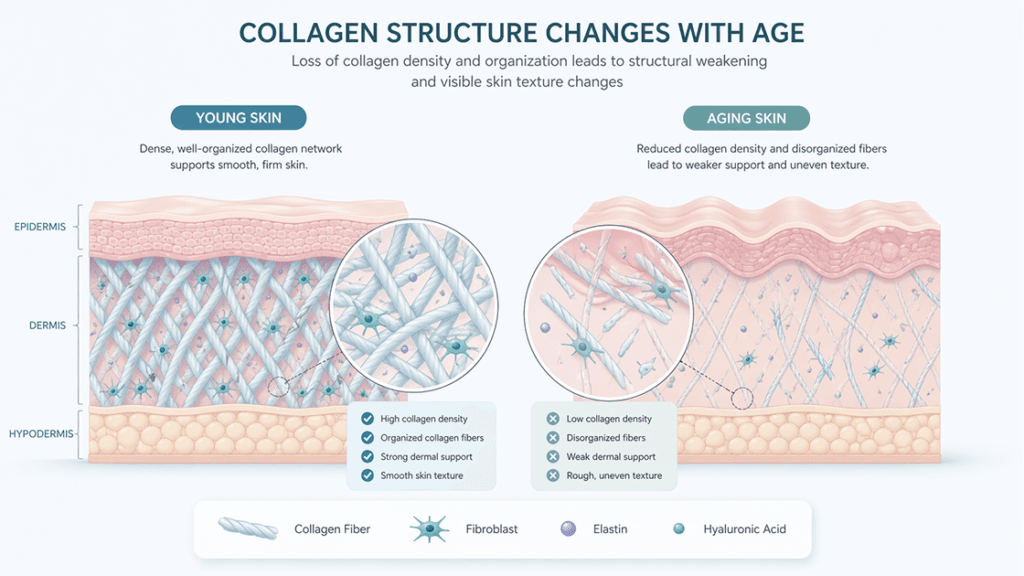
The dermis provides the mechanical support of the skin through a dense network of collagen and elastin fibers. Over time, enzymatic activity such as matrix metalloproteinases breaks down collagen structures, leading to reduced dermal density and elasticity.
This structural weakening manifests as fine lines, shallow depressions, enlarged pores, and loss of firmness. Unlike pigmentation issues, these changes are structural in nature and require deeper tissue remodeling to correct.
1.3 Chronic inflammation and extracellular matrix disruption
Low-grade chronic inflammation plays a significant role in long-term skin texture deterioration. Pro-inflammatory cytokines interfere with fibroblast activity and reduce extracellular matrix synthesis. This imbalance slows tissue repair and leads to irregular regeneration patterns across both epidermal and dermal layers.
Even mild but repeated inflammation, such as acne or environmental irritation, can contribute to persistent textural irregularities over time.
2. Why Modern Dermatology Prioritizes Skin Texture Over Color
In clinical aesthetics, skin texture has become a more reliable indicator of skin aging than pigmentation alone.
2.1 Optical uniformity and light reflection physics
Skin appearance is heavily influenced by how light interacts with its surface. Smooth skin reflects light evenly, creating a natural glow and youthful appearance. In contrast, irregular texture scatters light in multiple directions, producing shadows that exaggerate aging features.
This optical effect explains why individuals with similar skin tones can appear significantly different in perceived age depending on texture quality.
2.2 Limitations of pigment-focused skincare approaches
Topical skincare products primarily target epidermal biochemical pathways such as melanin production, hydration balance, and antioxidant protection. While these mechanisms can improve brightness and tone, they do not significantly affect dermal structure or collagen organization.
As a result, patients often experience improved skin color but continue to struggle with rough texture, enlarged pores, or uneven surface contours.
2.3 Objective dermatological imaging and texture metrics
Modern diagnostic tools such as 3D skin mapping and optical surface profilometry now allow clinicians to measure skin texture objectively. Parameters such as roughness index, pore density, and dermal elasticity are commonly evaluated.
Clinical data consistently shows that texture deterioration often precedes visible pigmentation changes, reinforcing its importance as an early indicator of skin aging.
3. Mechanisms of Advanced Laser Skin Resurfacing Systems
Modern laser treatment platforms are designed to trigger controlled biological responses that restore skin structure rather than simply altering surface appearance.
3.1 Fractional photothermolysis and controlled micro-injury
Fractional laser technology delivers energy in a grid-like pattern, creating microscopic zones of thermal injury while leaving surrounding tissue intact. This approach preserves healthy skin structures that accelerate healing.
The controlled injury activates the body’s natural wound healing cascade, initiating cellular repair and tissue regeneration without causing full-surface damage.
3.2 CO₂ wavelength energy and dermal thermal remodeling
CO₂ laser energy is highly absorbed by water molecules within skin tissue, producing precise thermal effects in the dermis. This heat causes immediate collagen fiber contraction followed by long-term neocollagenesis.
Over time, fibroblasts produce new collagen fibers that reorganize the dermal matrix, improving skin firmness and reducing structural irregularities.
3.3 Epidermal ablation and regeneration cycles
At the epidermal level, laser energy removes damaged or disorganized skin layers. This controlled ablation stimulates rapid keratinocyte regeneration, leading to the formation of new, more uniformly structured epidermal tissue.
This process enhances surface smoothness and improves the skin’s ability to reflect light evenly.
4. Clinical Indications for Texture-Focused Laser Treatments
Laser resurfacing systems are primarily indicated for structural skin issues that cannot be corrected through topical or superficial treatments.
4.1 Enlarged pores and dermal support loss
Enlarged pores are often caused by reduced dermal support around follicular structures. As collagen density decreases, pore walls lose structural tension and appear more visible.
Laser treatments improve surrounding dermal integrity, indirectly reducing pore visibility by restoring structural support rather than targeting pores directly.
4.2 Atrophic scarring and localized tissue collapse
Atrophic scars result from localized collagen loss following inflammation or injury. These depressions disrupt surface uniformity and create uneven light reflection.
Fractional laser systems stimulate fibroblast activity in these areas, promoting collagen regeneration and gradual restoration of surface continuity.
4.3 Photoaging and cumulative environmental damage
Chronic ultraviolet exposure leads to collagen fragmentation, elastin degradation, and epidermal thickening. These changes result in rough texture, fine wrinkles, and uneven surface reflectivity.
Laser resurfacing helps reverse these structural effects by stimulating dermal regeneration and normalizing epidermal turnover.
5. Functional and Perceptual Benefits of Skin Texture Improvement
Beyond biological repair, improvements in skin texture influence psychological perception and social interaction.
5.1 Enhanced self-perception and confidence
Smoother skin is often associated with health and vitality. When texture improves, individuals frequently report increased confidence and improved self-image, even when no major color changes occur.
5.2 Social perception and visual judgment
Human observers rely heavily on skin smoothness when forming first impressions. Improved texture often leads to perceptions of youthfulness, energy, and overall well-being.
5.3 Influence of high-definition visual environments
With the rise of high-resolution imaging and digital media, skin texture imperfections have become more visible than ever. This has increased demand for treatments that address structural quality rather than only pigmentation.
FAQ
Why is skin texture more important than skin color?
Because texture directly affects perceived age and skin smoothness, while color mainly affects tone.
Can skincare alone improve skin texture?
Skincare improves surface hydration but cannot restructure dermal collagen.
How do laser systems improve skin texture?
They stimulate controlled dermal remodeling and epidermal regeneration.
Are laser treatments suitable for all skin types?
Suitability depends on individual skin condition and professional evaluation.
Conclusion
Skin texture reflects the underlying structural health of both the epidermis and dermis, making it a more accurate indicator of skin aging than pigmentation alone. Advanced laser skin resurfacing systems used in clinical aesthetic environments target these structural layers through fractional energy delivery, CO₂-based dermal heating, and controlled epidermal regeneration. By stimulating collagen remodeling and restoring tissue architecture, these systems address the root causes of skin irregularities rather than surface symptoms. As a result, modern dermatology is increasingly shifting toward structure-based skin restoration rather than color-based correction.
References
Urdiales-Gálvez F. et al.
“Structural Changes in Skin Aging and Dermal Remodeling Mechanisms”
https://pubmed.ncbi.nlm.nih.gov/29131234
Kang J.W. et al.
“Fractional Photothermolysis and Skin Rejuvenation via Laser-Induced Dermal Remodeling”
https://pubmed.ncbi.nlm.nih.gov/23614455
Goldman M.P. et al.
“Clinical Applications of CO₂ Laser Resurfacing in Aesthetic Dermatology”
https://pubmed.ncbi.nlm.nih.gov/29490312
Alexiades-Armenakas M.R. et al.
“Laser-Induced Collagen Remodeling and Skin Rejuvenation Outcomes”
https://pubmed.ncbi.nlm.nih.gov/20077415
Lee K.B. et al.
“Quantitative Evaluation of Skin Texture and Surface Roughness in Dermatologic Science”