Introduction
Urban living exposes the skin to multiple environmental and lifestyle stressors that accelerate aging. Pollution, UV radiation, and chronic stress collectively damage the skin’s barrier function, degrade collagen and elastin, and increase oxidative stress, leading to premature fine lines, wrinkles, hyperpigmentation, and dullness. Traditional topical skincare can only address superficial layers, often requiring long-term use with limited efficacy. Non-invasive laser therapy has emerged as a scientifically validated approach to combat urban skin aging by stimulating collagen synthesis, promoting tissue regeneration, and reducing pigmentation irregularities. This article explores how laser therapy works, who benefits most, and how to integrate it safely into a holistic skincare routine.
1. Understanding Urban Skin Aging
Urban skin aging is a multifactorial process driven by external and internal factors. Understanding its mechanisms is critical to selecting effective interventions.
1.1 What Is Urban Skin Aging?
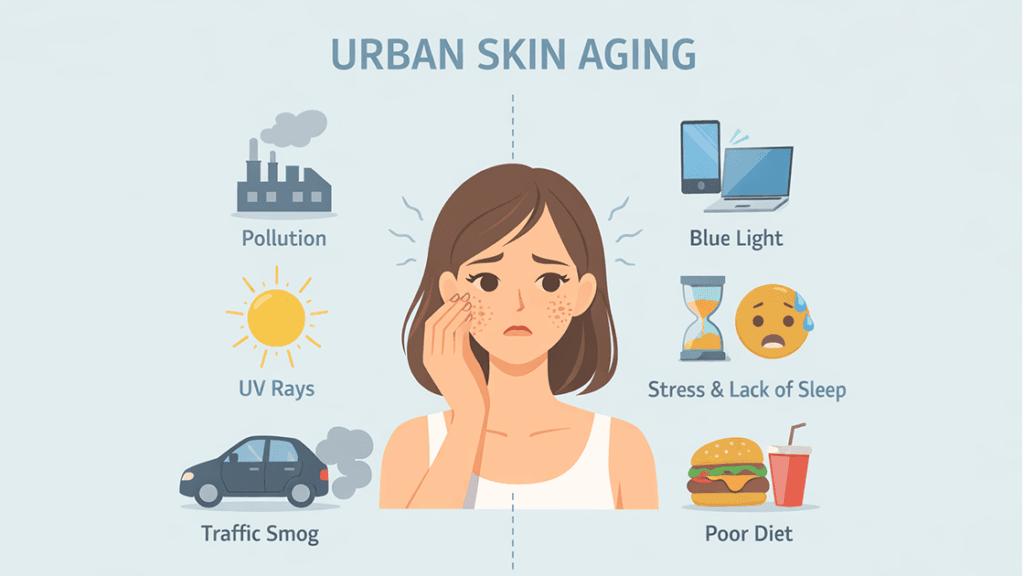
Urban skin aging refers to the premature deterioration of skin quality caused by chronic exposure to environmental pollutants, UV radiation, and lifestyle-related stressors. It often presents as fine lines, wrinkles, uneven skin tone, hyperpigmentation, and loss of elasticity. Key molecular processes include oxidative damage by reactive oxygen species (ROS), disruption of collagen and elastin fibers, and impairment of the epidermal barrier. Over time, cumulative damage leads to structural and functional changes in both the dermis and epidermis, making the skin more susceptible to sensitivity, dryness, and uneven texture. Early intervention is crucial to prevent permanent damage and maintain youthful skin appearance.
1.2 Key Environmental and Lifestyle Factors
Several external and lifestyle factors accelerate urban skin aging. Airborne pollutants, such as particulate matter (PM2.5) and nitrogen oxides, generate free radicals that degrade collagen and elastin. Chronic UV exposure contributes to photoaging, characterized by hyperpigmentation, telangiectasia, and elastosis. Lifestyle factors, including sleep deprivation, high stress levels, and poor nutrition, further compromise the skin’s antioxidant defense mechanisms. Blue light exposure from electronic devices may exacerbate oxidative stress in dermal cells. Recognizing these factors helps individuals understand why traditional skincare alone may be insufficient, and highlights the role of advanced therapies such as laser treatment in reversing early signs of urban skin aging.
2. How Laser Therapy Helps
Laser therapy targets the skin at the cellular level, offering benefits beyond what topical treatments can achieve.
2.1 Stimulating Collagen and Skin Renewal
Laser therapy delivers controlled thermal energy to the dermis, inducing micro-injury that stimulates fibroblast activity. Activated fibroblasts synthesize new collagen and elastin fibers, restoring structural integrity and skin elasticity. This regenerative effect reduces fine lines, tightens sagging tissue, and improves overall skin texture. Unlike superficial exfoliants, laser treatment penetrates deep dermal layers, promoting long-term structural changes. Additionally, microcirculation is enhanced, improving nutrient delivery and supporting natural skin repair mechanisms. The non-invasive nature of laser therapy allows repeated treatments with minimal downtime, making it an effective solution for urban residents seeking sustained rejuvenation.
2.2 Reducing Pigmentation and Uneven Skin Tone
Hyperpigmentation, melasma, and post-inflammatory marks are common manifestations of urban skin aging. Laser therapy targets melanin-containing cells using precise photothermolysis, fragmenting pigment particles that are then naturally cleared by the lymphatic system. By selectively affecting melanocytes without damaging surrounding tissue, laser treatments improve skin tone uniformity and diminish dark spots. Regular sessions can address cumulative pigment damage from chronic sun exposure, environmental stressors, and blue light, leading to a brighter, more even complexion. This precision and effectiveness make laser therapy a superior choice compared to chemical peels or topical depigmenting agents alone.
2.3 Minimizing Fine Lines and Wrinkles
Fine lines and wrinkles form due to collagen degradation, elastin fragmentation, and repetitive facial muscle movements. Laser therapy induces controlled thermal stimulation in the dermis, triggering neocollagenesis and remodeling existing collagen networks. As new collagen is deposited, skin firmness improves and wrinkles become less pronounced. Repeated treatments further consolidate results, enhancing skin resilience against future damage. Importantly, laser therapy achieves these outcomes without surgical intervention or significant downtime, providing a practical and non-invasive option for individuals experiencing early to moderate signs of aging.
3. Ideal Candidates for Urban Skin Laser Treatments
Laser therapy is suitable for a wide range of individuals, but certain profiles benefit most.
- Individuals exposed to high pollution environments, chronic UV radiation, or blue light from digital devices
- Adults presenting early signs of fine lines, uneven skin tone, hyperpigmentation, or loss of firmness
- People seeking non-invasive rejuvenation without the risks and recovery associated with surgery
- Those motivated to combine professional treatments with daily skincare routines for long-term results
Understanding who benefits most allows for personalized treatment plans that maximize results and safety.
4. Treatment Process and Safety Considerations
Laser therapy is effective and safe when performed by trained professionals in a controlled clinical environment.
4.1 What to Expect During a Session
Sessions typically begin with thorough skin cleansing and assessment. Protective measures, such as ocular shields, are applied to safeguard sensitive areas. The laser is then delivered in precise pulses to target dermal layers, with energy settings tailored to individual skin type and treatment goals. Each session may last 20–45 minutes depending on the area treated. Most patients experience mild warmth or tingling, which is tolerable and indicates effective stimulation of collagen remodeling. Treatment protocols may include multiple sessions spaced over several weeks to achieve optimal results.
4.2 Safety and Comfort
Laser therapy’s safety stems from its precision. Energy levels are calibrated to avoid damage to surrounding tissue, minimizing the risk of burns or scarring. Temporary side effects may include mild erythema, swelling, or tingling, which typically resolve within 24–48 hours. The non-invasive nature allows patients to resume normal activities immediately. Proper pre-treatment evaluation, including assessment of skin type and medical history, ensures safety and reduces adverse reactions. Laser therapy is generally safe for all skin types when administered by certified professionals following standard protocols.
5. Aftercare and Maintenance
Post-treatment care is essential to maximize efficacy and maintain long-term skin health.
- Sun Protection: Apply broad-spectrum sunscreen daily to prevent new UV-induced damage
- Hydration and Moisturization: Maintain skin barrier integrity with emollients and antioxidants
- Avoid Aggressive Products: Delay exfoliants, retinoids, or chemical peels for several days post-treatment
- Healthy Lifestyle: Adequate sleep, balanced nutrition, and stress management support skin repair and reduce oxidative damage
- Regular Follow-Up: Periodic laser sessions or maintenance treatments can help sustain results and prevent recurrence of pigmentation or fine lines
Integrating laser therapy with these aftercare strategies ensures a comprehensive approach to managing urban skin aging.
FAQ
Does laser therapy hurt?
Most patients feel only mild tingling or warmth; discomfort is minimal and transient.
How soon will I see results?
Noticeable improvements in tone and texture often appear within 2–4 weeks, with progressive benefits over multiple sessions.
How many sessions are usually required?
Treatment plans vary, typically 3–6 sessions spaced 2–4 weeks apart, depending on severity and skin goals.
Is it safe for all skin types?
Yes, modern laser protocols accommodate different skin types, but assessment by a professional is essential to minimize risk.
Can laser therapy completely reverse urban skin aging?
Laser therapy improves structural integrity, reduces pigmentation, and minimizes fine lines, but results are maximized when combined with ongoing skincare and lifestyle management.
Conclusion
Urban skin aging is accelerated by environmental pollutants, UV exposure, and lifestyle factors that damage collagen, elastin, and skin barrier function. Laser therapy provides a non-invasive, scientifically validated approach to stimulate collagen, improve texture, reduce pigmentation, and minimize fine lines. When combined with diligent aftercare, sun protection, and a healthy lifestyle, laser treatments offer a comprehensive solution for maintaining youthful, resilient skin. Early intervention and personalized treatment plans are key to optimizing results and preserving long-term skin health.
References
Rittié, L., & Fisher, G. J. “UV-light-induced skin aging: Role of ROS and collagen degradation.” Journal of Investigative Dermatology, 2002.
https://doi.org/10.1046/j.0022-202x.2002.01667.x
Gold, M. H., & Goldman, M. P. “Non-ablative laser skin rejuvenation: Mechanisms and clinical efficacy.” Dermatologic Surgery, 2004.
https://doi.org/10.1111/j.1524-4725.2004.32148.x
Farris, P. K. “Topical antioxidants in the management of photodamage.” Dermatologic Therapy, 2005.