Введение
Living in urban environments exposes skin to a constant barrage of pollutants, including particulate matter, nitrogen dioxide, ozone, and volatile organic compounds. These environmental stressors accelerate premature skin aging, trigger oxidative stress, and contribute to pigmentation irregularities, dullness, and weakened barrier function. Traditional skincare regimens often fall short in reversing the cumulative impact of pollution. Pico laser technology has emerged as a scientifically validated approach to repair urban skin damage by targeting pigment irregularities, stimulating collagen production, and enhancing skin texture. Understanding the mechanisms by which pico lasers restore skin integrity provides insight into why this treatment is increasingly recommended for individuals seeking rejuvenation in challenging environmental conditions.
1. Understanding Urban Pollution and Its Effects on Skin Health
Before exploring how pico laser treatment can repair skin damage, it is essential to understand the specific mechanisms through which urban pollution compromises skin health.
1.1 Particulate Matter and Skin Barrier Disruption
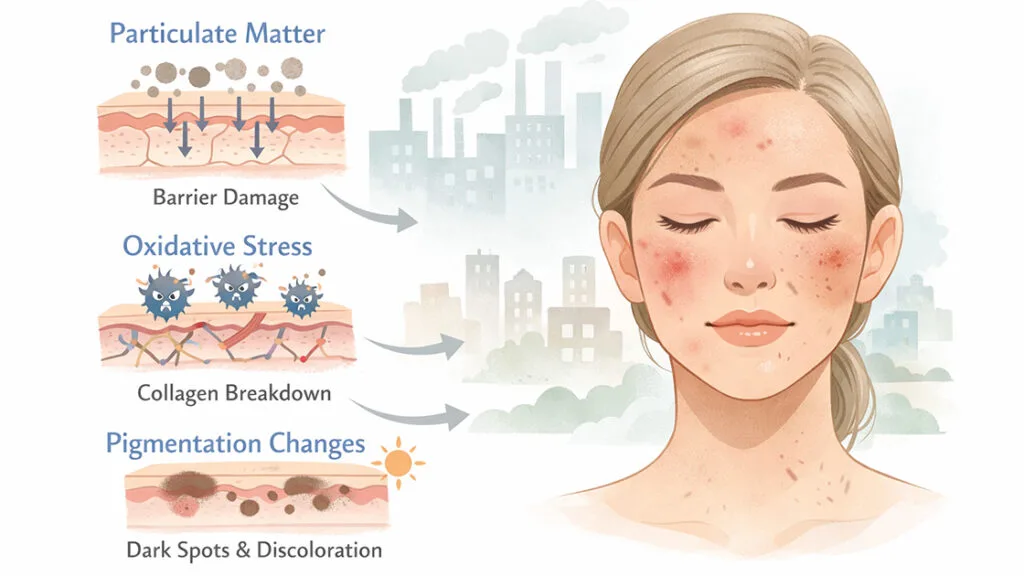
Fine particulate matter (PM2.5 and PM10) from traffic emissions, industrial activities, and construction dust can penetrate the superficial layers of the skin, exacerbating barrier dysfunction. When these particles accumulate in the stratum corneum, they induce inflammation, increase transepidermal water loss, and impair the lipid matrix. Chronic exposure often manifests as dryness, sensitivity, and accelerated photoaging. By recognizing the disruptive effects of particulate matter, skincare specialists can better assess which interventions, including pico laser treatments, are most effective for repairing structural damage and restoring barrier function.
1.2 Reactive Oxygen Species and Oxidative Stress
Pollutants such as ozone and nitrogen dioxide catalyze the formation of reactive oxygen species (ROS) in the skin, triggering oxidative stress that damages proteins, lipids, and DNA. ROS accumulation accelerates collagen degradation and elastin breakdown, leading to fine lines, wrinkles, and reduced elasticity. Pico laser therapy, through its precise photomechanical energy, stimulates fibroblast activity and promotes neocollagenesis, helping counteract the structural damage caused by chronic oxidative stress.
1.3 Pigmentation Changes from Environmental Exposure
Chronic exposure to airborne pollutants can provoke melanocyte hyperactivity, leading to uneven pigmentation, dark spots, and post-inflammatory hyperpigmentation. Individuals with sensitive skin or preexisting melasma are particularly susceptible. The ultra-short pulse duration of pico lasers allows for precise disruption of pigment particles in the dermis without excessive thermal damage, making it a preferred modality for restoring an even skin tone in pollution-exposed urban populations.
2. Pico Laser Mechanisms for Urban Skin Damage Repair
Лазерная технология Pico operates on the principle of delivering ultra-short pulses of high-intensity energy to targeted dermal structures, inducing photomechanical effects that facilitate skin rejuvenation and pigmentation correction.
2.1 Photomechanical Disruption of Pigment Particles
Pico lasers generate pulses in the picosecond range, which produce a photoacoustic effect that shatters melanin clusters and exogenous pigment deposits into smaller fragments. These fragments are subsequently cleared by the lymphatic system. This mechanism is particularly effective for pigment irregularities induced by pollution-related melanocyte activation, allowing the skin to achieve a more uniform appearance without the prolonged recovery associated with traditional Q-switched lasers.
2.2 Stimulation of Collagen and Elastin Synthesis
In addition to targeting pigment, pico laser pulses induce controlled dermal micro-injury, triggering fibroblast activation and the synthesis of collagen and elastin. This regenerative response strengthens the dermal matrix, improves skin elasticity, and reduces fine lines caused by oxidative stress and environmental aging. Over successive sessions, patients often report smoother skin texture, increased firmness, and a restored radiant complexion.
2.3 Minimizing Thermal Damage for Sensitive Urban Skin
One key advantage of pico laser technology is its minimal thermal diffusion, reducing the risk of post-inflammatory hyperpigmentation and edema. Urban skin, often compromised by chronic exposure to pollutants, benefits from this precision, as the treatment preserves surrounding tissue while targeting damaged pigment or dermal structures. This makes pico lasers suitable for individuals with reactive skin who may be more prone to irritation from conventional laser treatments.
3. Clinical Applications for Pollution-Induced Skin Conditions
Pico laser therapy can address a variety of dermatological manifestations caused by urban pollution, providing both aesthetic and functional benefits.
3.1 Treatment of Environmental Pigmentation and Dark Spots
Patients frequently present with small, irregular dark spots and areas of hyperpigmentation due to chronic exposure to environmental pollutants. Pico laser treatment precisely targets these areas, fragmenting melanin deposits and promoting lymphatic clearance. Over a series of sessions, pigmentation becomes more uniform, restoring skin clarity and radiance.
3.2 Skin Texture and Tone Improvement
Pollutant exposure often leads to dull, rough skin due to impaired desquamation and epidermal barrier function. Pico laser-induced micro-injury stimulates epidermal turnover and dermal remodeling, resulting in smoother skin texture, refined pores, and improved overall tone. This mechanism is especially beneficial for urban professionals seeking visible skin improvements without extended downtime.
3.3 Reduction of Early Signs of Photoaging
UV radiation combined with air pollutants accelerates photoaging, manifesting as fine lines, sagging, and subtle textural irregularities. Pico laser treatment promotes collagen synthesis and elastin restoration, reinforcing the skin’s structural integrity. Patients typically notice diminished fine lines and a firmer, more youthful appearance, even after relatively few treatment sessions.
4. Treatment Protocols and Recovery Considerations
Optimizing treatment protocols is crucial to ensure efficacy and safety, particularly for individuals with skin exposed to chronic environmental stressors.
4.1 Session Frequency and Energy Settings
Treatment frequency is typically scheduled in 3–6 sessions, spaced 3–6 weeks apart, depending on the severity of pigmentation and skin damage. Energy parameters are carefully calibrated to achieve effective pigment disruption while minimizing irritation. Dermatologists often perform patch tests prior to full-face treatment to confirm tolerability, particularly in patients with sensitive or reactive skin.
4.2 Post-Treatment Care in Urban Environments
After pico laser treatment, skin is temporarily more sensitive to environmental stressors. Patients are advised to apply broad-spectrum sunscreen daily, maintain a gentle skincare routine, and avoid excessive pollutant exposure when possible. Proper post-treatment care supports optimal healing and enhances long-term outcomes, ensuring that skin remains protected against ongoing urban challenges.
4.3 Combining Pico Laser with Adjunctive Modalities
For enhanced results, pico laser therapy can be combined with adjunctive treatments such as antioxidant serums, gentle chemical exfoliation, or RF skin tightening. These complementary approaches amplify collagen stimulation, reduce inflammation, and protect against oxidative stress, creating a holistic strategy for urban skin repair.
5. Long-Term Benefits and Preventive Effects
Pico laser therapy not only repairs existing damage but also contributes to long-term skin resilience.
5.1 Strengthened Skin Barrier Function
By stimulating dermal remodeling and enhancing epidermal turnover, pico laser treatments reinforce the skin’s barrier against environmental insults. Strengthened barrier function helps reduce transepidermal water loss, sensitivity, and inflammation, preparing the skin to better withstand future pollutant exposure.
5.2 Prevention of Progressive Pigmentation
Early intervention with pico laser therapy can prevent the accumulation of environmental pigment deposits and chronic hyperpigmentation. By breaking down melanin clusters before they become deeply embedded, the treatment helps maintain an even skin tone over time.
5.3 Overall Improvement in Skin Health and Radiance
Patients often report enhanced skin radiance, improved texture, and more resilient skin following a series of treatments. These benefits are particularly pronounced for individuals living in heavily polluted urban areas, where the cumulative impact of environmental stressors can otherwise compromise skin appearance and function.
FAQ
Is pico laser safe for sensitive or pollution-exposed skin?
Yes, the ultra-short pulse duration minimizes thermal damage, making it suitable for sensitive and reactive skin types.
How many sessions are typically required for visible improvement?
Most patients see noticeable results within 3–6 sessions, depending on pigmentation severity and skin condition.
Can pico laser treat all types of pollution-induced skin issues?
It is most effective for pigmentation irregularities, early signs of photoaging, and skin texture improvement, though adjunctive treatments may enhance results.
Is there downtime after treatment?
Downtime is minimal; slight redness or mild swelling may occur but usually resolves within 24–48 hours.
Should I continue sun protection after treatment?
Absolutely. Daily broad-spectrum sunscreen is essential to prevent further pigmentation and protect treated skin.
Заключение
Pico laser therapy provides a scientifically supported solution for repairing skin damage caused by urban pollution, addressing pigmentation, texture, and early photoaging while enhancing collagen and elastin production. When combined with proper post-treatment care and preventive strategies, it offers long-term benefits, improved skin resilience, and a revitalized, radiant complexion for individuals navigating the challenges of city living.
References
Hwang J, Kim M, et al. “Pico Laser Treatment for Hyperpigmentation: Mechanisms and Outcomes.” Journal of Cosmetic Dermatology, 2021.
https://pubmed.ncbi.nlm.nih.gov/33456218
Krutmann J, et al. “Pollution and Skin: From Epidemiology to Mechanisms.” Journal of Dermatological Science, 2017.
https://pubmed.ncbi.nlm.nih.gov/28760588
Trelles MA, et al. “PicoSure Laser Technology in Skin Rejuvenation and Pigmentation Management.” Lasers in Surgery and Medicine, 2019.
https://pubmed.ncbi.nlm.nih.gov/31037902
Kim YK, et al. “Effects of Air Pollution on Skin Aging: Clinical Evidence and Mechanistic Insights.” International Journal of Molecular Sciences, 2020.
https://www.ncbi.nlm.nih.gov/pmc/articles/PMC7284958
Zhang Y, et al. “Collagen Remodeling Induced by Picosecond Laser Therapy in Photoaged Skin.” Lasers in Medical Science, 2018.