
Introduction
You built your resume with internships, certifications, and hard-earned experience. Yet every time you apply for a client-facing position, a small voice in your head wonders: will they notice the tattoo? For millions of young professionals, visible body art has become an unexpected career roadblock. According to Pew Research Center, nearly one-third of American adults have at least one tattoo, and among adults aged 18 to 34, that number climbs to almost 40%. Yet hiring managers often view visible ink as unprofessional—a perception that can quietly derail your job search before you even say a word. Laser tattoo removal offers a safe, effective, and increasingly accessible solution. By permanently eliminating visible ink, you can walk into any interview with confidence, knowing that your qualifications—not your appearance—will do the talking.
1. The Career Impact of Visible Tattoos
1.1 Hiring Bias Still Exists
Despite growing acceptance in creative and tech industries, visible tattoos remain a hiring liability in many client-facing fields. A 2022 study found that visible tattoos can reduce hireability and starting salary offers, especially when tattoos are large or considered “extreme”. A separate survey revealed that a striking 76% of respondents believe tattoos and piercings hurt an applicant’s chances of being hired during a job interview. For roles in finance, law, healthcare, luxury hospitality, and education, conservative appearance standards often still discourage body art. Whether fair or not, your visible ink may lead employers to make snap judgments about your professionalism, discipline, and judgment before they ever review your portfolio or call your references.
1.2 The Client-Facing Disadvantage
Customer-facing roles present a particular challenge for tattooed professionals. Many employers worry that visible tattoos might offend conservative clients or damage brand reputation. This concern translates into real consequences for job seekers. Hiring managers may deny tattooed candidates client-facing assignments, require them to cover up despite discomfort or impractical dress codes, and pass them over for promotions in favor of non-tattooed peers. Even if you perform at the highest level, an exposed tattoo can create a perceived “professional ceiling” that restricts your career growth.
1.3 Covering Up Isn’t Always Enough
Many professionals try to hide visible tattoos with long sleeves, high collars, makeup, or strategic hairstyles. While these methods work for some, they fail for many others. Tattoos on the neck, hands, wrists, lower legs, and face are nearly impossible to conceal with standard business attire. Even when coverage is possible, the constant worry about an accidental slip—rolling up your sleeves on a warm day or pushing back your hair during a presentation—adds unnecessary stress to every professional interaction. For young professionals eager to focus on building their careers, this constant self-monitoring is a distraction they don’t need.
2. The Modern Laser Technology Behind Tattoo Removal
2.1 From Q-Switched to Pico: A Technological Leap
Laser tattoo removal has advanced dramatically in recent years. Older Q-switched lasers use nanosecond pulses (billionths of a second) to heat and fragment ink particles. While effective for darker inks like black and blue, Q-switched lasers generate significant heat, which can cause burns, hyperpigmentation, or scarring. Modern Pico lasers represent a major upgrade. These devices deliver ultra-short pulses measured in picoseconds (trillionths of a second), creating a powerful photoacoustic (shockwave) effect rather than relying on heat. The result: ink shatters into dust-sized fragments that the body can clear away naturally, with far less damage to surrounding skin.
2.2 Why Pico Lasers Outperform Older Technology
Pico laser technology offers several advantages for professionals seeking fast, safe removal. First, the shorter pulse duration generates less heat, making the procedure safer and more comfortable. Second, Pico lasers can effectively treat a wider range of ink colors, including stubborn shades like green, blue, and yellow that older lasers struggle to remove. Third, because the ink fragments are smaller, the body clears them more efficiently, often requiring fewer total sessions. Many patients see visible improvement after just two to four sessions, reducing total treatment time by 30 to 50 percent compared to Q-switched lasers.
2.3 Dual-Wavelength Precision for All Skin Types
Professional Pico laser systems typically feature dual wavelengths: 532nm for red, orange, and brown pigments in superficial skin layers, and 1064nm for deeper penetration to target black and blue inks. This versatility allows practitioners to customize treatment based on your specific tattoo colors. Importantly, advanced Pico lasers are safe for all Fitzpatrick skin types, including darker skin tones (types IV through VI) that were previously at higher risk for pigmentation complications. This means professionals from diverse ethnic backgrounds can access effective removal without worrying about uneven results or permanent discoloration.
3. What the Removal Process Looks Like
3.1 Initial Consultation and Realistic Expectations
The journey begins with a professional consultation. A qualified technician will evaluate your tattoo’s ink colors, depth, size, and location, as well as your skin type and medical history. Together, you will discuss realistic expectations. Complete removal is possible for many tattoos, but the number of sessions varies depending on factors like ink color, tattoo age, and your body’s immune response. Darker inks like black and blue typically respond fastest, while lighter colors like yellow and green may require more sessions. Older tattoos often break down more easily than fresh ones, as the ink has already begun to fade naturally over time.
3.2 During the Session
A typical laser tattoo removal session lasts anywhere from a few minutes to under an hour, depending on the size of the tattoo. Before treatment, the technician may apply a topical numbing cream to minimize discomfort. Many patients describe the sensation as similar to being snapped by a rubber band or the feeling of getting the original tattoo—but much faster. Each laser pulse targets the ink particles beneath your skin, breaking them into tiny fragments without damaging the surrounding tissue. Because Pico lasers generate less heat than older technologies, the procedure is generally more comfortable and requires less recovery time.
3.3 Session Spacing and Aftercare
Your body needs time to clear the shattered ink fragments. Standard protocols recommend spacing sessions six to eight weeks apart to allow for complete healing and pigment elimination. Most tattoos require between three and ten sessions for full removal, though results vary. After each session, you may experience temporary redness, swelling, or a mild sunburn-like sensation. Keeping the treated area clean, applying recommended ointments, avoiding sun exposure, and staying hydrated all support faster healing and better results. Most importantly, avoid picking at any scabs that form—this can lead to scarring and delayed healing.
4. Navigating Employer Policies and Workplace Norms
4.1 The Cost-Benefit Analysis of Removal
Choosing to remove a visible tattoo is a personal decision that requires weighing multiple factors. How much does the tattoo matter to your career goals? Will it restrict you from client-facing roles, promotions, or certain industries? How much time and money are you willing to invest in removal versus other career development activities? For many young professionals, the answer is clear: removing a visible tattoo opens doors that would otherwise remain closed. The confidence of knowing that your appearance will never hold you back allows you to focus entirely on your skills, experience, and interview performance. As one career advisor put it, “The professional removal of your exposed tattoos will greatly increase your chances of making a positive impression on an employer during the interview process”.
4.2 Timing Your Removal for Career Transitions
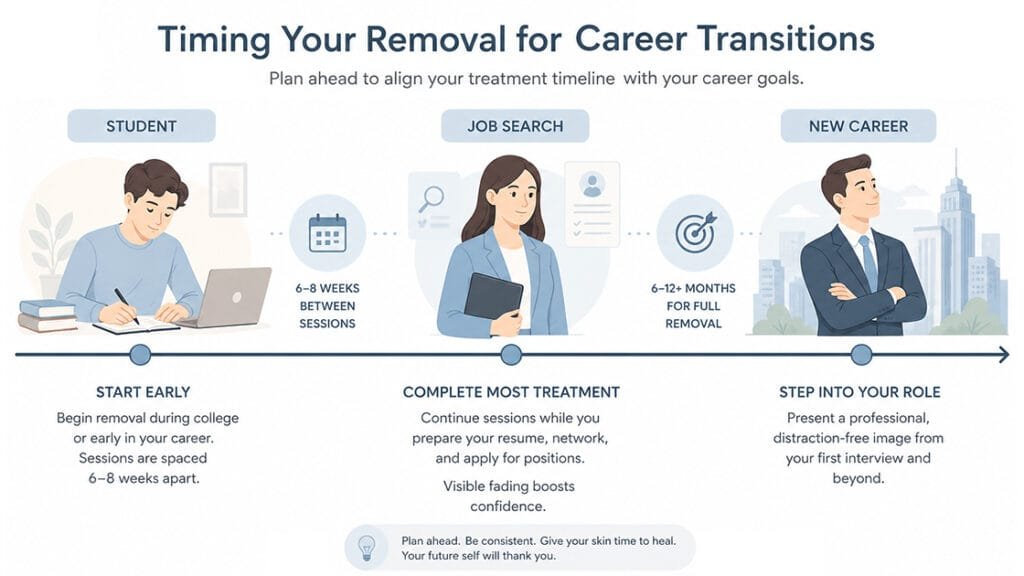
If you are planning a career transition into a client-facing field, start the removal process early. Since sessions are spaced six to eight weeks apart, full removal may take six months to over a year, depending on your tattoo’s characteristics. By planning ahead, you can complete the majority of your treatment before you begin actively job searching. This timeline allows you to present a professional, distraction-free appearance from your very first interview. For recent graduates entering the job market, starting removal during your final year of college can align perfectly with graduation and job search timelines.
5. Practical Advice for Young Professionals
5.1 Do Your Research Before Getting Inked
For college students and young adults not yet committed to a career path, careful tattoo placement can save significant time and money later. If you choose to get a tattoo, consider placing it in an area that standard business attire can easily cover—such as the torso, upper back, or upper thigh. Avoiding highly visible locations like the hands, neck, face, wrists, and lower legs preserves your flexibility to pursue any career path without the need for removal. This simple precaution gives you the freedom to enjoy body art now while keeping all professional options open for the future.
5.2 Professional Resources for Removal
When you decide to pursue removal, choose a reputable clinic with board-certified dermatologists or licensed laser technicians. Avoid basing your decision solely on cost or convenience—inexperienced providers using the wrong laser settings can cause burns, scarring, or incomplete removal. Look for clinics that use advanced Pico laser technology, offer transparent pricing, and provide detailed pre-treatment and post-treatment care instructions. A professional consultation will give you a clear understanding of the expected timeline, number of sessions, and total cost before you commit.
5.3 The Confidence Factor
Beyond the practical career benefits, tattoo removal offers a powerful psychological advantage. Removing a visible tattoo that causes you anxiety during interviews eliminates one major source of stress. Without the distraction of worrying whether your tattoo is showing, you can present your best self—confident, focused, and fully present. Employers respond to confidence. When you believe in your own qualifications and present yourself without hesitation, that assurance translates into a more compelling interview presence. Many professionals who have undergone removal report that the procedure not only advanced their careers but also lifted a heavy emotional burden they had carried for years.
FAQ
Q: How many laser sessions will I need to remove a visible tattoo?
A: Most tattoos require 3 to 10 sessions spaced 6 to 8 weeks apart. Darker inks like black and blue typically clear faster than lighter colors.
Q: Does laser tattoo removal hurt?
A: Most patients describe the sensation as similar to a rubber band snapping against the skin—uncomfortable but tolerable. Topical numbing cream is often available.
Q: Will laser removal leave a scar on my skin?
A: When performed by a trained professional using appropriate laser settings, Pico laser removal typically does not leave permanent scars. Proper aftercare is essential.
Q: How much does professional laser tattoo removal cost?
A: Costs vary widely based on tattoo size, ink colors, location, and number of sessions. Many clinics offer package pricing for full removal.
Q: Can I start the removal process while I’m still job searching?
A: Yes. Starting early allows you to make progress on fading while you look for opportunities. Many professionals begin removal several months before actively applying.
Conclusion
For young professionals entering client-facing roles, visible tattoos represent an obstacle that your skills and experience should not have to overcome. While workplace attitudes are slowly evolving, hiring bias based on visible body art remains a reality in finance, law, healthcare, education, and many other industries. Laser tattoo removal—particularly advanced Pico technology—offers a safe, effective, and increasingly accessible path to eliminating this barrier. By removing visible ink, you free yourself from the constant worry about coverage and judgment, allowing your qualifications to speak for themselves. The decision to remove a tattoo is not about erasing your past or denying your identity. It is about choosing the career path you want and presenting the professional image that opens those doors. Your resume tells employers what you can do. Removing visible ink ensures that they hear that message loud and clear.
References
Oggitalent. (2025). Tattoos in the Workplace: Breaking the Stigma or Drawing the Line?
https://oggitalent.com/tattoos-in-the-workplace/
Winter Park Tattoo Removal. (2025). Are Tattoos Professional? Career Impact & Tattoo Removal Insights.
https://winterparktattooremoval.com/tattoos-and-workplace-stigma/
Winter Park Tattoo Removal. (2025). Tattoo Discrimination in the Workplace.
https://winterparktattooremoval.com/tattoo-discrimination-in-the-workplace/
Security Boulevard. (2025). Tattoos in the Professional World: Leadership, Authenticity, and the Modern Workplace.
Streetdirectory.com. Professional Interviewing: Tattoos and Career Success.
http://origin.streetdirectory.com/etoday/print_article.php?articleId=pjwjja
Winkonlaser. (2025). The Professional‘s Guide: Essential Features in a Picosecond Laser Tattoo Removal Machine.
RheinLasers. (2025). Can Pico Lasers Completely Remove a Tattoo?
https://www.rheinlasers.com/can-pico-lasers-completely-remove-a-tattoo.html
RheinLasers. (2025). Common Tattoo Removal Mistakes and How to Avoid Them.
https://www.rheinlasers.com/common-tattoo-removal-mistakes.html