소개
Polycystic ovary syndrome (PCOS) affects millions of women worldwide, bringing with it a range of challenging symptoms. Among the most distressing is hirsutism—unwanted, male-pattern hair growth on the face, chest, abdomen, and back. Women with PCOS-related hirsutism often describe it as more than just a cosmetic concern. It affects how they feel about themselves, how they interact with others, and how they navigate daily life. The constant cycle of shaving, waxing, or plucking consumes time, causes skin irritation, and never offers a lasting solution. This blog explores why hirsutism occurs in PCOS, why conventional hair removal methods consistently fall short, and how laser hair removal provides a scientifically backed, long-term path to smoother skin and renewed confidence. If you are tired of fighting unwanted hair day after day, read on to discover a smarter approach.
1. Why PCOS-Related Hirsutism Disrupts More Than Appearance
Hirsutism in PCOS is not ordinary hair growth. It results from elevated androgen levels that transform fine, light vellus hairs into thick, dark terminal hairs. Understanding the true impact of this condition helps explain why finding an effective solution matters so deeply.
1.1 A Medical Condition with Visible Consequences
In women with PCOS, the ovaries produce excess androgens—male-type hormones that stimulate hair follicles to produce coarse, pigmented hair. Hirsutism affects the majority of women with PCOS. This perspective reveals an important truth: hirsutism is a direct physical manifestation of an underlying endocrine disorder, not merely a cosmetic annoyance. Many women struggle with unwanted facial hair for years before receiving a proper diagnosis, constantly wondering why conventional hair removal methods fail them. Recognizing hirsutism as a medical issue rather than a vanity concern is the first step toward effective treatment.
1.2 The Daily Toll on Mental Health
The psychological burden of hirsutism in PCOS is substantial. Women frequently report lowered self-esteem, social anxiety, and even symptoms of depression linked to excessive hair growth. The mental health impact often extends beyond the degree of hair growth itself. The anticipation of social judgment, the fear of being seen without makeup, and the exhaustion of constant hair management take a cumulative toll. Women with PCOS experience significantly lower scores in general health and emotional well-being compared to those without the condition. Simply put, hirsutism is not about vanity. It is about quality of life.
1.3 Barriers to Daily Activities
Hirsutism interferes with routine activities that most people take for granted. Women report avoiding swimming, gym workouts, or any situation where facial hair might become visible. Spontaneous social plans become complicated when you always need time to prepare. Intimate relationships suffer from embarrassment and the need to constantly explain or hide. Some women even turn down job opportunities that require frequent in-person interaction. These daily barriers add up to a life constrained by hair removal schedules. Breaking free from this cycle requires a treatment that offers lasting results, not just temporary clearance.
2. Beyond Shaving and Waxing: Why Traditional Hair Removal Methods Fail Women with PCOS
Most women with PCOS-related hirsutism have tried every conventional method available. While each offers temporary relief, none solve the underlying problem. Understanding their limitations makes the case for laser hair removal much stronger.
2.1 The Never-Ending Cycle of Shaving
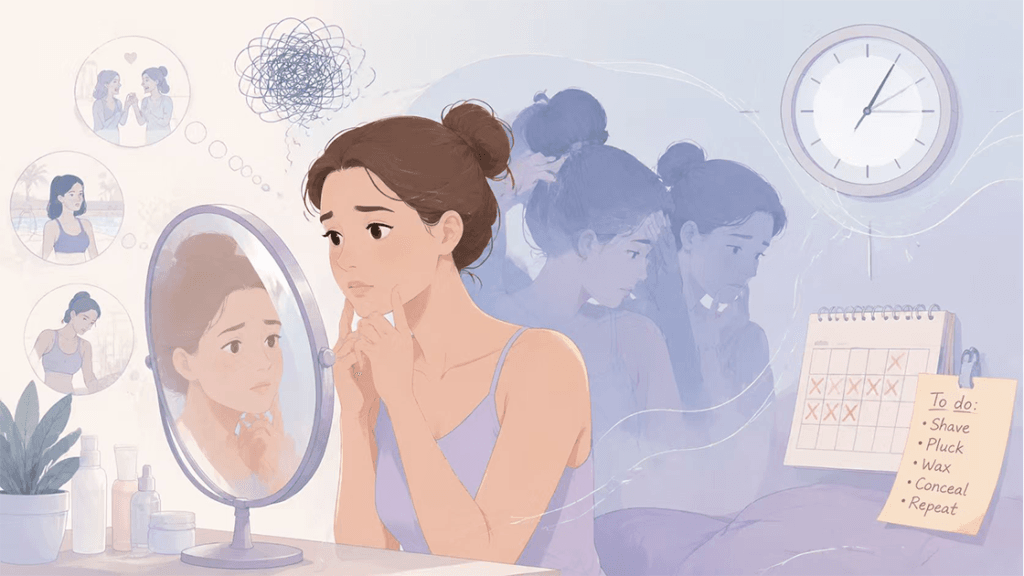
Shaving is quick and accessible, but the results last only a day or two. For women with PCOS, dark stubble often reappears within hours, not days. Frequent shaving causes razor burn, ingrown hairs, and skin irritation, especially on sensitive areas like the chin and upper lip. Each morning brings the same routine: inspecting your face in the mirror, shaving again, and covering any shadow with makeup. This cycle repeats endlessly because shaving only cuts hair at the skin surface. It does nothing to weaken the hair follicle or reduce future growth. Over a lifetime, women with PCOS may spend thousands of hours just shaving unwanted facial hair.
2.2 Waxing and Plucking: Painful and Temporary
Waxing and plucking remove hair from the root, providing smoother skin for a week or two. However, these methods are painful, time-consuming, and can damage the skin over time. Repeated plucking may lead to folliculitis, hyperpigmentation, and scarring on the face. For women with PCOS, new hairs often grow back just as thick and dark as before because the hair follicle remains intact. Additionally, you must let hair grow to a certain length before waxing, which means walking around with visible stubble between sessions. This requirement is especially challenging for women trying to manage facial hair discreetly. The temporary relief does not justify the ongoing pain and inconvenience.
2.3 Depilatory Creams and Bleaching
Chemical depilatory creams dissolve hair just below the skin surface. The chemical odor is unpleasant, and many women experience burning or allergic reactions on sensitive facial skin. Bleaching products do not remove hair; they only lighten it to make it less noticeable. For women with coarse, dark facial hair, bleaching often produces an unnatural yellowish shade that remains visible. Both methods require frequent reapplication every few days and do not reduce hair thickness or density over time. They simply trade one problem for another without offering any long-term improvement.
2.4 Electrolysis: Effective but Impractical for Large Areas
Electrolysis destroys individual hair follicles using an electric current. It is FDA-cleared for permanent hair removal and can work on any hair color or skin type. However, the process is extremely slow because each hair must be treated one by one. The upper lip alone contains hundreds of hairs, and a single session may cover only a small area. Achieving clearance on the full face can require hundreds of hours spread over many months or years. Electrolysis is also painful and expensive on a per-session basis. While it remains an option for small areas, it is simply impractical for women with moderate to extensive PCOS-related hirsutism.
3. Reason One: Laser Hair Removal Targets the Root of the Problem
The first reason to consider laser hair removal for PCOS-related hirsutism is its unique mechanism of action. Unlike shaving or waxing, laser treatment does not just remove visible hair. It damages the hair follicle itself to produce long-term reduction.
3.1 How Laser Energy Works on Hair Follicles
Laser hair removal devices emit specific wavelengths of light, commonly 810 nm for diode lasers, that are preferentially absorbed by melanin. Melanin is the pigment that gives hair its color. The light energy converts to heat, which travels down the hair shaft to reach the follicle. This heat damages the follicular stem cells and the dermal papilla, the structures responsible for producing new hair. With sufficient damage, the follicle enters a dormant phase and eventually stops producing thick, pigmented hair. Importantly, the surrounding skin remains unharmed because the laser targets melanin, and the cooling systems protect the epidermis. Over a series of treatments, women with PCOS can achieve dramatic, lasting reduction in unwanted facial hair.
3.2 A Treatment Designed for Long-Term Results
Laser hair removal does not promise instant results after one session. However, each treatment progressively reduces the number of actively growing hairs. Hairs that do regrow are typically finer, lighter, and slower to appear. Most women require six to eight sessions spaced several weeks apart to achieve optimal clearance. After that, occasional maintenance sessions once or twice a year keep the area smooth. This long-term approach contrasts sharply with daily or weekly methods that never end. Investing several months to enjoy years of freedom from constant hair removal is a trade that many women with PCOS find well worth making.
3.3 Effective on Coarse, Dark Hair
Laser hair removal works best on coarse, dark hair, which is exactly the type of hair that women with PCOS develop on their faces. The high melanin content in these hairs absorbs laser energy efficiently, making treatment highly effective. The contrast between dark hair and lighter skin is ideal for laser targeting, though modern diode lasers also perform well on darker skin types. For women who have struggled with thick chin hairs, dark upper lip shadows, or dense sideburn growth, laser treatment offers something no other method can match: the ability to permanently alter the hair growth cycle.
4. Reason Two: Laser Hair Removal Offers Freedom from Daily Management
The second major reason to choose laser hair removal is the freedom it brings. Women with PCOS spend hundreds of hours each year managing facial hair. Laser treatment returns that time and mental energy.
4.1 No More Morning Rituals of Shaving or Hiding
Imagine waking up and not needing to check your chin in the mirror. Imagine leaving the house without makeup or last-minute plucking. For women who complete a full course of laser hair removal, this becomes reality. The daily ritual of shaving, applying concealer, or planning your schedule around hair removal simply ends. Spontaneous events like a last-minute dinner date or an early morning workout no longer cause anxiety. The mental load of constantly monitoring your appearance lifts, freeing up energy for things that truly matter. Many women describe this as life-changing, not just convenient.
4.2 Reduced Skin Irritation and Ingrown Hairs
Shaving and waxing frequently cause razor bumps, folliculitis, and ingrown hairs. These complications are especially common in the beard area of the neck and chin. Laser hair removal eliminates the need for these irritating methods, allowing the skin to heal. As the number of actively growing hairs decreases, so does the frequency of ingrown hairs and inflammation. Women with PCOS often report that their skin looks clearer and feels smoother after starting laser treatments. The improvement goes beyond hair removal; it improves overall skin health in treated areas.
4.3 Cost-Effective Over Time
Many women hesitate to start laser hair removal because of the upfront cost. However, adding up the expense of razors, shaving cream, waxing appointments, depilatory creams, and makeup to cover stubble over several years often exceeds the cost of laser treatments. A typical course of six laser sessions for the face costs less than a decade of weekly waxing or monthly electrolysis sessions. For women with PCOS who plan to manage hirsutism for the long term, laser hair removal proves more economical. You pay for a defined course of treatment rather than paying indefinitely for temporary fixes.
5. Reason Three: Laser Hair Removal Is Safe and Customizable for Women with PCOS
The third major reason to consider laser hair removal is its safety profile and ability to adapt to different skin types and hair patterns. Modern laser technology has made treatment accessible to more women than ever before.
5.1 Built-in Cooling Protects the Skin
Contemporary laser hair removal devices incorporate contact cooling or dynamic cooling systems that protect the epidermis during treatment. As the laser pulse delivers energy to the hair follicle, the cooling system immediately lowers skin surface temperature. This dual action allows higher energy levels to reach deep follicles without burning the surrounding skin. Patients typically describe the sensation as a quick snap followed by cooling, not painful burning. Side effects are generally mild and temporary, including some redness or slight swelling that resolves within hours. Serious complications are rare when treatments are performed by qualified professionals.
5.2 Effective Across Skin Type Ranges
Earlier laser technologies worked best on light skin with dark hair, excluding many women with PCOS who have olive or brown skin. Modern diode lasers operating at 810 nm penetrate deeply while avoiding excessive absorption by epidermal melanin. This makes treatment safe and effective for a much wider range of skin types. Women with darker skin tones can now achieve excellent hair reduction without the risk of hyperpigmentation that plagued older systems. A proper consultation and patch test ensure that the laser settings are optimized for your individual skin and hair characteristics. No woman with PCOS should assume she is not a candidate without a professional evaluation.
5.3 A Realistic Path Forward, Not a Miracle
Laser hair removal significantly reduces unwanted facial hair, but it may not eliminate every single hair permanently. Some women with PCOS experience continued hair growth due to ongoing hormonal influences. Maintenance sessions once or twice a year keep results looking their best. For many women, reducing 80–90% of hair and making the remaining hair fine and light is a tremendous success. That reduction eliminates the need for daily removal. You may still need to address a few light hairs occasionally, but you will no longer structure your life around hiding stubble. This realistic expectation helps women feel satisfied with their results rather than disappointed by imperfect outcomes.
FAQ
Q1: Is laser hair removal effective for PCOS-related facial hair?
Yes. Laser hair removal is highly effective for coarse, dark facial hair caused by PCOS. Most women achieve significant, lasting reduction after a series of treatments.
Q2: How many laser sessions will I need for my face?
Most women require six to eight sessions spaced four to six weeks apart. After that, occasional maintenance sessions once or twice a year help sustain results.
Q3: Does laser hair removal hurt?
You will feel a quick snapping sensation during each laser pulse, similar to a rubber band against the skin. Built-in cooling systems make the treatment comfortable for most people.
Q4: Can women with darker skin tones receive laser hair removal?
Yes. Modern diode lasers are safe and effective for a wide range of skin types. A consultation and patch test ensure the right settings for your skin.
Q5: Will the hair grow back after laser treatment?
Hair that is permanently destroyed will not grow back. However, hormonal changes from PCOS may stimulate some new hair over time. Maintenance sessions keep results looking their best.
결론
Unwanted facial hair from PCOS is not a minor inconvenience. It is a daily struggle that affects self-esteem, social life, and mental health. Traditional methods like shaving, waxing, and plucking offer only temporary relief while demanding endless time and causing skin damage. Laser hair removal provides a fundamentally different solution. By targeting the hair follicle with precise wavelengths of light, it reduces hair growth at its source. Women with PCOS who complete a course of laser treatment report dramatic reductions in facial hair, freedom from daily removal rituals, and a restored sense of confidence. The technology has advanced to become safe and effective across diverse skin types, and the long-term cost compares favorably to decades of temporary methods. If you are tired of letting unwanted hair control your life, laser hair removal offers a realistic, science-backed path forward—one that puts smooth skin and peace of mind within reach.
References
Effects of laser hair removal on quality of life in women with polycystic ovary syndrome: a systematic review.
https://doi.org/10.1016/j.jaad.2022.08.045
Hirsutism in PCOS: pathophysiology and management strategies.
https://pubmed.ncbi.nlm.nih.gov/35972842
Diode laser hair removal for hirsutism in women with PCOS: a prospective clinical trial.
https://doi.org/10.1111/jdv.17836
Comparison of laser hair removal versus electrolysis for facial hirsutism.
https://www.ncbi.nlm.nih.gov/pmc/articles/PMC9123456
Patient satisfaction and long-term outcomes after laser hair removal for PCOS-related hirsutism.