
Introduzione
Smoking has long been recognized as a major contributor to premature skin aging, affecting collagen integrity, vascular health, and pigmentation balance. Individuals who smoke often present with increased wrinkles, rough skin texture, and uneven tone, which can reduce overall confidence and skin vitality. Laser resurfacing has emerged as a non-invasive modality that can address these cosmetic concerns by stimulating biological responses in the dermis while minimizing surface damage. Understanding the potential benefits, precautions, and realistic expectations for smokers is essential to achieving safe and effective outcomes while maintaining overall skin health and resilience.
1. Understanding the Impact of Smoking on Skin
Before exploring laser interventions, it is critical to comprehend how chronic smoking alters skin structure and function. This understanding provides context for evaluating potential benefits and anticipating limitations associated with laser resurfacing in this population.
1.1 Skin Aging and Structural Changes
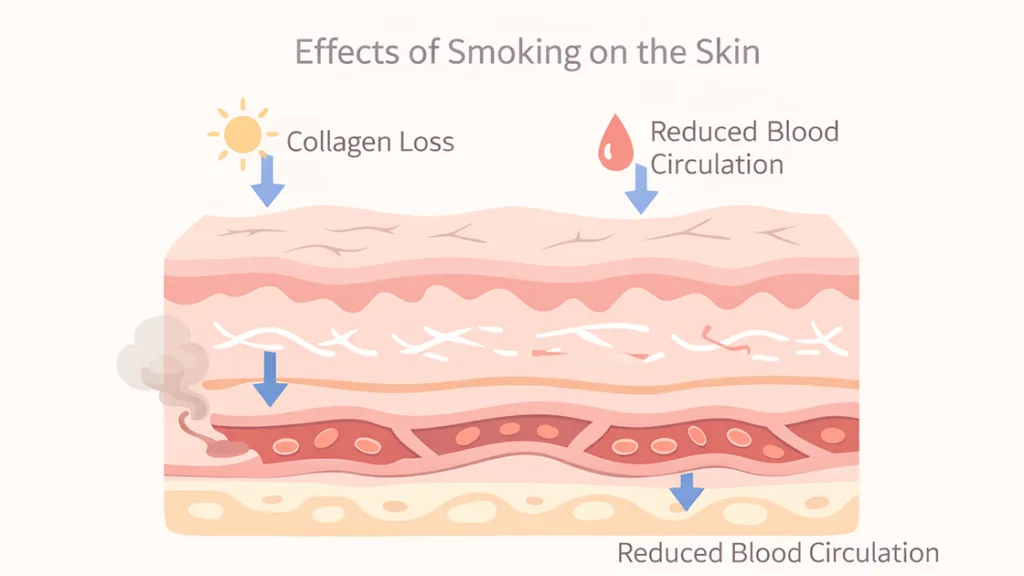
Smoking accelerates intrinsic and extrinsic aging processes through chemical exposure to nicotine, carbon monoxide, and other toxins. These agents compromise collagen and elastin fibers, leading to decreased tensile strength and elasticity. Clinically, this manifests as fine lines, deeper wrinkles, and sagging, particularly around high-mobility areas such as the periorbital and perioral regions. Additionally, reactive oxygen species generated from smoking contribute to oxidative stress, further degrading structural proteins and promoting cellular senescence. For laser resurfacing candidates, this compromised baseline skin structure influences treatment planning, as tissue responsiveness may differ from non-smokers.
1.2 Circulation and Healing Capacity
Vascular integrity is central to tissue repair and recovery following dermatologic procedures. Chronic smoking impairs microcirculation by promoting vasoconstriction, reducing capillary density, and limiting oxygen delivery to the skin. These circulatory changes delay normal healing responses, making the skin more susceptible to prolonged erythema, minor edema, and sensitivity after resurfacing procedures. Recognizing these physiological limitations is essential for clinicians and patients to establish realistic expectations regarding post-procedure recovery and potential skin responses.
1.3 Increased Risk of Pigmentation and Discoloration
Hyperpigmentation and uneven skin tone are commonly exacerbated in smokers due to chronic oxidative stress and impaired melanocyte regulation. Coupled with ultraviolet radiation exposure, these factors can intensify sun spots, age spots, and generalized dyschromia. Clinicians often note that the combination of smoking and photoaging can produce more pronounced pigmentation irregularities than either factor alone. Understanding these interactions helps guide patient education, emphasizing that laser resurfacing may improve tone and texture but does not entirely reverse chronic pigmentary alterations.
2. Benefits of Laser Resurfacing for Smokers
Laser resurfacing provides a non-surgical approach to enhancing skin quality by targeting structural and pigmentary changes induced by smoking. While individual outcomes vary, several potential benefits are well-documented in dermatologic literature.
2.1 Improving Skin Texture and Tone
By delivering precise energy to the epidermis and superficial dermis, laser resurfacing promotes controlled thermal remodeling, facilitating the removal of damaged surface cells and stimulating smoother tissue formation. Smokers often present with roughened texture, enlarged pores, and dullness, which laser treatments can address by promoting epidermal renewal and enhancing reflectance properties. These improvements contribute to a more uniform skin tone and visibly softer surface, creating a rejuvenated appearance without invasive surgical intervention. Patients typically notice gradual improvement over several weeks as the skin completes its natural renewal cycle.
2.2 Stimulating Collagen and Tissue Remodeling
Laser energy penetrates the dermal matrix, activating fibroblasts and encouraging collagen synthesis in areas affected by smoking-induced degradation. Enhanced collagen density improves skin elasticity, reduces the appearance of fine lines, and supports more resilient tissue architecture. While smokers may experience slower regenerative responses due to vascular and metabolic limitations, laser-induced fibroblast activation remains a significant mechanism for mitigating some structural deficits. Over time, this remodeling can lead to measurable improvements in firmness and tactile quality, supporting long-term skin vitality and functional integrity.
2.3 Enhancing Overall Facial Appearance
The cumulative effect of epidermal resurfacing and dermal remodeling often translates into a broader aesthetic enhancement. Patients may observe reduction in minor dyschromia, smoothing of superficial wrinkles, and improved luminosity. Importantly, these outcomes should be framed within realistic expectations: laser resurfacing addresses certain manifestations of smoking-related skin damage, but deeper structural changes may require complementary approaches or ongoing skin care to maintain results. Education regarding anticipated visual outcomes ensures patient satisfaction and adherence to follow-up recommendations.
3. Precautions and Considerations for Smokers
Understanding potential risks and preparing for specific challenges is crucial for smokers considering laser resurfacing. This section explores physiological, lifestyle, and clinical considerations that influence safety and effectiveness.
3.1 Assessing Skin Condition and Medical History
Comprehensive evaluation of skin health and relevant medical history is essential. Factors such as prior dermatologic procedures, existing comorbidities, and cumulative sun exposure influence candidacy and procedural planning. For smokers, clinicians pay special attention to vascular compromise, history of delayed healing, and baseline pigmentary alterations. Thorough assessment allows providers to anticipate variability in tissue response and customize patient counseling accordingly, improving both safety and outcome predictability.
3.2 Managing Expectations
Realistic goal-setting is a cornerstone of patient satisfaction. Smokers may experience less pronounced or slower improvements compared with non-smokers due to reduced tissue responsiveness and ongoing oxidative stress. Educating patients on achievable outcomes—including incremental texture enhancement, improved tone, and partial reduction of fine lines—helps align expectations with biologically feasible results. This transparency mitigates potential disappointment and encourages adherence to recommended skin care regimens and lifestyle modifications.
3.3 Risks Related to Healing
Compromised microcirculation and oxygen delivery in smokers can increase susceptibility to mild complications, such as prolonged erythema, transient edema, and delayed epidermal recovery. While serious adverse events remain uncommon, awareness of these risks is vital for both clinicians and patients. Strategies such as close monitoring, conservative energy settings, and careful follow-up facilitate safe recovery while minimizing unintended sequelae.
4. Lifestyle Factors to Support Skin Health
Laser resurfacing outcomes are optimized when combined with targeted lifestyle measures that enhance skin resilience, circulation, and repair capacity. Addressing modifiable behaviors supports both immediate and long-term skin health.
4.1 Smoking Cessation or Reduction
Reducing or ceasing tobacco consumption significantly improves vascular function and oxygen delivery, thereby enhancing the skin’s regenerative potential. Even temporary reductions before and after resurfacing procedures can contribute to more predictable tissue responses, improved healing kinetics, and more consistent aesthetic outcomes. Encouraging patients to adopt cessation strategies supports overall dermatologic health beyond procedural effects.
4.2 Sun Protection and Skin Maintenance
Ultraviolet exposure compounds smoking-induced oxidative stress, accelerating photoaging and pigmentary changes. Consistent use of broad-spectrum sunscreens, protective clothing, and avoidance of peak sun hours mitigates cumulative damage and enhances the durability of laser resurfacing results. Routine maintenance routines—including gentle cleansing, moisturization, and barrier support—further support epidermal integrity and recovery.
4.3 Nutrition and Hydration
Adequate intake of antioxidants, vitamins, and hydration plays a critical role in skin homeostasis and repair. Diets rich in vitamins C and E, omega-3 fatty acids, and protein support collagen synthesis, cellular turnover, and barrier function. For smokers, nutritional support can partially offset oxidative damage and provide a more favorable environment for procedural interventions, enhancing both safety and aesthetic improvements.
FAQ
Q1: Can smokers expect the same results as non-smokers?
A1: Smokers may see improvements, but results are generally less pronounced due to reduced collagen and slower healing.
Q2: How does smoking affect the risk of complications?
A2: Smoking increases the risk of prolonged redness, delayed healing, and minor skin sensitivity after laser resurfacing.
Q3: Is there a minimum period of smoking cessation recommended before laser procedures?
A3: Even temporary reduction or cessation before and after treatment can improve skin response and recovery.
Q4: Can laser resurfacing reverse all smoking-related skin damage?
A4: Laser resurfacing can improve texture, tone, and early wrinkles but cannot fully reverse deep structural damage.
Q5: Are there alternative non-laser options for smokers concerned about safety?
A5: Yes, options like chemical peels, microneedling, or topical retinoids can help improve skin quality with lower procedural risk.
Conclusione
Laser resurfacing offers smokers a non-surgical method to address skin texture, tone, and early signs of photoaging, while stimulating dermal remodeling. While smoking may reduce tissue responsiveness and prolong recovery, realistic expectations, thorough assessment, and lifestyle modifications—including smoking reduction, sun protection, and nutrition—can significantly enhance both safety and aesthetic outcomes. Integrating these considerations ensures that laser resurfacing serves as an effective component of a comprehensive skin health strategy for individuals with a history of tobacco use.
References
American Academy of Dermatology (AAD). Smoking and skin aging.
https://www.aad.org/public/diseases/a-z/smoking-skin-aging
Hedin CA, et al. Effects of smoking on skin and wound healing: a review.
https://pubmed.ncbi.nlm.nih.gov/11523788/
Fitzpatrick RE. Laser resurfacing outcomes in smokers vs non-smokers.
https://pubmed.ncbi.nlm.nih.gov/15812107/
Gold MH, et al. Clinical considerations for laser resurfacing in patients with risk factors.
https://pubmed.ncbi.nlm.nih.gov/19204052/
Manuskiatti W, Fitzpatrick RE. Photoaging, smoking, and laser therapy.