
Introducción
Cosplay brings fictional characters to life through detailed costumes, carefully styled wigs, makeup, and accessories. For many cosplayers, achieving the right look also involves preparing visible areas of skin. Facial hair, leg hair, underarm hair, or hair around the neckline may affect how a costume looks under bright convention lighting or in professional photographs. Shaving and waxing can provide temporary results, but frequent hair removal may also cause razor bumps, irritation, or ingrown hairs. Laser hair removal offers another option for people who want to reduce unwanted hair over time. However, it requires advance planning rather than a last-minute appointment before an event. Understanding treatment schedules, skin preparation, and professional laser technology can help cosplayers make informed decisions about their grooming routines.
1. Understanding Hair Removal Needs in Cosplay
1.1 Why Smooth Skin Matters for Detailed Costumes
Cosplay costumes often expose specific areas of the body, including the legs, arms, shoulders, chest, and neckline. Some characters also require a clean-shaven face or a carefully defined hairline to achieve a particular appearance.
The amount of visible hair that matters depends on the costume design and personal preference. For example, a fantasy character may require exposed shoulders, while an armored character may need only a small area of visible skin around the neck. Identifying these areas early helps cosplayers decide whether hair removal is necessary and which method best fits their needs.
1.2 The Challenges of Repeated Shaving and Waxing
Shaving is convenient because it removes hair at the skin’s surface. However, the results are temporary, so the routine may need to be repeated every few days, depending on individual hair growth. Repeated shaving can contribute to razor burn, small cuts, and ingrown hairs.
Waxing removes hair from the root and generally lasts longer than shaving, but it can cause temporary redness and irritation. Both methods may be inconvenient when several costume changes are planned over a weekend.
Laser hair removal works differently by targeting pigment in the hair follicle to reduce future hair growth. It is not an instant replacement for shaving, and multiple sessions are usually needed. Nevertheless, it may be worth considering for cosplayers who want to reduce the amount of ongoing grooming required.
1.3 Matching Hair Removal to Your Character Design
Before choosing a treatment, consider the areas exposed by your most frequently worn costumes. A sleeveless costume may make underarm and arm hair more noticeable, while a character with a high-cut outfit may place greater emphasis on leg hair.
It is also useful to distinguish between areas that need long-term hair reduction and areas that require only occasional grooming. Laser treatment is generally more practical for selected areas where hair reduction is desired over time. For small areas or light-colored hair that does not respond well to laser treatment, other hair removal methods may be more appropriate.
2. Cómo funciona la depilación láser
2.1 The Role of Diode Laser Technology
Professional diode laser hair removal uses concentrated light that is absorbed by pigment in the hair. The resulting heat affects structures involved in hair growth, helping reduce future growth in the treated area.
The technology is designed to target hair follicles while limiting unnecessary heating of surrounding skin. However, results depend on several factors, including hair color, hair thickness, skin tone, the treatment area, and the stage of the hair growth cycle.
Professional diode laser systems commonly use wavelengths selected for hair reduction. An 810 nm wavelength is one established option in this field. Appropriate settings must still be selected for each person, and no single wavelength or treatment protocol is ideal for everyone.
2.2 Why Multiple Sessions Are Necessary
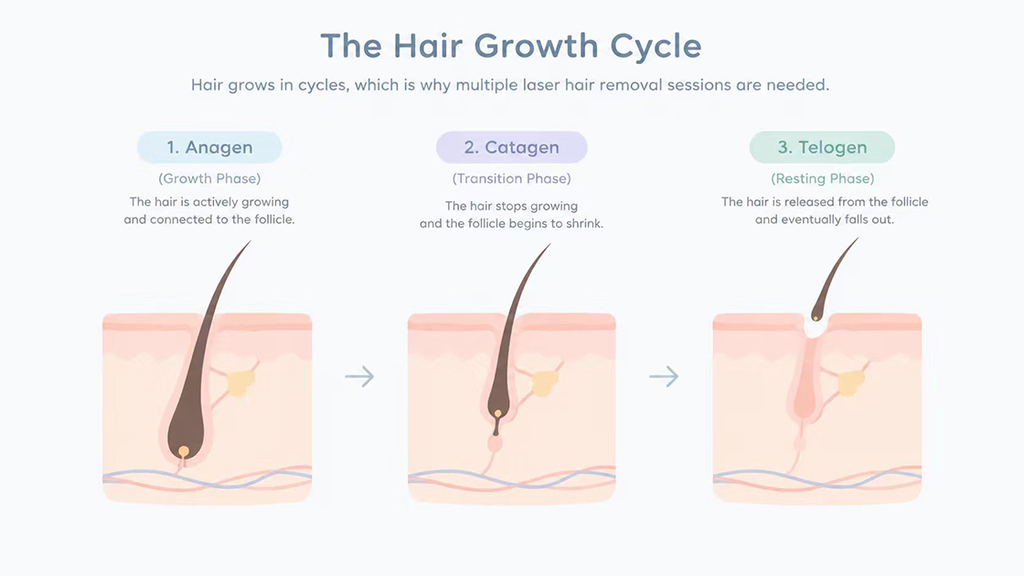
Hair does not grow uniformly. Follicles move through different growth stages, and laser hair removal is most effective when the targeted hairs are in a suitable stage for treatment.
As a result, one appointment is not usually enough to achieve the desired reduction. A series of sessions spaced according to professional recommendations is typically required. Maintenance treatments may also be appropriate when some hair regrows.
For cosplayers, this means laser hair removal should be viewed as a longer-term grooming strategy. Starting well before a major convention gives a practitioner time to assess progress and adjust the treatment schedule when necessary.
2.3 The Importance of Skin Cooling
Laser hair removal involves delivering energy to hair follicles, so managing the skin’s response is an important part of professional treatment. Some diode laser systems incorporate contact cooling to help cool the skin during treatment.
For example, sapphire contact cooling is a feature used in certain professional systems. It is designed to support skin comfort and help manage surface heating during treatment. Its presence does not eliminate the possibility of side effects, and appropriate treatment settings remain essential.
Cosplayers should ask their provider about the device’s cooling method, how skin response is monitored, and what measures are used to protect the treatment area. These details are particularly relevant when treating visible areas that will be featured in costume photography.
3. Planning Laser Hair Removal Around Convention Dates
3.1 Start Planning Before the Event Calendar Fills Up
One of the most common planning mistakes is scheduling laser hair removal shortly before a convention. Although many people return to normal activities soon after treatment, temporary redness, swelling, or sensitivity can occur.
A better approach is to begin with a professional consultation well ahead of the event. The provider can assess the intended treatment areas, explain the expected number of sessions, and recommend suitable intervals between appointments.
There is no universal schedule that guarantees a particular result by a specific convention date. Hair growth, skin response, and individual treatment plans vary. Cosplayers should therefore avoid relying on a single last-minute session to produce a completely hair-free appearance.
3.2 Coordinate Treatments With Costumes and Photoshoots
A convention weekend may include costume previews, studio photography, outdoor shoots, and several outfit changes. Planning treatments around these activities can help reduce scheduling conflicts.
If a costume exposes the legs or shoulders, those areas may deserve attention well before the event. Facial treatment may require additional consideration because the skin can be more visible in close-up photography.
It is also important to leave adequate time for the skin to settle after each session. Follow the treating professional’s instructions rather than assuming that all treatment areas will recover at the same rate. If a major photoshoot is approaching, ask the provider whether the proposed appointment timing is appropriate.
3.3 Avoid Last-Minute Tanning and Skin Experiments
Convention preparation sometimes includes outdoor travel, beach visits, tanning products, body makeup, and new skincare routines. These activities can complicate laser treatment planning.
Recent tanning may increase the risk of unwanted skin reactions, depending on the treatment system and individual skin characteristics. The American Academy of Dermatology advises patients to avoid tanning and use broad-spectrum sunscreen before laser hair removal.
Cosplayers should tell their provider about recent sun exposure, tanning products, medications, and any history of skin reactions. It is also wise to avoid introducing unfamiliar exfoliants or potentially irritating products immediately before treatment without professional guidance.
4. Preparing Different Areas for Cosplay
4.1 Legs, Arms, and Underarms
Legs, arms, and underarms are common areas of concern when costumes reveal more skin. Because these areas can differ in hair thickness, skin sensitivity, and exposure to sunlight, treatment planning should be individualized.
Before a session, follow the provider’s instructions about shaving and skin care. Laser treatment generally requires the visible hair to be managed in a specific way, while waxing and plucking may interfere with the treatment process because they remove the hair from the follicle.
After treatment, protect exposed skin from direct sunlight and follow the recommended aftercare routine. This is particularly important for cosplayers attending outdoor events or traveling between venues.
4.2 Facial Hair and Character Makeup
Some cosplay looks rely on a smooth facial appearance, especially when makeup, prosthetics, or detailed character shading are involved. Frequent shaving can sometimes contribute to irritation, making facial hair management a recurring concern.
Laser hair removal may reduce unwanted facial hair for suitable candidates, but facial treatment requires careful assessment. Hormonal factors can influence facial hair growth, and results may differ from those achieved on other body areas.
Laser treatment can also affect the skin temporarily. Therefore, it is important not to schedule an unfamiliar treatment immediately before a convention or an elaborate makeup session. Discuss the intended character look and event dates with a qualified provider before creating a treatment plan.
4.3 Necklines, Backs, and Other Costume-Specific Areas
Some costumes expose the back, shoulders, chest, or neckline. These areas can be difficult to manage with shaving alone, particularly when the costume has an open back or intricate cutouts.
A useful first step is to review the costume itself. Identify which areas will actually be visible, then discuss whether laser hair removal is appropriate for those locations. Treating every area is not necessary when only a few sections affect the final appearance.
Skin sensitivity, hair characteristics, and sun exposure should all be considered. Areas that are frequently exposed outdoors may need additional planning to avoid treatment conflicts with travel and convention activities.
5. Building a Long-Term Hair Removal Plan
5.1 Choose a Qualified Provider and Suitable Technology
Professional laser hair removal requires more than selecting a device based on its wavelength or cooling features. The provider must understand skin anatomy, hair growth, treatment parameters, and the potential risks associated with different skin types.
During a consultation, ask how the provider evaluates skin tone and hair characteristics, what results are realistic, and how many sessions may be needed. Discuss any history of scarring, recent tanning, medications, or skin conditions that could affect treatment.
Professional diode laser systems may include features such as an 810 nm wavelength, contact cooling, and treatment management tools. These are technical capabilities, not guarantees of a particular result. Appropriate clinical judgment and correct operation remain essential.
5.2 Maintain Skin Comfort Between Sessions
A thoughtful skincare routine can help support the skin during a course of laser hair removal. Use gentle cleansing and follow the provider’s instructions regarding moisturizers, exfoliating products, and sun protection.
Avoid waxing, plucking, or other hair-removal methods that conflict with the treatment plan. If temporary redness or sensitivity occurs, allow the skin to recover according to professional guidance before applying heavy body makeup or using adhesive costume products on the treated area.
If blistering, severe pain, unusual pigmentation changes, or other concerning reactions develop, contact the treating professional promptly. Do not attempt to cover up a significant skin reaction simply because a convention is approaching.
5.3 Keep Expectations Realistic
Laser hair removal is intended to provide long-term hair reduction, not necessarily complete and permanent removal of every hair. Some hair may remain, and maintenance sessions may be needed over time.
Results also vary with hair color and thickness, skin characteristics, the body area treated, and the laser system used. Very light-colored hair, including white, gray, and many blonde or red hairs, may respond poorly because it contains less of the pigment targeted by conventional hair-removal lasers.
For cosplayers, the most practical goal is to create a manageable grooming plan that fits personal preferences, costume designs, and event schedules. A realistic plan can reduce last-minute pressure without promising a perfectly smooth appearance for every convention.
Frequently Asked Questions
1. How far in advance should cosplayers start laser hair removal?
Start with a consultation well before the convention season. A full course often requires multiple sessions, and the schedule varies by person and treatment area.
2. Can one laser session remove all unwanted hair before a convention?
No. Laser hair removal usually requires a series of sessions because hair grows in different cycles. One appointment cannot guarantee complete hair removal.
3. Is diode laser hair removal suitable for every skin tone?
Different systems and wavelengths may be suitable for different skin tones, but careful assessment and appropriate settings are essential. Consult an experienced medical professional.
4. Can I shave between laser hair removal sessions?
Shaving is often permitted between sessions, but follow your provider’s specific instructions. Avoid waxing or plucking if these interfere with your treatment plan.
5. Can I wear body makeup after laser hair removal?
Wait until the skin has settled and follow your provider’s aftercare instructions. Avoid applying makeup or costume adhesives to irritated or damaged skin.
6. Does laser hair removal work on blonde or red hair?
Conventional laser hair removal often responds less effectively to blonde, red, gray, or white hair because of its lower or different pigment characteristics.
Conclusión
Cosplay preparation involves many details, from costume construction and makeup testing to photography schedules and travel arrangements. Hair removal can be another part of that process, especially when a character’s design exposes large areas of skin or requires a carefully groomed appearance. Professional laser hair removal may help reduce unwanted hair over time, but it requires multiple sessions, suitable treatment settings, and consistent aftercare. Diode laser technology, including systems that use an 810 nm wavelength and contact cooling, offers professional treatment options when selected and operated appropriately. The most effective approach is to plan early, consult a qualified provider, and coordinate treatment with the convention calendar. With realistic expectations and careful preparation, cosplayers can make more informed decisions about long-term hair management while keeping their attention on the costumes and characters they love.
References
1. Hair Removal — Professional Diode Laser Treatment Applications
https://www.rheinlasers.com/treatments/hair-removal
2. Diode Laser Hair Removal Technology and Contact Cooling
https://www.rheinlasers.com/product-list/artemis-diode-laser-hair-removal-machine
3. American Academy of Dermatology — Laser Hair Removal: Preparation
https://www.aad.org/public/cosmetic/hair-removal/laser-hair-removal-preparation
4. American Academy of Dermatology — Laser Hair Removal: Frequently Asked Questions
https://www.aad.org/public/cosmetic/hair-removal/laser-hair-removal-faqs
5. American Academy of Dermatology — Laser Hair Removal Overview
https://www.aad.org/public/cosmetic/hair-removal/laser-hair-removal-overview