Introducción
The shoulders are often exposed to sunlight during outdoor activities, warm-weather outings, and everyday routines, making them a common area for visible pigmentation changes. Small brown spots may look like freckles, sunspots, or other forms of uneven skin tone, but these marks do not always share the same cause. Age, ultraviolet (UV) exposure, genetics, and changes in melanin production can all influence how pigmentation develops. Understanding the differences between these skin concerns helps people make informed decisions about skin care and professional aesthetic options. Modern laser technologies, including picosecond laser systems, offer targeted approaches to managing certain types of benign pigmentation, although results vary according to the underlying condition, skin type, and individual response. By recognizing common pigmentation patterns and understanding the role of professional assessment, readers can take a more informed approach to maintaining a more even-looking shoulder area.
1. Freckles vs. Sunspots: What Makes Them Different?
Freckles and sunspots can appear similar at first glance, particularly on the shoulders, where sunlight frequently reaches the skin. However, they differ in their typical appearance, development, and relationship with UV exposure. Recognizing these distinctions provides a useful starting point for understanding uneven body pigmentation.
1.1 What Are Freckles?
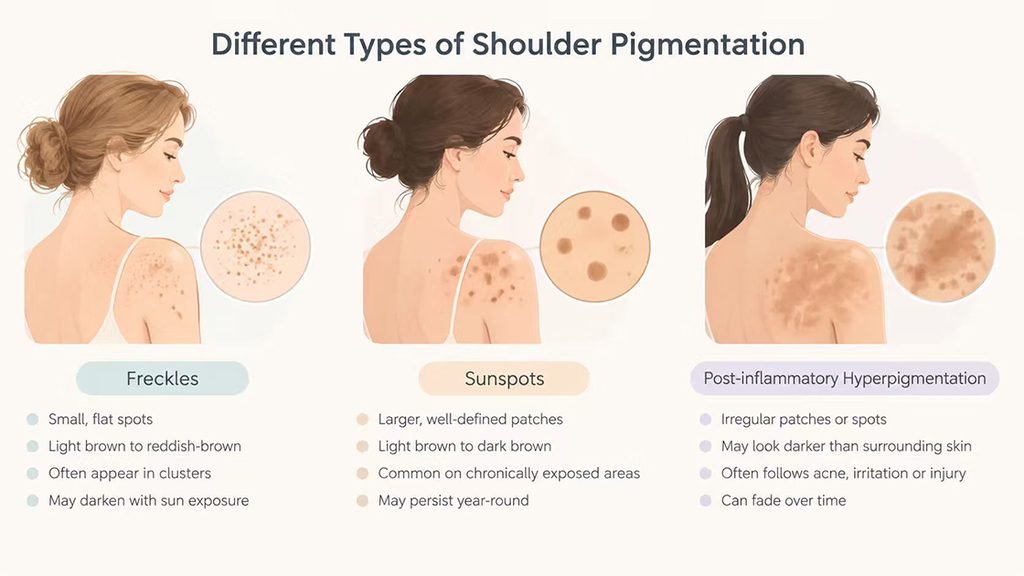
Freckles, medically known as ephelides, are small, flat, light-brown to reddish-brown spots that often develop on sun-exposed skin. Genetic factors influence their formation, and people with lighter skin tones may notice them more readily. Freckles commonly become darker during periods of increased sunlight exposure and may fade when UV exposure decreases. They generally appear in clusters rather than as isolated, larger patches.
1.2 What Are Sunspots?
Sunspots, also called solar lentigines or age spots, are flat areas of increased pigmentation associated with cumulative UV exposure. They often appear on the shoulders, upper back, arms, and other frequently exposed areas. Unlike freckles, solar lentigines tend to persist throughout the year and may become more noticeable with age. Their color ranges from light brown to dark brown, and their borders may appear more clearly defined than those of typical freckles.
1.3 Why Accurate Identification Matters
Although freckles and sunspots often look harmless, not every brown spot represents a benign pigmentation concern. Some skin conditions, including certain precancerous lesions and skin cancers, can resemble ordinary spots. A dermatologist can assess lesions that appear new, change in size or color, develop irregular borders, itch, or bleed. Correct identification matters because cosmetic laser procedures are not appropriate for every pigmented lesion, and suspicious spots require medical evaluation before any aesthetic treatment.
2. Why Do Brown Spots Develop on the Shoulders?
The shoulders receive substantial incidental sun exposure, even when people do not intentionally sunbathe. Several biological and environmental factors can contribute to pigmentation changes in this area, and more than one factor may influence the same patch of skin.
2.1 Ultraviolet Radiation and Melanin Production
Melanin is the pigment that gives skin its color and helps absorb some of the energy from UV radiation. When UV exposure stimulates melanocytes, the cells responsible for melanin production, the surrounding skin may develop a darker appearance. Repeated exposure can contribute to persistent solar lentigines and other signs of photoaging.
UVA radiation penetrates more deeply into the skin than UVB radiation, while UVB plays a major role in sunburn. Both contribute to UV-related skin damage. Because shoulders often remain uncovered during outdoor activities, they can accumulate exposure over time.
2.2 Genetics, Age, and Skin Phototype
Genetics influence how readily freckles develop, how skin responds to sunlight, and how pigmentation appears across different skin tones. Some people develop freckles early in life, while others notice more persistent sunspots as they grow older. The Fitzpatrick skin phototype classification describes how skin typically responds to UV exposure, including its tendency to burn or tan. However, this classification does not replace an individualized skin assessment.
Age-related changes can also make existing pigmentation more noticeable. Uneven skin tone does not automatically indicate a serious condition, but age alone cannot confirm that a spot is harmless.
2.3 Friction, Inflammation, and Other Contributing Factors
UV exposure is not the only possible source of uneven pigmentation. Inflammation from acne, folliculitis, contact dermatitis, or irritation may leave behind post-inflammatory hyperpigmentation (PIH). Friction from clothing, backpack straps, or repeated skin irritation can contribute to inflammation in susceptible individuals.
These marks may look similar to sunspots but follow a different biological process. Distinguishing the underlying cause helps determine whether a concern primarily involves excess melanin, inflammation, or another skin condition.
3. How to Recognize Different Types of Shoulder Pigmentation
Appearance provides useful clues, although it cannot establish a diagnosis on its own. Looking at the color, shape, distribution, and behavior of a spot over time can help readers understand why professional assessment may be necessary.
3.1 Color, Shape, and Distribution
Freckles usually appear as multiple small, flat spots that become more noticeable after sun exposure. Solar lentigines often appear as more persistent, well-defined brown patches on chronically exposed skin. Post-inflammatory hyperpigmentation may follow the outline of a previous rash, inflamed hair follicle, or other irritated area.
Color alone does not reliably distinguish benign pigmentation from a concerning lesion. Some harmless marks look irregular, while certain skin cancers initially resemble ordinary brown spots. A clinician may use dermoscopy, a handheld magnification tool with specialized lighting, to examine structures that are difficult to see with the naked eye.
3.2 When a Brown Spot Needs Medical Evaluation
A changing spot deserves more attention than a stable, familiar freckle. The ABCDE guide offers a useful framework for recognizing warning signs: asymmetry, border irregularity, color variation, diameter, and evolution over time. A spot can still require evaluation even if it does not meet every criterion.
Seek medical assessment for a lesion that grows, changes shape, develops several colors, bleeds, becomes persistently itchy, or looks noticeably different from surrounding spots. A dermatologist may recommend additional examination or a biopsy when the diagnosis remains uncertain. Cosmetic treatment should wait until suspicious lesions receive appropriate evaluation.
4. Understanding Laser Technology for Pigmented Skin
Once a qualified professional identifies a benign pigmentation concern, energy-based aesthetic technologies may form part of an individualized care plan. Laser treatment does not suit every lesion, and the appropriate approach depends on the pigment involved, the skin’s characteristics, and the treatment objective.
4.1 How Picosecond Laser Technology Interacts With Pigment
Picosecond lasers deliver very short pulses of light, measured in trillionths of a second. Melanin absorbs selected wavelengths, allowing the device to direct energy toward pigment-containing structures. The rapid pulse duration promotes a strong photomechanical effect, which can fragment pigment particles while limiting some forms of surrounding thermal exposure.
The body’s natural processes then help clear fragmented pigment over time. This mechanism differs from simply exfoliating the skin’s surface. Clinical literature has explored picosecond laser technology for freckles, solar lentigines, and other benign pigmented lesions, but outcomes depend on the specific device, wavelength, settings, lesion type, and individual response.
4.2 Wavelength Selection and Individual Skin Assessment
Different laser wavelengths interact with melanin at different depths and with varying degrees of absorption. A qualified practitioner considers the lesion’s appearance, skin phototype, history of pigmentation changes, and risk of post-inflammatory hyperpigmentation before selecting treatment parameters.
Skin with greater baseline pigmentation may carry an increased risk of unwanted lightening or darkening after certain laser procedures. A conservative treatment plan, appropriate parameter selection, and a test spot when indicated may help inform clinical decisions. No single wavelength or protocol works equally well for every skin type or pigmentation concern.
4.3 What Can Affect Results and Recovery?
The response to laser-based pigmentation treatment varies. Some benign spots may lighten noticeably, while others respond less predictably or require additional assessment. Temporary redness, swelling, tenderness, crusting, or changes in pigmentation can occur after treatment.
Sun exposure during recovery may increase irritation and the risk of post-inflammatory hyperpigmentation. A practitioner may recommend gentle skin care, temporary avoidance of irritating products, and diligent sun protection. These measures support recovery, but they cannot guarantee a particular cosmetic outcome or eliminate every potential complication.
5. Maintaining More Even-Looking Shoulder Skin
Professional aesthetic care represents only one part of managing uneven pigmentation. Consistent sun protection and attention to changes in the skin remain important for preserving skin health and reducing additional UV-related pigmentation.
5.1 Daily Sun Protection and Skin Care
Broad-spectrum sunscreen with SPF 30 or higher helps protect exposed skin against UVA and UVB radiation. Apply it to the shoulders and other uncovered areas, and reapply according to the product instructions, especially after swimming, sweating, or prolonged outdoor activity. UPF-rated clothing, wide-brimmed hats, and shade provide additional protection.
A gentle cleanser and regular moisturizer can support the skin barrier, while avoiding unnecessary friction may help reduce irritation. Sun protection remains important even after professional pigmentation treatments because treated areas can develop new pigmentation with further UV exposure.
5.2 Setting Realistic Expectations for Pigmentation Management
Freckles, solar lentigines, and post-inflammatory hyperpigmentation develop through different processes, so they do not necessarily respond to the same approach. Laser-based aesthetic treatments may help improve the appearance of selected benign pigmented lesions, but they do not prevent all future spots or eliminate the underlying influence of UV exposure and genetics.
A qualified practitioner can explain potential benefits, limitations, recovery requirements, and risks before treatment. Regular skin monitoring and ongoing sun protection help support a long-term approach to skin health rather than focusing exclusively on the appearance of individual spots.
FAQ
Are freckles on the shoulders the same as sunspots?
No. Freckles typically fluctuate with sun exposure, while solar lentigines tend to persist throughout the year. A professional assessment can help distinguish them from other pigmented lesions.
Can picosecond laser technology help improve shoulder pigmentation?
It may help lighten selected benign pigmented lesions. Results vary with the lesion type, skin phototype, treatment parameters, and individual response.
Can sunspots return after laser treatment?
Yes. Treated spots may recur, and new spots can develop with continued UV exposure. Consistent sun protection remains essential.
Is laser pigmentation treatment suitable for every skin tone?
Not necessarily. Skin phototype and the risk of post-inflammatory hyperpigmentation influence treatment selection. A qualified practitioner should assess suitability and potential risks.
When should I see a dermatologist about a brown spot?
Seek evaluation if a spot changes in size, shape, or color, develops irregular features, bleeds, or becomes persistently itchy. Do not assume that a changing lesion is a harmless sunspot.
Does sunscreen help prevent new sunspots on the shoulders?
Yes. Broad-spectrum sunscreen reduces UV exposure, which contributes to solar lentigines. Protective clothing and shade provide additional protection.
Conclusión
Freckles and sunspots on the shoulders may look similar, but differences in their development, persistence, and appearance can help explain uneven body pigmentation. UV exposure, genetics, aging, and inflammation all influence how these marks develop. Understanding these factors helps readers recognize when a spot may need medical evaluation and when professional aesthetic care may be appropriate. Picosecond laser technology offers one option for improving the appearance of selected benign pigmented lesions, although treatment results and recovery vary between individuals. A careful skin assessment, realistic expectations, and consistent sun protection provide a more balanced approach to managing pigmentation and maintaining healthier-looking skin over time.
References
1. Solar Lentigo — DermNet
https://dermnetnz.org/topics/solar-lentigo
2. Brown Spots, Lentigos and Freckles — DermNet
https://dermnetnz.org/topics/brown-spots-and-freckles
3. What Can Get Rid of Age Spots? — American Academy of Dermatology
https://www.aad.org/public/cosmetic/age-spots-marks/get-rid-spots
4. Treatment of Solar Lentigines: A Systematic Review of Clinical Trials — Journal of Cosmetic Dermatology (2025)
https://pmc.ncbi.nlm.nih.gov/articles/PMC11948172
5. A Systematic Review of Picosecond Laser in Dermatology: Evidence and Recommendations — Lasers in Surgery and Medicine