
Introducción
Tattoo removal has become one of the most requested aesthetic procedures as personal styles, career goals, and lifestyle preferences change over time. However, removing a tattoo is far more complex than simply targeting ink beneath the skin. Different tattoo pigments absorb light differently, which means that various colors respond best to specific laser wavelengths. Modern tattoo removal platforms address this challenge through multi-wavelength technology, allowing practitioners to target a broader range of ink colors with greater precision. Understanding how different wavelengths interact with tattoo pigments helps explain why advanced laser systems play such an important role in contemporary tattoo removal treatments.
1. Understanding the Complexity of Tattoo Ink
1.1 Why Tattoo Colors Respond Differently to Laser Energy
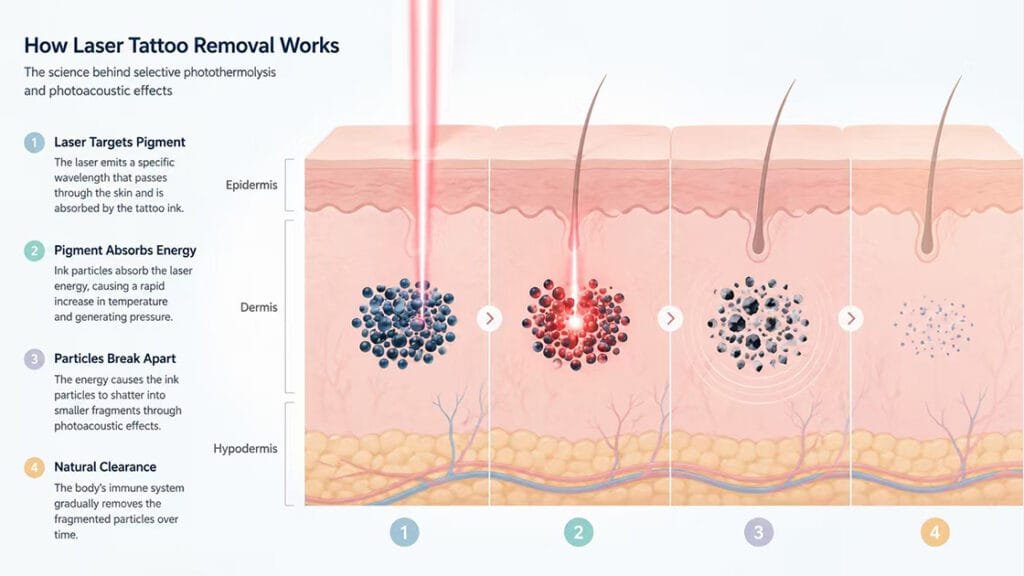
Tattoo ink consists of pigment particles placed within the dermal layer of the skin. Each pigment color reflects and absorbs light differently. Because laser energy works through selective photothermolysis and photoacoustic effects, the wavelength must closely match the absorption characteristics of the target pigment.
For example, black pigment absorbs a wide range of wavelengths, making it one of the easiest colors to treat. In contrast, green, blue, red, and yellow pigments often require specific wavelengths to achieve optimal energy absorption. This variation explains why tattoo removal technologies have evolved from single-wavelength devices to advanced multi-wavelength platforms.
1.2 The Growing Demand for Advanced Tattoo Removal
As tattoos have become more common across different age groups and professions, demand for effective removal solutions has also increased. Individuals may seek tattoo removal for professional image considerations, aesthetic preferences, cosmetic corrections, or preparation for cover-up tattoos.
Modern laser technology provides a non-surgical approach that can be adapted to different tattoo characteristics, including ink color, tattoo age, ink density, and skin type.
2. The Science Behind Laser Tattoo Removal
2.1 Selective Photothermolysis and Photoacoustic Effects
Laser tattoo removal relies on delivering concentrated energy into pigment particles while minimizing interaction with surrounding tissue. When the appropriate wavelength reaches the tattoo pigment, the ink absorbs the laser energy and breaks into smaller particles.
These fragmented particles gradually become easier for the body’s natural clearance processes to manage. Different wavelengths produce varying levels of absorption depending on the pigment color, which is why wavelength selection remains one of the most important aspects of treatment planning.
2.2 Why Multiple Wavelengths Improve Treatment Flexibility
Single-wavelength systems often face limitations when treating tattoos containing multiple colors. Multi-wavelength platforms allow practitioners to select the most appropriate wavelength for each pigment type.
This flexibility improves treatment customization and enables practitioners to address a broader range of tattoo designs, from simple black ink tattoos to complex multicolored artwork.
3. Key Laser Wavelengths Used for Tattoo Removal
3.1 1064nm Wavelength for Dark Pigments
The 1064nm wavelength is widely used for black, dark blue, and deep gray tattoo pigments. Because darker pigments absorb this wavelength efficiently, it remains one of the most important tools in tattoo removal.
In addition to its effectiveness on dark ink, the 1064nm wavelength can penetrate deeper into the skin compared with shorter wavelengths. This characteristic allows practitioners to address pigment located within deeper dermal layers while maintaining precision.
Many professional tattoo removal systems incorporate 1064nm technology as a foundational treatment option for common tattoo colors.
3.2 532nm Wavelength for Red and Warm-Toned Pigments
Red, orange, and certain yellow pigment shades often respond better to the 532nm wavelength. These colors reflect longer wavelengths and absorb shorter wavelengths more efficiently.
Because colorful tattoos continue to increase in popularity, the ability to target warm-toned pigments has become increasingly important in aesthetic practices. The 532nm wavelength expands treatment versatility and helps address colors that may not respond effectively to 1064nm treatments alone.
This capability is particularly valuable when treating decorative tattoos that contain multiple color variations.
3.3 Multi-Wavelength Approaches for Complex Designs
Modern tattoo designs frequently combine black outlines with blue, green, red, and orange pigments. Treating these complex designs often requires more than one wavelength during the overall treatment process.
Advanced laser platforms equipped with multiple wavelength options allow practitioners to customize treatments according to the unique color composition of each tattoo. This adaptability has become a key feature in contemporary tattoo removal technology.
4. Why Advanced Laser Platforms Matter
4.1 Precision Energy Delivery
Modern laser systems are designed to deliver controlled energy with high precision. Adjustable pulse durations, energy settings, and wavelength selection enable practitioners to tailor treatments to individual tattoo characteristics.
This level of customization supports more accurate targeting of pigment particles while preserving surrounding tissue structures. Precision remains especially important when treating detailed artwork or tattoos located in highly visible areas.
4.2 Versatility Across Tattoo Types
Not all tattoos are created equal. Variables such as tattoo depth, pigment composition, age of the tattoo, and artistic complexity can influence treatment planning.
Advanced laser platforms provide greater flexibility for practitioners working with:
- Professional tattoos
- Amateur tattoos
- Cosmetic tattoos
- Multicolored tattoos
- Cover-up preparation cases
The ability to adjust treatment parameters helps support a personalized approach for a wide variety of tattoo types.
5. The Future of Laser Tattoo Removal Technology
5.1 Enhanced Energy Control
Modern aesthetic technology continues to focus on delivering laser energy with greater precision and consistency. Improved energy control allows practitioners to adapt treatments according to tattoo characteristics while maintaining treatment efficiency.
As technology evolves, practitioners gain access to increasingly sophisticated tools that support individualized treatment strategies.
5.2 Expanding Applications Beyond Traditional Tattoos
Laser systems originally developed for tattoo removal are now commonly used in broader aesthetic applications. Many advanced platforms support additional procedures related to pigmentation management, skin rejuvenation, and cosmetic corrections.
This multifunctional capability makes modern laser technology an important component of today’s aesthetic treatment environment.
FAQ
Why do different tattoo colors require different laser wavelengths?
Different pigments absorb light differently. Specific wavelengths target specific colors more effectively.
Is black tattoo ink easier to remove than colored ink?
Black ink generally absorbs laser energy efficiently, making it one of the most commonly treated pigment colors.
Why is 1064nm commonly used in tattoo removal?
The 1064nm wavelength effectively targets black and dark-colored pigments while reaching deeper dermal layers.
What colors respond best to 532nm lasers?
Red, orange, and some yellow pigments typically respond well to 532nm wavelengths.
Why are multi-wavelength laser systems beneficial?
They allow practitioners to treat multiple pigment colors within a single tattoo by selecting the most appropriate wavelength for each color.
Conclusión
Modern tattoo removal relies heavily on selecting the correct laser wavelength for each pigment color. While black and dark-colored inks often respond well to 1064nm wavelengths, red and warm-toned pigments typically require 532nm technology. As tattoos become increasingly colorful and complex, multi-wavelength laser platforms provide the flexibility needed to address a broader range of designs. Through precise energy delivery, customizable treatment parameters, and advanced wavelength options, contemporary laser systems continue to play a central role in professional tattoo removal and aesthetic practice development.
References
Eliminación de tatuajes con láser: Una actualización clínica
https://www.ncbi.nlm.nih.gov/pmc/articles/PMC4411590
Picosecond Laser Treatment for Tattoos and Benign Pigmented Lesions
https://www.ncbi.nlm.nih.gov/pmc/articles/PMC5801452
Laser Tattoo Removal: Principles and Practice
https://www.ncbi.nlm.nih.gov/books/NBK442007
Selective Photothermolysis: Precise Microsurgery by Selective Absorption of Pulsed Radiation
https://pubmed.ncbi.nlm.nih.gov/7241036
Laser Treatment of Tattoos: Basic Principles and Current Technologies
https://www.sciencedirect.com/science/article/pii/S0738081X14001239