
Einführung
You pull your favorite sleeveless party dress out of the closet, slip it on, and look in the mirror—only to notice the fine, papery folds of skin at your elbows. For countless women, this moment arrives every holiday season. The dress fits perfectly everywhere else, but the crepey texture at the elbows makes you reach for a cardigan or a long-sleeved alternative. You are not alone. A survey of over 4,200 beauty consumers found that 36% of women report neck crepiness as a top skin concern, and the same textural issues appear on elbows where skin is thin and prone to the same age-related thinning. The elbow is a uniquely challenging area: it has fewer oil glands than almost any other part of the body and undergoes constant flexing and extension. This combination makes it one of the first places where crepey texture becomes visible.
Topical creams hydrate briefly but cannot rebuild lost collagen inside the dermis. Radiofrequency (RF) skin tightening offers a non‑surgical, no‑downtime solution that reaches deep into the skin to thicken it from within. This article explains why elbows develop crepey skin, how RF energy stimulates collagen remodeling, and why this holiday season can be the first one you wear that sleeveless dress with complete confidence.
1. Why Elbows Develop Crepey Skin
Crepey skin is not the same as wrinkles. It is a thinning of the dermis that makes the skin look papery, finely lined, and loose to the touch. Understanding what causes this texture helps explain why the elbow is particularly vulnerable and why surface creams are not enough.
1.1 Thin Dermis and Low Sebaceous Gland Density
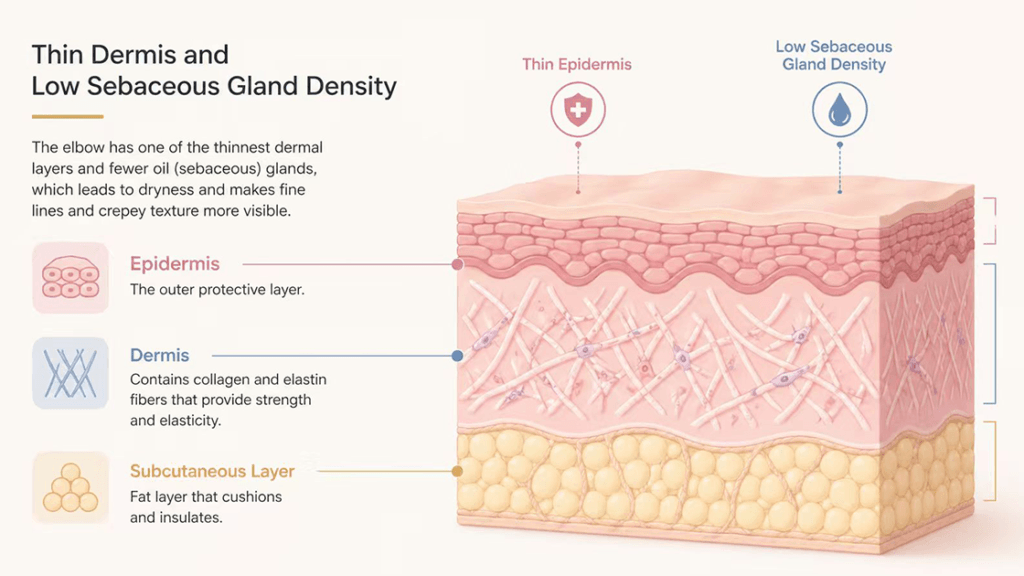
The dermis, or middle layer of the skin, contains collagen and elastin fibers that provide structural support and elasticity. With age, the body naturally produces less collagen, and existing fibers become fragmented and disorganized. The elbow has one of the thinnest dermal layers on the body, meaning it has less structural reserve to begin with. In addition, sebaceous glands in the elbow region are sparse. These glands produce natural oils that keep skin supple. With fewer of them, the elbow skin dries out more quickly and loses its barrier function, making fine lines more visible. Unlike the face, which benefits from daily moisturizing routines, elbows are often neglected until the crepey texture is already noticeable.
1.2 Cumulative Sun Exposure and Mechanical Stress
Most people apply sunscreen diligently to their faces but rarely extend it to their elbows. Over decades, ultraviolet radiation damages the collagen in elbow skin through a process called photoaging. UV light breaks down existing collagen and inhibits the formation of new collagen, accelerating the thinning process. At the same time, the elbow is in nearly constant motion. Every time you bend and straighten your arm, the skin stretches and relaxes. This repetitive mechanical stress creates fine creases that, over time, do not fully rebound. The combination of chronic sun damage and daily mechanical strain makes the elbow an early warning site for age‑related dermal thinning.
1.3 What Topical Creams Cannot Fix
A rich moisturizer can temporarily plump the top layer of skin, reducing the appearance of crepiness for a few hours. Ingredients like hyaluronic acid draw water into the stratum corneum, causing a short‑term smoothing effect. However, moisturizers cannot reach the dermis, where collagen loss actually occurs. They do not stimulate fibroblast activity to produce new structural fibers. Likewise, retinoid creams can accelerate cell turnover and mildly boost collagen over many months, but their effect on thin elbow skin is often limited by irritation and the practical challenge of applying a cream to a high‑movement area several times a week. For true structural improvement, the skin needs a treatment that penetrates below the surface and activates the body’s natural collagen‑building machinery.
2. How RF Energy Restores Thickness and Elasticity
Radiofrequency technology uses electromagnetic waves to generate controlled heat deep within the skin. This heat triggers two distinct processes: an immediate tightening of existing collagen fibers and a longer‑term rebuilding of new collagen. Together, they reverse the thinning that causes crepey texture.
2.1 Delivering Heat to the Dermis Without Surface Injury
RF devices emit electromagnetic waves that pass harmlessly through the outer layer of the skin (epidermis). These waves encounter resistance as they enter the dermis, converting into thermal energy at temperatures between 40°C and 45°C (104–113°F). The epidermis remains at a lower temperature because RF energy does not rely on specific pigment absorption, unlike laser treatments. This selective heating means that even women with darker skin tones or sensitive skin can safely undergo RF skin tightening without the risk of burns or post‑inflammatory hyperpigmentation.- For the elbow, where skin is naturally thin and delicate, this safety advantage is critical.
2.2 Immediate Collagen Contraction and Instant Tightening
The first effect of RF energy happens immediately. Existing collagen fibers, which have become loose and stretched over time, have a triple‑helix structure. When heated to therapeutic temperatures, the hydrogen bonds that hold these helices together temporarily break, causing the fibers to unwind and then re‑form in a contracted, shorter shape. This process, called immediate collagen contraction, produces visible tightening during the treatment session itself. In a clinical setting, RF devices are passed slowly over the elbow for several minutes. Even before the session ends, the crepey texture may look visibly reduced. The effect is not an illusion; it is a real physical change in the collagen network.
2.3 Neocollagenesis and Progressive Thickening Over Months
The second, more powerful effect unfolds over the following three to six months. The controlled thermal injury triggers what is known as neocollagenesis—the growth of new, healthy collagen fibers. Heat shock proteins are activated within fibroblasts, the cells responsible for producing collagen. These fibroblasts respond by synthesizing fresh structural proteins and depositing them in an organized, functional arrangement. Unlike the old, fragmented collagen that caused crepiness, the new fibers restore dermal thickness and resilience. Clinical studies show that patients experience visible tightening and smoother texture after a short series of RF sessions, with long‑term collagen rebuilding continuing for months.-31
2.4 Improved Elastin Networks for Lasting Resilience
Collagen provides strength, while elastin fibers allow skin to snap back after stretching. Elbow skin is stretched and compressed thousands of times each day. Without sufficient elastin, the skin holds onto the stretched shape, which worsens crepey folds. RF energy also stimulates elastin synthesis, improving the network of elastic fibers throughout the treated dermis. Women who complete a full series of RF skin tightening often report that their elbows not only look smoother but also feel thicker and more supple. The improvement is not just cosmetic; it is a functional upgrade in how the skin responds to daily movement.
3. What to Expect from RF Skin Tightening for Elbows
RF skin tightening is straightforward, comfortable, and requires no recovery time. Knowing the details of the procedure helps you plan around your schedule and set realistic expectations for the holiday party season.
3.1 The Treatment Experience
A typical elbow treatment session takes 15 to 25 minutes for both elbows. The clinician applies a conductive gel and then passes a hand held RF wand over the skin in slow, overlapping circles. The sensation is a deep, pleasant warmth, similar to a hot stone massage. No numbing cream or anesthesia is required. Patients can read, listen to music, or simply relax. After the session, the skin may appear slightly pink for an hour or two, but this fades quickly. There is no downtime, meaning you can return to work, drive yourself home, and wear makeup or sleeves immediately afterward. For the holiday season, this convenience allows you to slip in treatments during lunch breaks or after work without disrupting your busy schedule.
3.2 Number of Sessions and Spacing
Unlike surgical procedures that happen once, RF skin tightening works best as a short series of sessions. The standard protocol for crepey elbow skin is three to five sessions spaced two to four weeks apart. A single session produces modest immediate effects, but the cumulative collagen remodeling grows with each treatment. After the second session, patients typically notice the crepey texture beginning to smooth. By the end of the third session, the difference may be substantial. Full results appear three to six months after the final session, making autumn the perfect time to start treatment for December parties. Some women schedule a single annual maintenance session after the initial series to sustain the collagen benefits.
3.3 Comparing RF to Other Options
RF skin tightening occupies a unique middle ground between topical creams and surgery. Steroid injections only reduce inflammation temporarily and do not rebuild skin; RF, by contrast, addresses the underlying structural loss. Laser resurfacing often requires days of redness and peeling, whereas RF is gentle enough to use on delicate elbow skin. As for surgical arm lifts, they leave incisions and demand weeks of recovery, but RF has no scars and no downtime. For women who want noticeable improvement without rearranging their lives, RF is the most practical and evidence‑backed choice for crepey elbows.
3.4 Maintenance and Supporting Skincare
After completing the initial series, the new collagen remains for years, but the natural aging process does not stop. A single maintenance session every six to twelve months can preserve the results indefinitely. In between RF sessions, supporting skincare extends the benefits. A thick moisturizer containing ceramides or urea, applied nightly, keeps the stratum corneum hydrated so that the new collagen underneath can best be protected. A physical sunscreen on the elbows during outdoor activities prevents further photoaging. Gentle exfoliation once a week removes dead skin cells and allows moisturizers to penetrate more deeply. Women who adopt this combined approach often find that their elbows stay smooth for years after their final RF session.
4. Regaining Confidence for Sleeveless Holiday Style
The decision to treat crepey elbows is rarely about vanity alone. It is about being able to wear the clothes that make you feel beautiful without second‑guessing yourself.
4.1 The Psychological Shift
There is a tangible shift in posture and attitude that occurs when you no longer feel the need to hide a body part. Women who complete RF skin tightening for their elbows often describe walking into a holiday party with their shoulders back, not tugging at their sleeves. The tightening and thickening of the skin may be subtle to others, but the relief from self‑consciousness is profound. This psychological benefit is supported by consumer data showing that aesthetic concerns are driven not by other people‘s judgments but by the internal gap between how a woman wants to look and how she sees herself. Closing that gap for an area as visible as the elbows changes how you show up to every social event.
4.2 How RF Fits into a Modern Holiday Schedule
The weeks leading up to December are already packed with shopping, cooking, and coordinating flights. RF skin tightening respects that schedule. Each session takes less than half an hour. There is no downtime, no recovery, no need to explain to colleagues why you have redness or peeling. You can receive a treatment on your lunch break and attend a dinner party that same evening. Because results develop gradually, you are not announcing to the world that you “did something.” You simply look more rested, more vibrant, and more comfortable in the skin you are in. This subtlety appeals to women who want improvement without the “procedure look.”
4.3 The Cost‑Effectiveness Over Time
One of the most misunderstood aspects of RF skin tightening is its long‑term value. A single botulinum toxin treatment for the face lasts three to four months and costs several hundred dollars. One series of RF sessions for the elbows costs more upfront but delivers results that last for years with minimal maintenance. Compared to the cumulative cost of high‑end creams that do not rebuild collagen, RF is actually more economical. The FDA has cleared RF devices for reducing the appearance of wrinkles and improving skin texture, and the average patient sees results that persist well beyond a single season.
4.4 Taking the First Step
If you have been hiding your elbows for years, it is easy to assume that nothing can be done without surgery. RF skin tightening challenges that assumption. It is widely available, and supported by decades of clinical research showing that controlled thermal energy can safely rebuild thinning skin. The best time to start is now, before the holiday calendar fills up. With three sessions spaced a month apart, you could begin in late October and have fully tightened, supple elbows by your office holiday party in mid‑December. The dress you have been saving for a special occasion is already in your closet. All that is missing is the confidence to wear it.
Frequently Asked Questions (FAQ)
Q1: Will RF skin tightening hurt my elbows?
No. Most women feel a deep, comforting warmth during treatment. The skin may look slightly pink for an hour or two, but there is no pain, blistering, or downtime.
Q2: How many sessions will I need before the holiday parties start?
Most women need three to five sessions spaced two to four weeks apart. If you start in early October, you can complete the series by mid‑December.
Q3: Can I combine RF skin tightening with other treatments for crepey skin?
Yes. Many clinicians recommend pairing RF with a good moisturizing routine and in‑office treatments such as microneedling or gentle chemical peels. Your provider can design a customized plan.
Q4: Is RF safe for the thin, delicate skin on my elbows?
Yes. RF energy is precisely controlled and does not damage the skin’s surface. The technology has been used safely on thin neck skin and other delicate areas for years.
Q5: How long will the results last?
The new collagen produced during RF treatments continues to remodel for three to six months after the last session. Results typically last one to two years with a single annual maintenance session.
Schlussfolgerung
Crepey elbows do not have to dictate what you wear to holiday parties. The fine, papery skin that makes you reach for a cardigan is not an inevitable price of aging—it is a treatable condition caused by dermal thinning, collagen loss, and accumulated sun damage. Radiofrequency skin tightening offers a non‑surgical, no‑downtime solution that reaches deep into the dermis to contract existing collagen and stimulate the growth of new structural fibers. With a short series of comfortable, lunch‑break‑length sessions, women can restore thickness, suppleness, and confidence to an area they once hid. The sleeveless dress in the back of your closet is waiting. This year, you do not need to cover your arms. You just need to treat them.
References
Rhein Lasers. Treatments Overview.
https://www.rheinlasers.com/treatments
Rhein Lasers. Why RF Is the Go-To Non-Surgical Solution for a Firmer, Younger-Looking Neck.
WebMD. What Is Radiofrequency Skin Tightening?
https://www.webmd.com/beauty/what-is-radiofrequency-skin-tightening
GCI Magazine. Lift & Tuck: Consumer Attitudes Toward Aesthetic Procedures. February 2024.
https://gcimagazine.texterity.com/gcimagazine/library/item/february_2024/4167661/
Laceleaf MedSpa. How RF Microneedling Transforms Crepey Skin.
https://laceleafmedspa.com/how-rf-microneedling-transforms-crepey-skin/
MDedge. Cutaneous Remodeling From a Radiofrequency Perspective.
The Aesthetic Guide. Aesthetics Industry Insights: Growth Resumes in Key Categories. June 17, 2025.