Einführung
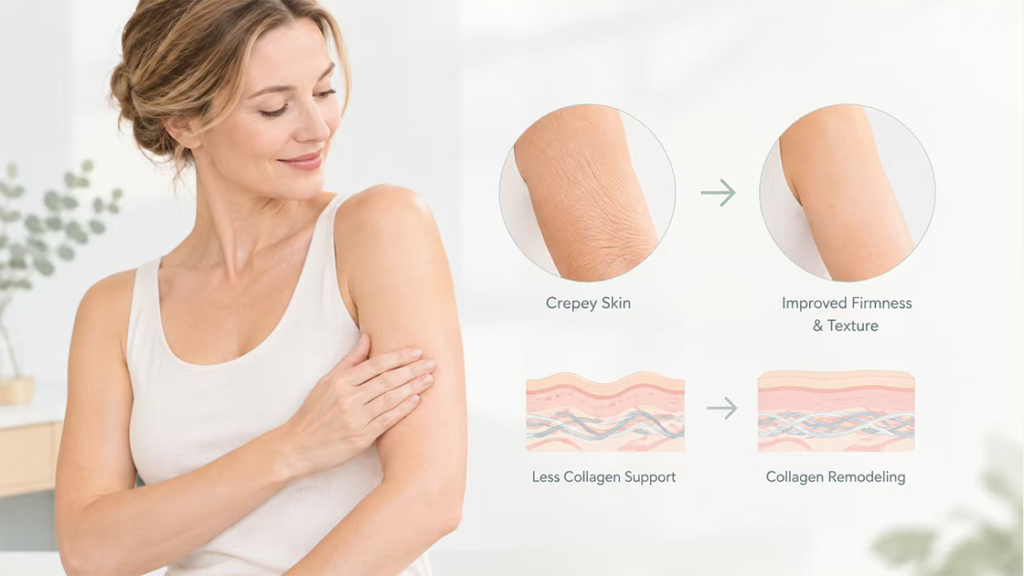
Crepey skin on the upper arms can make the skin appear thin, loose, finely wrinkled, or less smooth, especially when the arms move or the skin loses elasticity with age or changes in body composition. Unlike localized fat, crepey skin is primarily associated with changes in the dermal structure, including reduced collagen support, altered elastic fibers, and declining skin resilience. Radiofrequency (RF) skin tightening has become an important non-invasive aesthetic approach because controlled RF energy can heat targeted tissue and support collagen remodeling. When applied appropriately to the upper arms, RF technology may help improve the appearance of skin firmness and texture while addressing the tissue characteristics behind visible laxity.
1. Why Does Crepey Skin Develop on the Upper Arms?
The upper arms can develop crepey skin for several different reasons. Understanding what is happening within the skin helps determine whether a skin-tightening approach is appropriate.
1.1 Collagen Decline Can Affect Skin Firmness
Collagen provides much of the structural support within the dermis. As skin ages, collagen production and organization change, while existing collagen fibers can become fragmented or less effective at maintaining firmness. These changes can make the skin appear thinner and less resilient.
The upper arms are particularly noticeable because the skin covers a relatively mobile area. When collagen support declines, the skin may form fine folds and wrinkles instead of maintaining a smooth, firm surface. RF technology is designed to create a controlled thermal response within the tissue, which may encourage collagen remodeling and support a firmer skin appearance over time.
1.2 Changes in Elastic Fibers Can Increase Skin Laxity
Collagen is not the only structural component involved in skin firmness. Elastin fibers help skin stretch and return toward its original shape. Aging, environmental exposure, and changes in tissue structure can affect the quality and organization of these fibers.
When the skin loses some of its elastic properties, the upper arm may look loose even when there is little excess fat. This distinction matters because reducing adipose tissue does not necessarily correct skin laxity. A treatment strategy focused on dermal remodeling may be more relevant when the primary concern is skin texture and firmness.
1.3 Weight Changes Can Make Arm Laxity More Visible
Changes in body size can also alter the appearance of the upper arms. After substantial weight loss, the skin may not immediately return to its previous degree of tightness. The amount of laxity depends on factors such as age, genetics, duration of tissue expansion, and baseline skin elasticity.
For this reason, crepey arm skin should not automatically be viewed as a fat-reduction concern. A professional assessment can help distinguish between excess adipose tissue, skin laxity, or a combination of both.
2. How Does RF Hautstraffung Work on Crepey Skin?
RF skin tightening uses radiofrequency energy to generate controlled heat within targeted tissue. The objective is not simply to warm the skin, but to create an appropriate thermal environment that can influence collagen structure and subsequent tissue remodeling.
2.1 Controlled Heat Reaches the Dermal Tissue
RF energy interacts with tissue and generates heat according to the characteristics of the tissue and the treatment system. In aesthetic applications, controlled heating of the dermis can create a biological response associated with collagen remodeling.
The temperature and energy distribution need to remain within an appropriate therapeutic range. Excessive heating can increase the risk of unwanted tissue effects, while insufficient energy may not provide an adequate stimulus. This makes temperature monitoring, energy control, and consistent application important components of professional RF treatment.
2.2 Collagen Remodeling Can Support Firmer-Looking Skin
Research on RF-based aesthetic treatments has associated controlled dermal heating with collagen remodeling and changes in skin elasticity. The process can involve an initial thermal effect followed by longer-term remodeling within the treated tissue.
For crepey upper-arm skin, this mechanism is particularly relevant because the aesthetic goal is often improved firmness and surface quality rather than simply reducing volume. RF treatment may therefore form part of a broader strategy designed to improve the appearance of lax or finely wrinkled skin.
2.3 RF Is Different From Simple Surface Warming
Professional RF treatment is not equivalent to applying ordinary heat to the skin. A medical-aesthetic RF system is designed to deliver controlled electromagnetic energy and manage its interaction with tissue.
This distinction matters when treating areas such as the upper arms. The practitioner needs to consider the thickness of the tissue, the size of the treatment zone, skin condition, and the desired treatment endpoint. A controlled approach can help distribute energy more consistently across the target area.
3. RF Skin Tightening for Crepey Arms
RF technology can be incorporated into an aesthetic treatment plan when the main concern involves mild to moderate skin laxity, reduced firmness, or a crepey surface appearance.
3.1 Can RF Improve the Appearance of Crepey Arm Skin?
RF may help improve the appearance of loose and crepey skin by supporting collagen remodeling within the dermal tissue. Clinical literature has examined RF for skin laxity and body areas including the upper arms, with findings suggesting that radiofrequency can influence tissue firmness and skin quality.
However, RF should not be presented as a replacement for surgery in cases of substantial excess skin. When laxity is severe, especially after major weight loss, the amount of redundant tissue may exceed what non-invasive skin tightening can reasonably address.
For mild to moderate laxity, RF may provide a useful non-invasive option within a professionally designed aesthetic plan.
3.2 Why the Back of the Upper Arm Requires Careful Treatment
The posterior upper arm is one of the most recognizable areas for skin laxity. It also contains a combination of skin, subcutaneous tissue, and muscle that changes position as the arm moves.
Treatment therefore needs to follow the anatomy rather than simply treating the most visibly wrinkled section. Energy should be distributed across the appropriate treatment field so that the overall appearance of the upper arm remains balanced.
A structured treatment pattern can also reduce the possibility of concentrating energy in one small area while leaving adjacent lax skin untreated.
3.3 RF Can Address Skin Quality Beyond Visible Wrinkles
Crepey skin is not defined only by wrinkles. It can also involve reduced smoothness, lower elasticity, and a less uniform skin surface.
By targeting the dermal environment, RF may support broader improvements in skin quality rather than focusing on individual lines. This makes it particularly relevant when the upper arm looks thin, finely textured, or less firm across a wider area.
The goal is generally a more supported and smoother-looking skin surface rather than an artificially tight appearance.
4. Designing an Effective RF Approach for the Upper Arms
The effectiveness of RF skin tightening depends not only on the technology but also on how the treatment is designed for the individual anatomical area.
4.1 Start With Skin Laxity Rather Than Fat Volume
A professional assessment should first determine what contributes most to the appearance of the upper arms. Some individuals have primarily loose skin, while others have a combination of skin laxity and localized adipose tissue.
This distinction is important because RF skin tightening primarily addresses tissue remodeling and skin firmness. If excess fat is also present, an aesthetic plan may require a different or combined body-contouring strategy.
Separating these concerns helps establish a more realistic treatment objective and prevents skin tightening from being expected to solve every aspect of upper-arm contouring.
4.2 Match Energy Delivery to the Treatment Area
Upper-arm skin varies in thickness and mobility, so treatment parameters should be selected according to the target area rather than using identical settings for every body region.
A professional RF system with controlled energy delivery can help practitioners adjust treatment according to the tissue response and treatment objectives. Consistent movement across the treatment field is also important for maintaining even energy distribution.
The treatment endpoint should be based on appropriate tissue response rather than simply increasing energy in pursuit of a stronger sensation.
4.3 Temperature Monitoring Helps Support Consistent Treatment
Temperature control is particularly important when RF energy is used to create a controlled thermal response. Real-time monitoring can help practitioners maintain a more consistent treatment environment and avoid unnecessary overheating.
A system that supports controlled RF delivery and monitoring can therefore be useful when working across relatively large areas such as the upper arms. The practitioner can focus on maintaining an appropriate treatment pattern rather than relying only on subjective heat perception.
5. Supporting Long-Term Improvement in Arm Skin Quality
RF treatment works within a broader skin-care and aesthetic-management strategy. Maintaining skin quality and managing factors that contribute to laxity can help support the overall appearance of the arms.
5.1 Protect the Skin From Ongoing Environmental Stress
Chronic ultraviolet exposure contributes to changes in collagen and elastic fibers and can accelerate visible skin aging. Consistent sun protection is therefore an important part of maintaining the skin’s structural quality.
For individuals concerned about crepey skin, protecting the upper arms from excessive sun exposure can complement professional skin-tightening strategies. RF can support dermal remodeling, but it does not eliminate the effects of continued environmental stress.
5.2 Support Skin Quality With Consistent Care
Hydration, gentle cleansing, and appropriate topical skin care can help maintain the surface condition of the skin. These measures do not directly reproduce the tissue-remodeling effect of RF, but they can contribute to a smoother and healthier-looking skin surface.
Aesthetic care should therefore distinguish between improving surface hydration and addressing deeper dermal laxity. RF targets the latter, while routine skin care supports the former.
5.3 Consider the Full Upper-Arm Contour
Crepey skin can become more noticeable when the upper arm contains both skin laxity and changes in soft-tissue volume. In these situations, evaluating the entire contour may provide a more useful perspective than focusing only on wrinkles.
RF can be considered as part of a broader body-contouring strategy when appropriate. Some aesthetic platforms also combine radiofrequency with other technologies, allowing practitioners to address different tissue characteristics according to the individual’s needs.
The key is to match each technology to the tissue component it is designed to address rather than treating every upper-arm concern in the same way.
FAQ
Can RF skin tightening help crepey skin on the upper arms?
RF may help improve the appearance of mild to moderate crepey skin by supporting collagen remodeling and improving the visual firmness of the treated tissue. Results vary according to skin condition and the degree of laxity.
Is RF suitable for loose skin after weight loss?
RF may be considered when the main concern is mild to moderate skin laxity. Significant amounts of redundant skin may require evaluation for other treatment approaches.
Does RF reduce upper-arm fat?
RF skin tightening primarily focuses on tissue heating and remodeling. Some RF technologies may also be incorporated into body-contouring approaches, but skin tightening and fat reduction are different treatment objectives.
Why is temperature control important during RF treatment?
Controlled temperature helps create a more consistent thermal environment. Professional treatment should balance energy delivery with tissue response rather than simply maximizing heat.
Can RF replace surgery for very loose upper-arm skin?
Non-invasive RF may improve the appearance of mild to moderate laxity, but it should not be considered equivalent to surgical removal of substantial excess skin.
Schlussfolgerung
Crepey skin on the upper arms often reflects changes in collagen, elastin, and overall dermal structure rather than excess fat alone. RF skin tightening offers a non-invasive approach that uses controlled radiofrequency energy to create a thermal response within targeted tissue, potentially supporting collagen remodeling and improved skin firmness. When treatment is guided by careful assessment of skin laxity, tissue characteristics, treatment area, energy delivery, and temperature control, RF can become a useful component of an aesthetic strategy for improving the appearance of crepey upper-arm skin. The most appropriate approach depends on the degree and cause of laxity, making professional evaluation essential before treatment planning.
References
- Introduction and overview of radiofrequency treatments in aesthetic dermatology
https://pubmed.ncbi.nlm.nih.gov/36459080
- Radiofrequency therapy in esthetic dermatology: A review of clinical evidences
https://pubmed.ncbi.nlm.nih.gov/31691477
- Radiofrequency for the treatment of skin laxity: myth or truth
https://pubmed.ncbi.nlm.nih.gov/26560216
- A noninvasive approach to off-face skin laxity and tightening: A review of the literature
https://pubmed.ncbi.nlm.nih.gov/26566567
- Subdermal Radiofrequency for Skin Tightening of the Posterior Upper Arms