Einführung
Modern aesthetic care is moving beyond traditional facial treatments and expanding toward a wider range of skin and body concerns. Advanced laser beauty technology now supports personalized approaches for areas such as the hands, neck, body contours, unwanted hair, and uneven skin appearance. With innovations including picosecond laser technology, diode laser systems, radiofrequency energy, and targeted cooling solutions, aesthetic professionals can create more customized treatment plans based on different skin goals. Multi-wavelength laser platforms using technologies such as 532nm and 1064nm energy, 810nm diode laser applications, and radiofrequency-based skin tightening systems are becoming important tools in professional beauty environments.
1. The Evolution of Laser Beauty Technology Beyond Facial Treatments
For many years, facial skincare dominated the aesthetic industry, with most consumers focusing on concerns such as wrinkles, pigmentation, and skin texture. However, beauty expectations are changing, and more people are now paying attention to other visible areas that reflect aging, lifestyle, and personal appearance.
1.1 Why Aesthetic Care Is Expanding Beyond the Face
The face remains an important focus in aesthetic care, but other body areas often show visible changes caused by aging, environmental exposure, and daily habits. Areas such as the hands, neck, arms, and body contours are becoming increasingly important in modern beauty routines.
Laser beauty technology allows professionals to address different aesthetic concerns through customized energy delivery. Instead of using a single approach for every concern, advanced systems can provide different wavelengths and technologies designed for specific applications.
For example, picosecond laser technology uses extremely short pulse durations to deliver controlled energy, while diode laser technology focuses on hair follicle targeting. Radiofrequency technology uses controlled thermal energy to support skin firmness and texture improvement. These different technologies allow aesthetic professionals to design more personalized skincare strategies.
1.2 Understanding Different Laser Technologies in Aesthetic Applications
Modern aesthetic laser systems often combine multiple technologies to provide broader application possibilities. Different wavelengths interact with skin structures in different ways, making wavelength selection an important factor in professional aesthetic care.
Picosecond laser technology commonly uses wavelengths such as 532nm and 1064nm. The shorter 532nm wavelength is often associated with superficial pigment-related applications, while 1064nm energy can reach deeper skin layers and is frequently used in deeper pigmentation and skin revitalization approaches.
Diode laser technology, including 810nm wavelength systems, is commonly used for hair reduction by targeting melanin within hair follicles. Radiofrequency systems work differently by delivering electromagnetic energy to create controlled heating effects within tissues, supporting collagen-related skin firmness goals.
1.3 The Growing Demand for Personalized Beauty Solutions
Consumers increasingly prefer beauty treatments that match their individual needs rather than general solutions. Factors such as skin type, treatment area, lifestyle, and personal aesthetic goals all influence the selection of appropriate technology.
Personalized aesthetic care requires professionals to understand how different technologies work and how they may be combined within a broader skincare plan. Laser beauty technology supports this trend by offering adjustable settings, different wavelengths, and targeted applications.
This shift from one-size-fits-all beauty treatments toward customized approaches is changing how clinics and professionals provide modern aesthetic services.
2. Laser Beauty Technology for Commonly Overlooked Body Areas
While facial treatments remain popular, many consumers are beginning to focus on areas that were previously overlooked. These areas often reveal visible signs of aging or lifestyle changes and are becoming new opportunities within aesthetic care.
2.1 Laser Hand Rejuvenation for Aging Skin Appearance
Hands are one of the most visible areas that may show changes associated with aging. While many people invest in facial skincare routines, the hands often receive less attention despite frequent exposure to sunlight, environmental factors, and daily activities.
Laser hand rejuvenation focuses on improving the overall appearance of hand skin through advanced energy-based technologies. Laser approaches may support skin texture refinement, promote collagen-related processes, and help create a smoother-looking appearance.
Modern aesthetic systems using targeted laser energy allow professionals to customize treatments according to skin condition and individual goals. Hand rejuvenation represents a growing area where laser technology extends beyond traditional facial care.
2.2 Neck and Décolletage Laser Treatments for Complete Anti-Aging Care
The neck and décolletage areas are becoming increasingly important in anti-aging skincare because they often experience similar environmental exposure as facial skin. Many consumers now seek balanced appearance across the face, neck, and upper chest areas.
Laser and energy-based aesthetic technologies can be used to support skin texture improvement and firmness-focused skincare routines in these areas. Radiofrequency technology, for example, is commonly used in aesthetic applications where controlled thermal energy supports collagen-related processes and skin tightening goals.
Treating areas beyond the face allows aesthetic professionals to provide more comprehensive beauty plans that consider the entire visible appearance.
2.3 Body Areas and the Expansion of Laser Beauty Applications
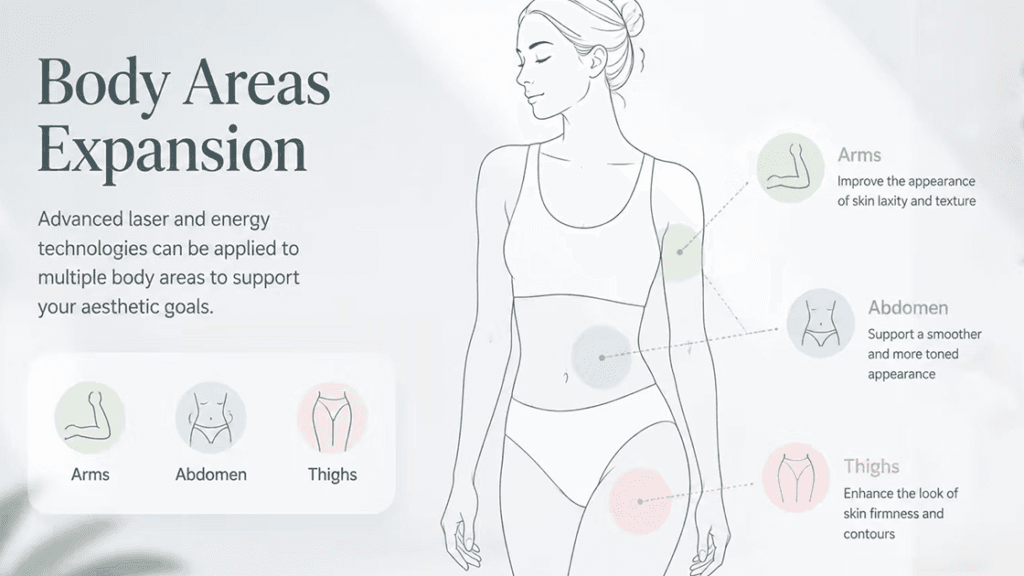
Modern laser beauty technology is also expanding into body-focused aesthetic services. Consumers are increasingly interested in improving the appearance of areas such as:
- Arms
- Unterleib
- Oberschenkel
- Body contours
Laser-based body technologies may combine different approaches, including energy delivery and radiofrequency support, to address aesthetic concerns related to body appearance. Systems using 1064nm laser energy combined with radiofrequency technology are designed for body contouring applications by focusing on targeted areas and supporting customized treatment plans.
The expansion of body-focused aesthetic treatments reflects a broader trend where beauty care is no longer limited to facial appearance.
3. Laser Technology Applications for Different Beauty Concerns
Different consumers have different aesthetic goals, and modern laser technology provides multiple approaches depending on the specific concern. Understanding these applications helps explain why advanced systems are becoming increasingly common in professional clinics.
3.1 Laser Technology for Uneven Skin Appearance and Pigmentation Concerns
Uneven skin tone and pigmentation concerns are among the most common reasons people explore aesthetic treatments. Pigmentation can develop due to various factors, including environmental exposure, skin aging, and natural changes in melanin production.
Picosecond laser technology uses high-speed energy pulses that interact with targeted pigments. Dual wavelength systems using 532nm and 1064nm technology provide professionals with options for addressing different pigment depths and skin concerns.
By selecting appropriate wavelengths and settings, professionals can create customized approaches based on individual skin characteristics.
3.2 Laser Hair Reduction Technology for Long-Term Skin Management
Hair reduction remains one of the most popular aesthetic applications worldwide. Traditional methods such as shaving and waxing require frequent maintenance, leading many consumers to explore laser-based alternatives.
Diode laser technology uses specific wavelengths, such as 810nm, to target hair follicles. This approach focuses on the interaction between laser energy and follicular melanin, making it suitable for professional hair reduction services.
Modern diode laser systems are designed with adjustable settings to accommodate different skin types and treatment areas, allowing professionals to provide more personalized experiences.
3.3 Skin Firmness and Collagen-Focused Aesthetic Technology
Skin firmness is another major concern among consumers seeking non-invasive beauty solutions. As skin changes over time, many individuals look for technologies that support smoother and firmer-looking skin.
Radiofrequency technology has become widely used in aesthetic care because it delivers controlled energy into tissue layers. The thermal effect associated with radiofrequency applications may support collagen-related processes and improve the overall appearance of skin texture.
Combining laser and energy-based technologies allows aesthetic professionals to address multiple beauty concerns through comprehensive treatment strategies.
4. How Professional Beauty Clinics Are Adapting to Multi-Functional Laser Technology
As consumer expectations continue to change, aesthetic clinics are moving toward more versatile technologies that can support different beauty goals within one professional environment. Modern laser platforms are no longer limited to a single application. Instead, advanced systems combine multiple energy technologies, allowing professionals to develop customized approaches for skin appearance, body care, hair reduction, and overall aesthetic improvement.
4.1 Multi-Wavelength Laser Systems for Customized Skin Care
One of the most important developments in aesthetic technology is the use of multi-wavelength laser systems. Different wavelengths allow professionals to select energy based on the targeted skin layer and specific aesthetic concern.
For example, dual-wavelength laser technology using 532nm and 1064nm energy provides different penetration characteristics. The 532nm wavelength is commonly associated with superficial skin applications, while 1064nm energy can reach deeper layers. This flexibility allows professionals to consider different pigment depths and skin conditions when creating personalized skincare plans.
Multi-wavelength technology represents a shift from general beauty treatments toward more precise and individualized aesthetic care.
4.2 Combining Laser and Radiofrequency Technology for Body Aesthetic Goals
Body-focused aesthetic treatments have become an important part of modern beauty services. Many consumers are interested in improving body appearance beyond traditional facial skincare, creating demand for technologies that support customized body care plans.
Some advanced systems combine 1064nm laser energy with radiofrequency technology. Laser energy can provide targeted energy delivery, while radiofrequency creates controlled thermal effects within tissue layers. This combination allows professionals to focus on body contouring and skin appearance goals through a comprehensive approach.
The integration of different energy technologies demonstrates how modern aesthetic equipment is evolving to provide broader service possibilities.
4.3 Supporting Comfortable Aesthetic Experiences With Cooling Technology
Comfort management has become an important consideration in professional aesthetic care. Many energy-based procedures involve controlled heat delivery, making cooling technology a valuable complementary approach.
Localized cooling systems provide targeted temperature management before, during, or after certain aesthetic procedures. By helping manage skin temperature and sensory comfort, cooling technology can support a more comfortable overall experience.
The combination of energy-based treatments with cooling solutions reflects a growing trend toward comprehensive aesthetic environments where technology focuses not only on appearance goals but also on client comfort.
5. The Future of Laser Beauty Technology in Personalized Aesthetic Care
The future of aesthetic technology is moving toward personalization, flexibility, and integrated solutions. As consumers become more informed, they increasingly seek beauty services designed around their unique skin conditions, lifestyle preferences, and aesthetic expectations.
5.1 Personalized Treatments Based on Skin Characteristics
Every person’s skin has different characteristics, including pigmentation level, sensitivity, texture, and aging patterns. Personalized aesthetic care considers these differences when selecting appropriate technologies and treatment parameters.
Advanced laser systems provide professionals with multiple settings, wavelengths, and energy options. This flexibility allows practitioners to adjust approaches according to different skin areas and aesthetic objectives.
Personalization is becoming a key factor in modern beauty care because consumers are looking for experiences that match their individual needs rather than standardized solutions.
5.2 The Role of Technology in Expanding Beauty Services
Laser beauty technology continues to expand beyond traditional facial applications. New service opportunities are developing around:
- Hand rejuvenation
- Neck and décolletage care
- Body contour appearance
- Hair reduction
- Skin texture improvement
This expansion allows beauty professionals to provide more complete aesthetic solutions. Instead of focusing on one specific concern, clinics can develop broader skincare programs that address multiple areas of appearance.
Technologies such as picosecond laser systems, diode laser systems, radiofrequency platforms, and localized cooling solutions are contributing to this wider approach.
5.3 Building the Next Generation of Aesthetic Care
The future of aesthetic care will continue to focus on combining scientific technology with personalized beauty experiences. Consumers are becoming more interested in advanced options that fit their lifestyle while maintaining a focus on professional guidance.
Laser technology provides new opportunities for aesthetic professionals to explore different applications while creating customized service strategies. As technology develops, beauty care will continue moving beyond traditional facial treatments toward a more complete approach that considers the entire appearance.
Frequently Asked Questions
What areas can laser beauty technology be used for besides the face?
Laser beauty technology can be applied to areas such as hands, neck, arms, body contours, and other selected areas depending on individual aesthetic goals.
How does multi-wavelength laser technology work?
Multi-wavelength laser technology uses different wavelengths, such as 532nm and 1064nm, to provide different energy penetration levels for customized aesthetic applications.
Can laser technology support body aesthetic treatments?
Yes. Some laser systems are designed for body-focused aesthetic applications and may be combined with other technologies such as radiofrequency energy.
Why are cooling systems used with aesthetic procedures?
Cooling systems help manage skin temperature and improve comfort during certain energy-based aesthetic procedures.
Is laser beauty technology suitable for all skin types?
Different technologies and settings may be adjusted according to skin characteristics. A professional consultation helps determine suitable approaches.
Why are beauty clinics investing in advanced laser systems?
Advanced laser systems allow clinics to offer more personalized services, multiple applications, and broader aesthetic care options.
Schlussfolgerung
Laser beauty technology is transforming modern aesthetic care by expanding beyond traditional facial treatments and introducing more personalized approaches for different body areas and beauty concerns. With technologies such as multi-wavelength laser systems, diode laser applications, radiofrequency energy, and localized cooling support, professionals can create customized aesthetic experiences based on individual needs. From hand rejuvenation and neck care to body-focused treatments and skin texture improvement, advanced laser technology continues to reshape how beauty services are designed. As the aesthetic industry evolves, integrated and personalized solutions will remain an important direction for future skincare innovation.
References
Laser and Light-Based Therapies for Dermatologic Applications
https://pubmed.ncbi.nlm.nih.gov/25828061
Picosecond Lasers in Dermatology: Applications and Advances
https://www.ncbi.nlm.nih.gov/pmc/articles/PMC5747172
Radiofrequency Technology in Aesthetic Medicine: A Review of Applications
https://www.ncbi.nlm.nih.gov/pmc/articles/PMC6173530
Laser Hair Removal: A Review of Current Technologies
https://www.ncbi.nlm.nih.gov/pmc/articles/PMC5429109
Advances in Non-Invasive Body Contouring Technologies