소개
Non-invasive body sculpting technologies have become an important part of modern aesthetic clinic treatments, especially for patients seeking improved contour definition and skin firmness without surgical procedures. Practitioners commonly use laser-based body contouring systems to target areas such as the arms and thighs, where localized fat accumulation and skin laxity often appear. These systems work through controlled energy delivery that interacts with subcutaneous tissue and dermal layers, supporting both structural tightening and contour refinement. In clinical environments, clinicians increasingly integrate this approach into personalized body management programs that focus on gradual and natural-looking improvement.
1. Laser Body Sculpting Mechanisms for Arms and Thighs
1.1 Controlled Energy Delivery for Localized Tissue Response
Laser body sculpting systems operate through precise energy emission that penetrates targeted areas of the body. When applied to arms and thighs, the energy interacts with both superficial and deeper tissue layers, supporting metabolic and structural responses associated with contour improvement.
1.2 Fat Layer Interaction and Contour Reduction Support
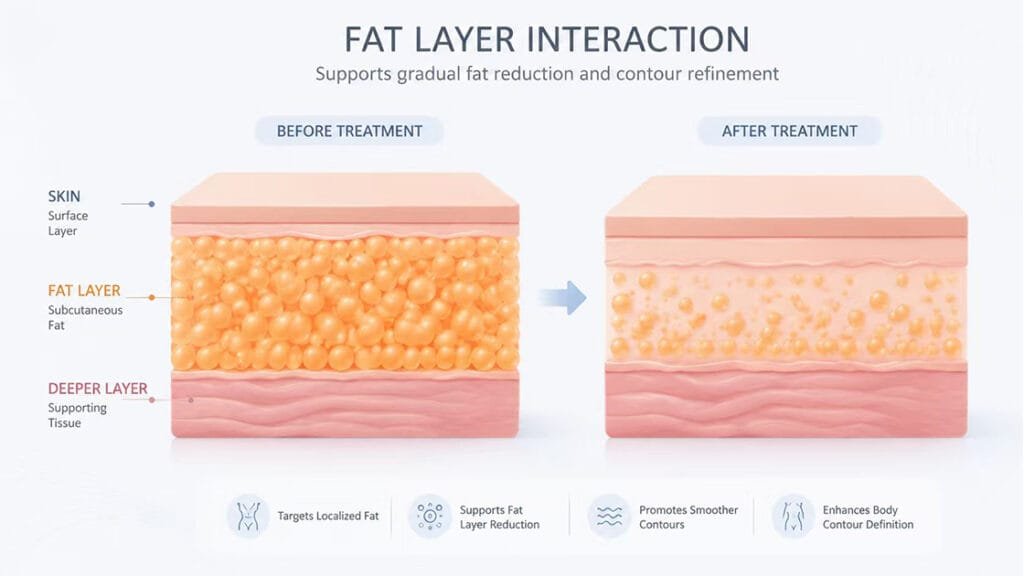
In aesthetic applications, laser energy is often directed toward subcutaneous fat layers. This interaction helps support gradual changes in tissue density and contributes to a more refined body contour appearance over time, especially in areas resistant to diet and exercise.
1.3 Skin Tightening Mechanisms in Body Sculpting
Beyond fat targeting, these systems also stimulate dermal layers responsible for skin elasticity. Practitioners commonly associate this process with improved firmness in areas such as the upper arms and inner thighs, where skin laxity is more visible.
2. Clinical Applications for Arm and Thigh Contouring
2.1 Upper Arm Tightening and Definition Support
The upper arm is a common treatment area due to its tendency to accumulate loose tissue. Laser body sculpting systems are used to support skin tightening effects and improve overall arm contour definition.
2.2 Inner Thigh Fat Reduction and Firmness Improvement
Inner thighs often present challenges related to both fat accumulation and skin laxity. Controlled laser energy is applied in clinical settings to support tissue remodeling and improve surface smoothness and firmness.
2.3 Post-Weight Change Body Refinement
Patients experiencing weight fluctuations often seek non-invasive solutions to restore balanced body contours. Laser-based sculpting systems are used as part of structured treatment plans to support gradual refinement of affected areas.
3. Integration of Laser Sculpting Systems in Aesthetic Clinics
3.1 Structured Treatment Planning in Body Contouring Programs
In clinical environments, laser body sculpting is typically integrated into multi-session treatment plans. Practitioners evaluate tissue condition, elasticity, and fat distribution before defining energy parameters and treatment frequency.
3.2 Adjustable Energy Settings for Different Body Areas
Modern laser systems used in aesthetic clinics offer adjustable parameters such as intensity levels and treatment modes. This allows customization for different anatomical regions, including smaller areas like arms and larger regions like thighs.
3.3 Combination with Complementary Aesthetic Modalities
Practitioners often combine laser body sculpting with additional non-invasive treatments such as lymphatic stimulation, radiofrequency-based tightening, or post-treatment skin conditioning protocols to enhance overall contour outcomes.
4. Role of Advanced Laser Systems in Skin Tightening and Body Shaping
4.1 Dual Action on Fat and Skin Structure
One of the key advantages of advanced laser sculpting systems is their dual action approach. They target both subcutaneous fat layers and dermal structures, allowing simultaneous support for contour reduction and skin tightening.
4.2 Gradual Remodeling of Body Contours
Rather than producing immediate structural changes, laser body sculpting supports gradual remodeling of treated areas. This aligns with clinical strategies that prioritize natural-looking and progressive aesthetic improvement.
4.3 Support for Long-Term Body Maintenance
These systems are also used as part of long-term body maintenance strategies in aesthetic clinics. Periodic treatments help maintain skin firmness and contour definition over time, especially in areas prone to elasticity loss.
5. Clinical Value of Laser Body Sculpting Systems for Arms and Thighs
5.1 Non-Invasive Alternative to Surgical Procedures
Laser body sculpting provides a non-invasive option for individuals seeking body contour improvement without surgical intervention. This makes it suitable for patients who prefer minimal downtime and gradual results.
5.2 Versatility Across Different Body Types
These systems can be adapted for different body compositions and aesthetic goals. Adjustable parameters allow clinicians to tailor treatments for lean contour refinement or more noticeable fat reduction support.
5.3 Integration into Modern Aesthetic Practice
As demand for non-surgical aesthetic solutions continues to grow, laser body sculpting systems have become a standard component of many professional aesthetic clinic offerings, particularly for arm and thigh contouring protocols.
FAQ
What areas can laser body sculpting treat?
It is commonly used for arms, thighs, abdomen, waist, and other areas with localized fat or skin laxity.
Does laser body sculpting reduce fat?
It supports gradual fat layer reduction and body contour refinement through controlled energy interaction with tissue.
Is it used for skin tightening as well?
Yes, it also targets dermal structures to support improved skin firmness and elasticity.
How is it applied in clinics?
It is performed in structured sessions by professionals using adjustable energy settings based on treatment goals.
Is this a surgical procedure?
No, it is a non-invasive aesthetic treatment that does not require surgery or recovery downtime.
결론
Laser body sculpting systems have become an important part of modern aesthetic treatments for arms and thighs, offering a non-invasive approach to contour refinement and skin tightening. By delivering controlled energy to targeted tissue layers, these systems support gradual improvements in fat distribution and skin firmness. In clinical practice, they are widely integrated into structured body shaping programs that emphasize long-term maintenance and natural aesthetic enhancement.
References
Non-Invasive Body Contouring Technologies in Aesthetic Medicine
https://www.ncbi.nlm.nih.gov/pmc/articles/PMC5843358/
Laser-Based Body Contouring and Fat Reduction Mechanisms
https://pubmed.ncbi.nlm.nih.gov/29093296/
Photobiomodulation Effects on Skin and Subcutaneous Tissue
https://www.ncbi.nlm.nih.gov/pmc/articles/PMC5523874/
Energy-Based Devices for Skin Tightening and Body Shaping
https://www.ncbi.nlm.nih.gov/pmc/articles/PMC4743664/
Advances in Non-Surgical Aesthetic Body Contouring