はじめに
Laser treatments have become an important part of modern aesthetic care, with applications ranging from unwanted hair reduction and pigmentation management to skin rejuvenation and skin tightening. However, the same treatment does not produce identical responses in every person. Some individuals may notice gradual changes in skin texture or hair growth, while others may experience temporary redness, slower recovery, or changes in pigmentation. These differences do not automatically mean that a treatment has failed. Skin biology, the condition being treated, the type of energy used, and the treatment parameters all influence the response. Understanding these factors helps patients and aesthetic professionals make more informed decisions, set realistic expectations, and prioritize skin safety. From wavelength selection to skin tone, treatment timing, and aftercare, several important variables explain why laser treatments must be tailored to individual needs.
1. Skin Biology: Why Every Person Responds Differently
Laser and other energy-based aesthetic treatments work by delivering controlled energy to specific targets in or beneath the skin. However, skin is a complex organ, and its structure, pigmentation, sensitivity, and healing capacity vary from person to person. These differences influence how energy interacts with tissue and how the skin responds afterward.
1.1 Melanin Levels and Natural Skin Tone
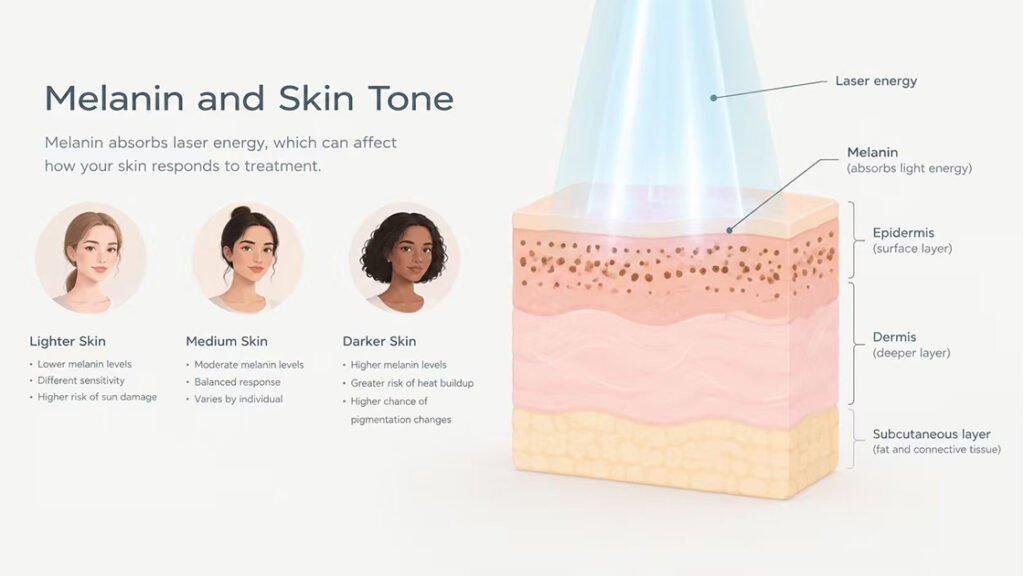
Melanin is the pigment that gives skin its color. It also absorbs energy from many laser wavelengths, making it an important factor in treatments for pigmentation and unwanted hair. However, melanin in the surrounding epidermis can compete with the intended treatment target for that energy.
People with higher levels of epidermal melanin may face a greater risk of unwanted heating, post-inflammatory hyperpigmentation, or temporary lightening of the skin if the treatment is not appropriately selected and adjusted. Lighter skin tones can present different challenges, including sensitivity to certain forms of irritation and sun-related damage.
The Fitzpatrick skin phototype scale, which classifies skin according to its response to ultraviolet exposure, can help inform treatment planning. However, it does not fully describe every person’s skin characteristics. A professional assessment should also consider the patient’s actual skin tone, tanning history, previous reactions, and the condition being treated.
1.2 Skin Thickness, Sensitivity, and Healing
Skin thickness and tissue structure vary across the face and body. The skin around the eyes, for example, differs from the skin on the cheeks, back, or legs. These anatomical differences can affect how energy is absorbed, how deeply it reaches, and how the tissue responds.
Skin sensitivity also varies. A person with a history of irritation, inflammation, or a compromised skin barrier may require a more cautious treatment plan. Similarly, healing responses can differ according to age, general health, the treatment area, and the intensity of the procedure.
Consequently, a treatment approach that may be appropriate for one body area or individual may not be suitable for another. Individual assessment is essential before selecting an energy-based procedure.
2. Wavelength and Energy: The テクノロジー Behind Different Results
Not all laser treatments work in the same way. Different technologies use different wavelengths, pulse durations, energy levels, and delivery patterns to target particular structures. These technical differences help explain why a treatment designed for unwanted hair may not be suitable for every pigmentation concern or skin texture issue.
2.1 Why Wavelength Matters
A laser wavelength influences how deeply light penetrates the skin and which structures absorb it. In pigmentation treatments, selected wavelengths can target melanin-containing structures. In hair reduction, energy is directed toward melanin in the hair follicle. Other laser approaches use controlled thermal effects to improve selected skin texture concerns.
For example, shorter visible wavelengths, such as 532 nm, interact strongly with certain superficial pigment targets. A 1064 nm wavelength generally penetrates more deeply and has different absorption characteristics. These wavelengths are not interchangeable, and the appropriate choice depends on the target, skin characteristics, and clinical objective.
Hair reduction also requires a different approach from pigment-focused treatment. Diode laser systems commonly use wavelengths around 810 nm to deliver energy toward hair follicles. Their performance depends on factors such as hair pigment, hair growth stage, skin tone, and the settings selected for the individual.
The key point is that no single wavelength is ideal for every aesthetic concern. Technology must match the target and the person’s skin characteristics.
2.2 Pulse Duration, Energy Level, and Treatment Coverage
Wavelength is only one part of treatment planning. Pulse duration determines how long energy is delivered, while fluence describes the energy delivered per unit area. Spot size, pulse frequency, and treatment coverage can also influence how energy interacts with tissue.
Short pulses can be useful for certain small pigment targets, while longer pulses may suit other targets, such as hair follicles. The appropriate combination depends on the intended effect and the surrounding tissue’s ability to tolerate the energy.
Higher energy does not automatically produce better results. Excessive energy can increase the risk of burns, blistering, unwanted pigment changes, and scarring. Conversely, settings that are too conservative for a particular objective may produce limited improvement. Effective treatment requires an appropriate balance between the intended target, expected response, and safety.
2.3 Different Technologies Address Different Concerns
Laser treatments should not be treated as one universal category. Pigment-focused systems, hair reduction lasers, and skin resurfacing technologies operate through different mechanisms. Radiofrequency treatments are also distinct because they deliver electrical energy that generates heat in tissue rather than relying on a laser wavelength.
Radiofrequency-based skin tightening aims to create controlled thermal effects in targeted tissue. The response depends on factors such as tissue characteristics, treatment depth, energy delivery, and the procedure’s overall design. Results and recovery patterns therefore differ from those associated with pigment-focused laser treatments.
Understanding these distinctions helps prevent unrealistic expectations. A technology selected for one goal should not automatically be assumed to address unrelated concerns.
3. The Skin Concern Being Treated Changes the Outcome
Even when two people have similar skin tones, they may respond differently because their underlying concerns are not the same. Pigmented spots, unwanted hair, acne-related marks, uneven texture, and skin laxity involve different structures and biological processes. A treatment plan should begin with identifying the target rather than simply choosing a popular technology.
3.1 Pigmentation Is Not One Single Condition
Dark spots can develop for several reasons, including sun exposure, hormonal influences, and inflammation. Freckles, solar lentigines, melasma, and post-inflammatory hyperpigmentation may look similar at first glance, but they differ in their causes and behavior.
Some localized pigment concerns may respond to appropriately selected laser treatment. Other conditions, particularly melasma, can be more persistent and may worsen after irritation or excessive heat. Post-inflammatory hyperpigmentation can also become more noticeable after skin injury, including an unsuitable energy-based procedure.
For these reasons, visible discoloration should not automatically be treated as a simple pigment problem. Correct identification is important before deciding whether a laser procedure is appropriate or whether other management options should be considered first.
3.2 Hair Color and Growth Stage Affect Hair Reduction
Laser hair reduction relies largely on melanin within the hair shaft and follicle. As a result, hair color, thickness, density, and growth stage influence treatment response.
Coarse, dark hair often provides a more distinct target than fine, light-colored hair. Blonde, white, gray, or red hair may respond less predictably because the hair contains less of the pigment that many hair reduction lasers target.
Hair also grows in cycles, and not every follicle is equally responsive at the same time. This explains why hair reduction generally requires a series of sessions rather than one treatment. The number and spacing of sessions depend on the treatment area, individual growth patterns, hormonal influences, and the technology used.
A gradual response is therefore expected, and complete permanent removal should not be assumed.
3.3 Texture Concerns and Skin Laxity Need Different Approaches
Uneven skin texture can result from acne scarring, enlarged pores, sun damage, or changes in skin structure. Skin laxity, by contrast, relates to changes in the tissue that supports firmness and contour. Although these concerns can occur together, they do not share exactly the same treatment targets.
Certain resurfacing approaches aim to create controlled changes in the skin that support texture improvement during healing. Radiofrequency-based treatments instead focus on controlled heating to support improvements in firmness and the appearance of mild to moderate laxity in appropriately selected individuals.
The extent of improvement depends on the original concern, treatment method, skin condition, and healing response. Neither approach should be presented as a universal solution for all textural or contour-related changes.
4. Lifestyle, Treatment Timing, and Aftercare Matter
Treatment results depend not only on skin biology and device characteristics but also on conditions before and after the procedure. Recent sun exposure, active irritation, skincare habits, and adherence to aftercare instructions can all influence recovery and the risk of unwanted reactions.
4.1 Recent Tanning and Sun Exposure
Recent tanning can increase the amount of melanin in the epidermis, changing how the skin absorbs laser energy. This can raise the risk of burns and unwanted pigmentation changes, depending on the treatment and settings.
Before a procedure, the practitioner should ask about recent sun exposure, tanning products, and any changes in skin tone. If the skin is tanned, sunburned, or irritated, postponing treatment may be the safer choice.
Sun protection also matters after treatment. Ultraviolet exposure can worsen existing pigmentation and contribute to post-inflammatory discoloration while the skin recovers. Following the recommended sun protection plan helps reduce avoidable irritation and pigment-related complications.
4.2 Skincare Products and Skin Barrier Condition
Certain skincare ingredients and procedures can increase irritation, especially when used too close to an energy-based treatment. Retinoids, exfoliating acids, abrasive scrubs, and other active products may need temporary adjustment according to the procedure and the practitioner’s instructions.
There is no universal rule that every product must be stopped for the same period. The appropriate plan depends on the treatment type, the skin’s current condition, and the clinician’s protocol. Patients should disclose prescription medications, recent peels, previous laser treatments, and any history of abnormal healing.
A calmer, intact skin barrier can make treatment planning more straightforward. However, skincare preparation cannot eliminate every risk, and it should not replace professional assessment.
4.3 Recovery Is Part of the Treatment Process
Temporary redness, swelling, warmth, or sensitivity may occur after some laser and energy-based procedures. The type and duration of these reactions vary according to the technology, treatment intensity, area treated, and individual response.
Following aftercare instructions helps protect the skin during recovery. This may include gentle cleansing, suitable moisturization, sun protection, and avoiding unnecessary heat or irritating products for the period recommended by the practitioner.
Severe or worsening pain, extensive blistering, increasing swelling, signs of infection, or unexpected skin color changes require prompt medical assessment. A reaction should not automatically be dismissed as a normal part of treatment.
5. How to Make Laser Treatment More Individualized
Because several variables influence treatment response, the best approach is not to search for a single treatment that works for everyone. Instead, planning should connect the person’s skin characteristics, treatment goal, technology, and safety requirements.
5.1 Start With a Thorough Skin Assessment
A useful assessment identifies the primary concern and examines factors that may affect treatment suitability. This includes skin tone, tanning history, hair or pigment characteristics, sensitivity, previous procedures, current medications, and any history of abnormal pigmentation or scarring.
The practitioner should also clarify what improvement is realistic. A treatment intended to reduce unwanted hair has different goals from one intended to improve uneven pigmentation or skin texture. When the diagnosis is uncertain, a qualified medical professional may need to evaluate the concern before cosmetic treatment proceeds.
For selected procedures, a test spot may help assess the skin’s immediate response, although it cannot guarantee that later treatment will be free of complications.
5.2 Choose Technology According to the Target
The choice of technology should follow the treatment objective. Pigment-focused laser systems, diode hair reduction systems, resurfacing lasers, and radiofrequency devices each have different characteristics. The practitioner should consider the intended target, skin type, treatment area, and possible risks before selecting a method.
Device features such as wavelength options, adjustable parameters, pulse control, and cooling mechanisms can support more tailored treatment planning. However, having multiple settings does not automatically ensure a safe or effective result. The operator’s training, appropriate protocols, and accurate assessment remain essential.
A well-designed plan also allows the treatment approach to be reassessed as the skin responds. If the response differs from expectations, the next step should be a careful review rather than automatically increasing energy.
5.3 Set Realistic Expectations for Results and Sessions
Laser and energy-based treatments often produce gradual changes rather than immediate, identical results for everyone. Hair reduction typically requires multiple sessions because follicles respond differently across growth cycles. Pigmentation and texture treatments may also need staged management, depending on the condition and the skin’s tolerance.
Before treatment begins, patients should understand the likely course, potential side effects, recovery requirements, and situations in which treatment may be delayed or stopped. Progress should be assessed against the original goal, not only by comparing results with another person’s experience.
Individualized treatment does not mean guaranteeing a particular outcome. It means making informed decisions based on the best available assessment and adjusting the plan responsibly.
FAQ
Why do laser treatments work better for some people than others?
Results vary with skin tone, hair or pigment characteristics, the condition being treated, wavelength, energy settings, treatment schedule, and individual healing responses.
Does darker skin mean laser treatment is unsuitable?
No. Some laser technologies can be used for darker skin tones, but careful device selection, parameter adjustment, and professional assessment are important because the risk of pigment changes may be higher.
Why do laser hair reduction treatments require multiple sessions?
Hair follicles pass through different growth stages. A single session cannot effectively target every follicle, so several sessions are usually needed to achieve gradual reduction.
Can the wrong laser settings cause pigmentation changes?
Yes. Inappropriate energy delivery can cause inflammation, burns, or changes in skin pigmentation. The risk depends on the device, settings, skin characteristics, and treatment technique.
Does higher laser energy produce faster results?
Not necessarily. Excessive energy may increase complications without improving the outcome. Treatment parameters should be selected according to the target and the person’s skin response.
How can I prepare for a laser treatment?
Discuss your medical history, medications, recent tanning, skincare products, and previous procedures with a qualified practitioner. Follow the preparation and sun protection instructions provided for the specific treatment.
結論
Skin responds differently to laser treatments because no two treatment plans involve exactly the same biological targets, skin characteristics, or technical requirements. Melanin levels, hair growth cycles, skin condition, wavelength, pulse duration, energy settings, sun exposure, and aftercare can all influence the outcome. Understanding these factors helps explain why a technology that suits one concern may not be appropriate for another. A thoughtful approach begins with an accurate assessment, matches the technology to the intended target, and considers both potential benefits and risks. When treatment decisions prioritize individual skin characteristics, realistic expectations, and professional oversight, laser and other energy-based procedures can be incorporated more responsibly into aesthetic care.
References
Laser Fitzpatrick Skin Type Recommendations — StatPearls, NCBI Bookshelf
https://www.ncbi.nlm.nih.gov/books/NBK557626/
Review of Laser Treatments for Post-Inflammatory Hyperpigmentation in Skin of Color
https://pubmed.ncbi.nlm.nih.gov/36781686/
Immediate Skin Responses to Laser and Light Treatments: Therapeutic Endpoints—How to Obtain Efficacy
https://www.sciencedirect.com/science/article/pii/S0190962215018058
Lasers and Light-Based Therapies in Ethnic Skin: Treatment Options and Recommendations for Fitzpatrick Skin Types V and VI
https://pubmed.ncbi.nlm.nih.gov/24098905/
Lasers for Treatment of Melasma and Post-Inflammatory Hyperpigmentation
https://pmc.ncbi.nlm.nih.gov/articles/PMC3461803/