はじめに
Lower body contouring has become an essential focus in modern aesthetic dermatology, especially for individuals seeking improved thigh and hip definition. Advanced laser systems designed for body sculpting combine controlled photothermal energy with precision targeting of subcutaneous tissues. These technologies, commonly used in aesthetic platforms such as professional laser systems, aim to address localized fat accumulation, skin laxity, and uneven texture. By integrating principles of selective photothermolysis, collagen remodeling, and dermal stimulation, laser-based body contouring offers a non-invasive approach to improving lower body appearance while maintaining structural integrity of surrounding tissues.
1. Core Technology Behind Laser Body Contouring Systems
1.1 Selective Photothermolysis and Tissue Targeting
Modern aesthetic laser systems operate based on the principle of selective photothermolysis, where specific wavelengths of laser energy are absorbed by targeted chromophores such as water and adipose tissue components. In lower body applications, this allows precise interaction with subcutaneous fat layers in the thighs and hips. The controlled thermal energy disrupts lipid structures while minimizing impact on surrounding dermal and muscular tissues. This mechanism forms the foundation of non-invasive body contouring technologies used in professional dermatology environments.
1.2 Multi-Wavelength Laser Delivery Systems
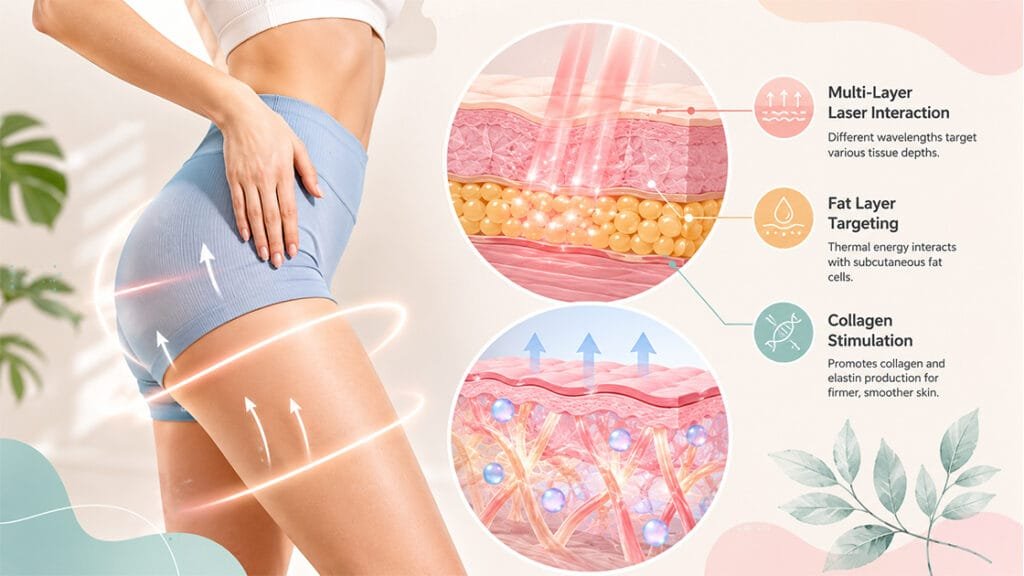
Advanced platforms often integrate multiple wavelengths to address different tissue depths. Shorter wavelengths interact primarily with superficial dermal layers to improve skin texture, while longer wavelengths penetrate deeper to influence adipose tissue. This dual-layer interaction allows simultaneous improvement of skin tightening and localized fat reduction. Such systems are widely applied in aesthetic body sculpting treatments focusing on lower body reshaping, where both volume and skin firmness require optimization.
2. Laser Interaction with Thigh and Hip Anatomy
2.1 Subcutaneous Fat Layer Response
The thighs and hips contain dense subcutaneous adipose tissue, which responds selectively to thermal energy exposure. When laser energy is delivered, adipocytes absorb heat, leading to structural destabilization of lipid membranes. This controlled interaction supports gradual remodeling of tissue architecture. The surrounding lymphatic system plays a role in processing cellular debris, contributing to a more refined contour appearance over time within aesthetic treatment frameworks.
2.2 Dermal Collagen Stimulation
Beyond fat targeting, laser energy also stimulates fibroblast activity within the dermis. This process enhances collagen and elastin synthesis, which are essential components of skin firmness and elasticity. In the thigh and hip region, where skin laxity often accompanies fat accumulation, collagen remodeling contributes to improved surface smoothness and tighter skin texture. This dual effect is a key advantage of modern aesthetic laser platforms.
3. Functional Applications in Lower Body Contouring
3.1 Localized Fat Reduction Technology
Laser-based body contouring systems are designed to address localized fat deposits that are resistant to lifestyle modifications. By delivering controlled thermal energy into targeted regions, these devices influence adipocyte integrity and support structural remodeling. In the context of thighs and hips, this allows for more defined contours and improved proportional balance between lower and upper body regions without invasive procedures.
3.2 Skin Tightening and Tissue Firmness Enhancement
Skin laxity is a major concern in lower body aesthetics. Laser systems incorporate thermal dermal stimulation that activates collagen contraction and long-term extracellular matrix remodeling. This process improves tissue firmness and enhances surface smoothness. The integration of tightening and contouring functions within a single platform represents a significant advancement in aesthetic laser technology.
3.3 Surface Texture and Cell Turnover Regulation
In addition to fat and collagen effects, laser energy influences epidermal renewal processes. Controlled photothermal stimulation can support increased cellular turnover rates, contributing to more even skin texture. This is particularly relevant in the thigh and hip regions, where uneven texture and dimpling often occur due to structural fat distribution patterns.
4. Aesthetic Laser Systems in Modern Body Sculpting
4.1 Integration of Diode and Fractional Laser Technologies
Many modern aesthetic platforms combine diode laser technology for deeper tissue penetration with fractional laser systems for surface-level refinement. This combination allows practitioners to address both structural fat layers and superficial skin quality simultaneously. The synergy between these technologies enhances the versatility of non-invasive body contouring solutions.
4.2 Precision Energy Control Systems
Advanced laser devices include precision energy modulation features that allow controlled delivery of thermal doses. This ensures that energy is distributed evenly across treatment zones while protecting surrounding tissues. In lower body contouring, precision control is essential due to variations in fat density and skin thickness across the thigh and hip regions.
5. Lower Body Aesthetic Considerations
5.1 Proportional Body Sculpting Principles
Lower body aesthetics rely heavily on proportional balance between waist, hips, and thighs. Laser contouring systems are designed to refine these proportions by targeting localized fat distribution and improving skin tightness. This contributes to a more harmonious silhouette without altering natural anatomical structure.
5.2 Skin Quality and Visual Smoothness
Skin surface quality significantly influences perceived body contour. Laser-induced collagen remodeling improves dermal density and elasticity, which enhances visual smoothness. In aesthetic dermatology, this is considered a key factor in achieving refined lower body appearance, especially in regions prone to uneven texture.
FAQ
Q1: How does laser body contouring target thigh and hip fat?
It uses controlled thermal energy to interact with subcutaneous fat cells through selective photothermolysis.
Q2: Does laser treatment affect skin texture?
Yes, it stimulates collagen production and supports improved dermal structure.
Q3: What makes multi-wavelength lasers important?
They allow different tissue depths to be targeted simultaneously for better contouring results.
Q4: Is muscle tissue affected by laser energy?
No, modern systems are designed to primarily interact with fat and dermal layers.
Q5: Can laser systems treat both fat and skin laxity?
Yes, many advanced platforms combine both functions in a single device.
結論
Laser thigh and hip contouring represents a sophisticated application of modern aesthetic laser technology, combining selective photothermolysis, collagen stimulation, and multi-wavelength energy delivery. By targeting both subcutaneous fat structures and dermal layers, these systems support improved lower body definition and skin quality. As part of advanced aesthetic platforms similar to those developed by leading laser technology providers, this approach reflects the evolution of non-invasive body sculpting toward more precise, multi-layered tissue interaction strategies.
References
Selective Photothermolysis in Laser Medicine
https://www.ncbi.nlm.nih.gov/pmc/articles/PMC3904184
Laser Lipolysis and Body Contouring Techniques
https://www.ncbi.nlm.nih.gov/pmc/articles/PMC4292128
Energy-Based Devices in Aesthetic Dermatology
https://www.dermatologytimes.com/view/energy-based-devices-aesthetic-medicine
Photobiomodulation and Skin Remodeling
https://www.ncbi.nlm.nih.gov/pmc/articles/PMC5523874
Non-Invasive Body Contouring Overview