Einführung
You raise your arm to wave at a friend, and suddenly you are acutely aware of the loose skin swaying underneath. The terms “bat wings” or “bingo wings” may sound playful, but the self‑consciousness they cause is anything but. For millions of women over forty, sagging skin under the upper arms is a daily reminder that time, gravity, and sometimes weight changes have left their mark. Many assume that the only way to achieve smoother arms is an invasive brachioplasty – a surgical arm lift that removes excess skin but often leaves a long scar from elbow to armpit. However, aesthetic technology has evolved. Today, the combination of 1064nm laser energy and radiofrequency (RF) offers a different path. Instead of cutting away skin, these energy‑based tools work from within – helping to reduce small pockets of fat while encouraging the body’s own collagen production. This article explains how laser and RF work together to support upper arm contouring without a scalpel.
1. Understanding the Anatomy of “Bingo Wings”
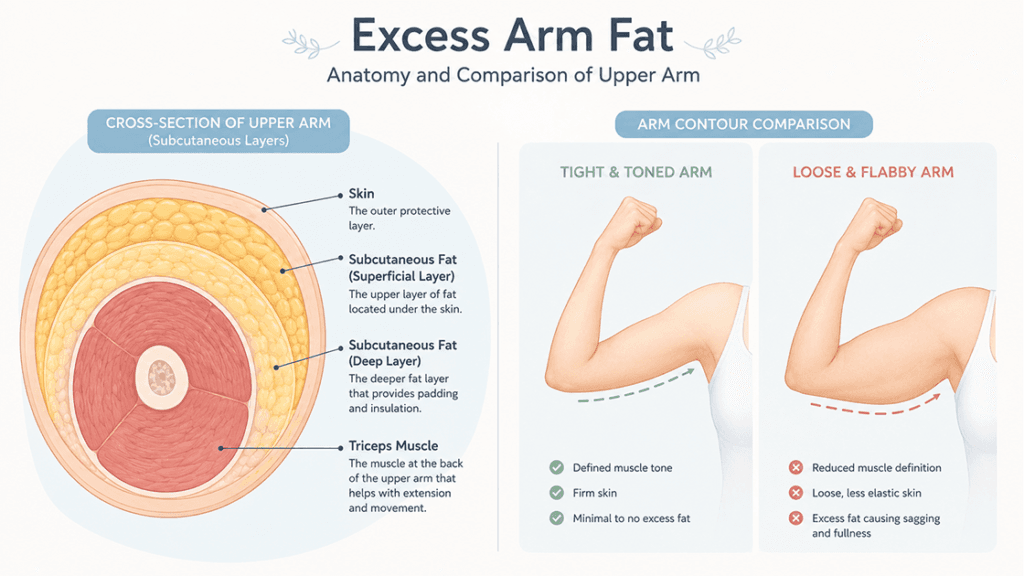
The loose, drooping tissue under the upper arm is rarely just one problem; it is usually a combination of two separate issues. Understanding these components helps explain why a dual‑technology approach can offer advantages.
1.1 Excess Fat Deposits in the Upper Arm
Many people carry stubborn fat on the back of the arm that is resistant to diet and exercise. This fat accumulates between the skin and the underlying muscle. It is not usually the heavy, deep fat found on the abdomen, but rather a softer, pinchable layer that can persist even in someone who is otherwise lean. When this fat volume increases, it pushes the skin outward, stretching the dermis and contributing to the rounded, full appearance of the upper arm.
1.2 Age‑Related Skin Laxity and Collagen Loss
Separate from the fat issue is the quality of the skin itself. As we age, collagen and elastin production slows. The skin becomes thinner, less elastic, and more prone to sagging. This is why some women have arms that are not necessarily large but have a crepey or loose texture – the scaffolding beneath the skin has weakened. This age‑related laxity is often more pronounced in the upper arms because the skin there is relatively thin and experiences a lot of movement. When skin laxity combines with even a small amount of stubborn fat, the familiar “bat wing” appearance becomes visible.
1.3 Why Diet and Exercise Often Fall Short for This Area
Upper arm fat is notoriously resistant to lifestyle changes. Genetics and hormonal factors largely govern the body‘s fat distribution, and for many women – particularly those in perimenopause or menopause – the upper arms serve as a primary storage site. Spot reduction is a myth; doing triceps exercises builds muscle but does not significantly reduce the fat sitting on top of that muscle. After significant weight loss, prolonged stretching has affected the skin, and it may not naturally retract. This leaves a frustrating gap: the weight is gone, but the loose skin remains. For these reasons, many people eventually look beyond diet and exercise for additional support in upper arm contouring.
2. How 1064nm Laser Energy Targets Stubborn Fat
Laser technology has evolved from surface treatments to deeper applications, and the 1064nm wavelength has become a well‑established tool for influencing adipose tissue. The principle behind it is a targeted approach that differentiates between fat and the surrounding skin.
2.1 The Mechanism of Photothermal Lipolysis
The 1064nm wavelength corresponds to a specific point on the near‑infrared spectrum. Water and blood have relatively low absorption at this wavelength, but the water contained within fat cells absorbs it effectively. When we deliver the laser energy to the subcutaneous layer, it converts into gentle heat within the adipose tissue. This heating process causes the fat cells to become temporarily more permeable. Over the following weeks and months, the body‘s natural elimination pathways process the disrupted fat, gradually reducing the thickness of the fat layer. We call this process photothermal lipolysis – using light‑generated heat to influence fat cells without damaging the surrounding dermis or muscle.
2.2 Why 1064nm Is Particularly Suited for Upper Arms
The upper arm has a moderate amount of subcutaneous fat sitting above the triceps muscle. The skin in this area is relatively thin, which can be an advantage for energy‑based treatments: the laser can penetrate to the appropriate depth without having to pass through a very thick fat layer first. The 1064nm wavelength is long enough to reach the deeper fat compartment effectively while still being safely absorbed. Because it does not aggressively heat the epidermis, patients experience less surface discomfort compared to some other wavelengths. Additionally, the same thermal effect that influences fat cells also produces a secondary benefit: mild heating of the dermis supports collagen production, which can contribute to modest skin tightening over subsequent months.
2.3 What Patients Typically Notice After Laser Treatment
The effects of 1064nm laser on upper arm fat are not instant. A short period of mild redness or warmth may occur, but there is no incision and usually no need to change daily activities. In the weeks after treatment, the fat layer gradually becomes less prominent. Patients often report that their arms feel less full when pressed against their sides, and the rounded contour begins to look more streamlined. Several sessions spaced apart are often recommended to achieve noticeable change, as each session influences a portion of the fat cells in the area. The key is patience – the body needs time to process the affected cells, and the full effect may not be visible for a few months.
3. The Role of Radiofrequency (RF) in Skin Tightening
While laser therapy works primarily on fat volume, radiofrequency addresses the other half of the equation: skin laxity. RF energy has long been used in aesthetic medicine to counteract the visible signs of aging without significant downtime.
3.1 How RF Stimulates Collagen and Elastin Production
Radiofrequency uses electromagnetic waves to heat the dermis – the middle layer of the skin where collagen and elastin fibers are located. This controlled heating causes the existing collagen fibers to contract temporarily, which produces an immediate tightening effect. More importantly, the heat triggers the body’s natural wound‑healing response, encouraging fibroblasts to produce new collagen and elastin over the following months. This process is called neocollagenesis. The new collagen is deposited in a more organized pattern, gradually improving skin firmness and texture. RF is particularly effective on areas where the skin is thin and has lost elasticity, such as the décolletage, the neck, and the upper arms.
3.2 The Difference Between Laser and RF for Arms
People often confuse laser and RF, but they play different roles. Water primarily absorbs 1064nm laser energy within fat cells, making it well‑suited for influencing adipose tissue. Manufacturers design RF energy to heat the dermis without significantly affecting the fat layer. For the upper arms, laser can help reduce the volume of fat pushing the skin outward. RF helps tighten the skin envelope itself so that it can better conform to the leaner contour underneath. Neither technology fully replaces the other; they work in parallel. This is why combining them often produces a more comprehensive outcome than using either one alone.
3.3 What Patients Typically Experience with RF Tightening
Radiofrequency treatments feel like a warm massage. Most patients find the sensation comfortable, and there is no downtime. Immediately after a session, the skin may appear slightly pink, but this usually fades within an hour. Some individuals notice a subtle difference in skin firmness right away due to the collagen contraction effect. The more durable improvement builds over the weeks and months as new collagen is laid down. Many patients schedule a series of RF sessions to maximize the cumulative effect, often spread out with one to two weeks between visits. When used on the upper arms, RF can help reduce the “crepey” texture and improve how smoothly the skin drapes over the underlying tissues.
4. The Combined Approach: Laser + RF for Upper Arm Contouring
When stubborn fat and loose skin coexist – as they do on many upper arms – addressing only one element leaves the other untouched. The rationale for combining 1064nm laser and radiofrequency is simple: treat the fat and treat the skin in a complementary manner.
4.1 Why Two Technologies Are Better Than One for Arms
If laser therapy reduces fat but the skin remains loose, the arm contour may improve but still look somewhat slack. If RF tightens the skin but the fat layer stays full, the underlying volume still pushes outward, and the tightening effect may not be fully visible. By using both technologies, the overall shape becomes leaner (less fat) and the covering becomes tighter (rejuvenated skin). In clinical settings, experts have described both RF‑assisted and laser‑assisted high‑definition liposculpture of the arms as effective and reproducible techniques for patients who seek an athletic and slim arm contour. The combination can adapt to a range of starting points, from mild to moderate concerns.
4.2 How the Two Treatments Are Typically Scheduled
A common strategy is to address the fat component first with a series of 1064nm laser sessions spaced several weeks apart. During this period, the laser gradually influences the fat cells, and the body begins to process them. After completing the laser series – or sometimes between sessions – we add RF treatments. Since RF causes no disruption to the treated area beyond mild warmth, we can perform it in the same visit as laser or on separate days. A full protocol might involve several laser sessions followed by a course of RF sessions. The laser thins the fat, and the RF follows to tighten the skin as it adapts to the new contour.
4.3 Realistic Progress After a Course of Treatment
Most people do not see a dramatic change after a single session. With laser, the first subtle signs of fat reduction may appear in the weeks after the second treatment. With RF, mild tightening may be noticeable after the first session, but the most significant improvement appears a few months later as collagen builds. The ultimate outcome – smoother, more tapered upper arms with less sag – develops gradually. Many individuals feel comfortable wearing short sleeves or sleeveless tops after completing their protocol, a change that often leads to a noticeable shift in confidence. Maintaining a stable weight helps ensure that the results last.
5. Practical Considerations After Treatment
The success of any aesthetic treatment does not end when the device is turned off. Simple daily habits can help extend the improvements achieved with laser and RF.
5.1 Immediate Aftercare Instructions
Both 1064nm laser and radiofrequency involve non‑invasive or minimally invasive techniques, so they require far less recovery time than surgery. After a laser session, the skin may feel warm for a few hours. Some people experience mild redness, which usually resolves within the same day. RF treatments typically leave no visible marks at all. You will not need bandages, activity restrictions, or time off work. We generally advise patients to apply sun protection on the treated area, because fresh collagen is more vulnerable to UV damage in the weeks following treatment.
5.2 How to Support Long‑Term Results
The aging process does not stop, and future lifestyle choices matter. Maintaining a stable body weight prevents new fat from accumulating in the treated area. Regular upper body strength training – specifically exercises that target the triceps, such as dips, overhead extensions, and push‑ups – can improve muscle tone underneath the skin, providing natural support for the dermis. Hydration and good nutrition support overall skin health. Some individuals choose to schedule occasional maintenance RF sessions once or twice a year to help keep collagen production active, especially as they continue to age.
5.3 When to Consider a Different Approach
For people with a very large amount of excess skin – for example, after massive weight loss – energy‑based tightening may not suffice. In such cases, the skin stretches beyond the point where collagen stimulation can create meaningful retraction. Similarly, if the fat deposit on the arm is very dense and deep, a single approach may yield only modest change. A consultation with a knowledgeable provider can help determine whether laser and RF are the appropriate tools or whether you should consider surgical options like an arm lift. For the vast majority of women with mild to moderate skin laxity and small pockets of stubborn fat, the combination of 1064nm laser and radiofrequency offers a logical, modern option.
FAQ
Q1: Does laser or RF treatment for upper arms hurt?
Most people describe the sensation as a deep warmth. No anesthesia is required, and discomfort is generally minimal.
Q2: How many sessions will I need to see a difference on my arms?
A typical plan involves several laser sessions spaced weeks apart, followed by a course of RF sessions. Visible changes often appear after two to three laser sessions.
Q3: Can I combine laser and RF treatments in a single appointment?
Yes. Many clinics offer both technologies sequentially during the same visit because their mechanisms are complementary and there is no additional recovery time.
Q4: Is the fat reduction from 1064nm laser permanent?
The treated fat cells are permanently affected. However, maintaining a stable body weight helps prevent remaining fat cells from expanding.
Q5: Will laser or RF cause scars on the upper arms?
Both technologies are non‑incisional. There are no cuts or sutures, so no visible scarring occurs.
Schlussfolgerung
The loose skin and stubborn fat that create “bingo wings” do not have to dictate how you dress or how you feel about your body. While living with these changes is one option, so is exploring modern, non‑invasive tools that work from within. The combination of 1064nm laser energy and radiofrequency addresses both elements of the problem – the fat volume that pushes outward and the skin laxity that fails to hold its shape. The laser helps reduce the underlying fullness, and the RF encourages the skin to become firmer and more resilient. This two‑pronged approach does not replace surgery for extreme cases, but for the many women who fall into the mild‑to‑moderate category, it offers a sensible, low‑disruption path forward. Each small improvement – the way a sleeve feels looser, the way skin lies smoother – builds day by day, serving as a reminder that a different shape is possible without a scalpel.
References
Rhein Laser. Treatments – Body Sculpting.
https://www.rheinlasers.com/treatments
Fotona. Laser Lipolysis – How It Works.
https://www.fotona.com/us/treatment/laser-lipolysis/
Wu S, Jiang Z, Dong J, Yao M. Evaluation of thermodynamic bioeffects of long-pulsed 1064 nm laser in the photothermal lipolysis. Lasers Surg Med. 2024;56(1):90-99.
https://pubmed.ncbi.nlm.nih.gov/38018661/
Klinger M, Battistini A, Rimondo A. RF-Assisted and Laser-Assisted High‑Definition Liposculpture of the Arms. In: Textbook of Plastic and Reconstructive Surgery. 2022:509-520.
https://ouci.dntb.gov.ua/en/?backlinks_to=10.1093/asj/sjx218
DiFrancesco L. The Challenge of Arm Skin Laxity – BodyTite and Liposuction Combination.
https://www.drdifrancesco.com/the-challenge-of-arm-skin-laxity/